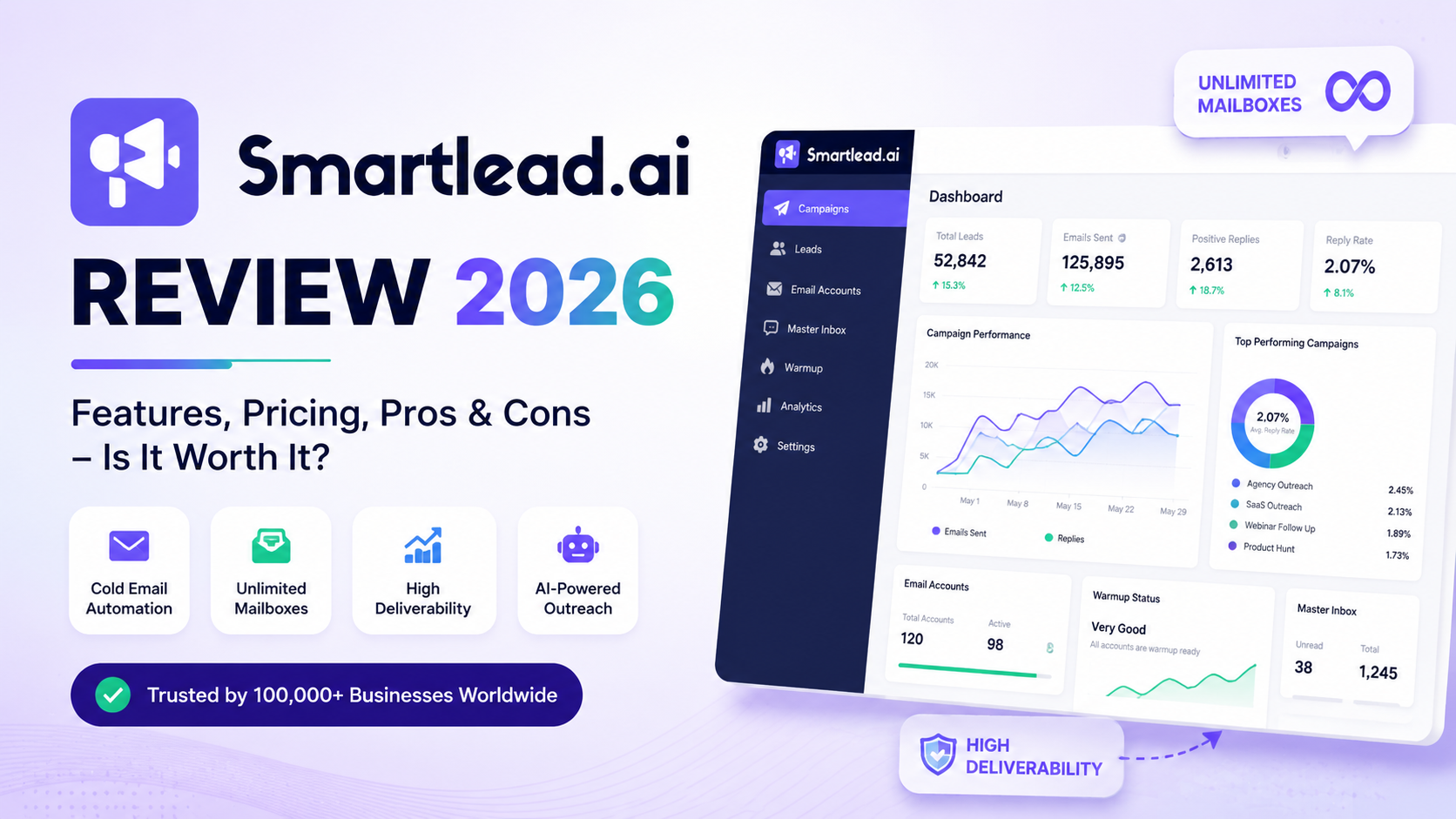
Smartlead Review 2026: Features, Pricing, Pros & Cons
If cold email is an important part of your B2B sales strategy, the software you choose can directly affect deliverability, campaign scalability, and how efficiently your team manages multiple sending accounts.
Smartlead is a cold email outreach platform built around high-volume outbound campaigns, email account management, deliverability, automated follow-ups, and centralized reply handling. It is particularly relevant for agencies, lead-generation businesses, SaaS companies, and sales teams that want to scale outbound email without relying on a single inbox.
In this Smartlead review, we look at what Smartlead does, who it is best suited for, how its core features work, where it stands out, and what limitations you should consider before choosing it.
Overall Rating: 4.7/5
Best For: B2B sales teams, cold email agencies, lead-generation businesses, SaaS companies, and high-volume outbound campaigns
Last Updated: August 2026
Reviewed by: Team Flowcrai
Affiliate Disclosure: Flowcrai may earn a commission if you purchase through links on this page, at no additional cost to you. Our reviews are based on official product information, publicly available documentation, feature analysis, and market comparisons. We do not claim hands-on testing unless explicitly stated.
Key Takeaways
- Smartlead is designed primarily for scalable cold email outreach, not traditional newsletter marketing.
- One of its biggest strengths is the ability to manage multiple sending accounts at scale, which is especially valuable for agencies and outbound sales teams.
- Email warm-up, mailbox rotation, centralized reply management, and campaign automation are major parts of the platform.
- Smartlead can be more complex than basic outreach tools, especially for beginners unfamiliar with email deliverability.
- It is most attractive when cold email is a serious customer-acquisition channel rather than an occasional marketing tactic.
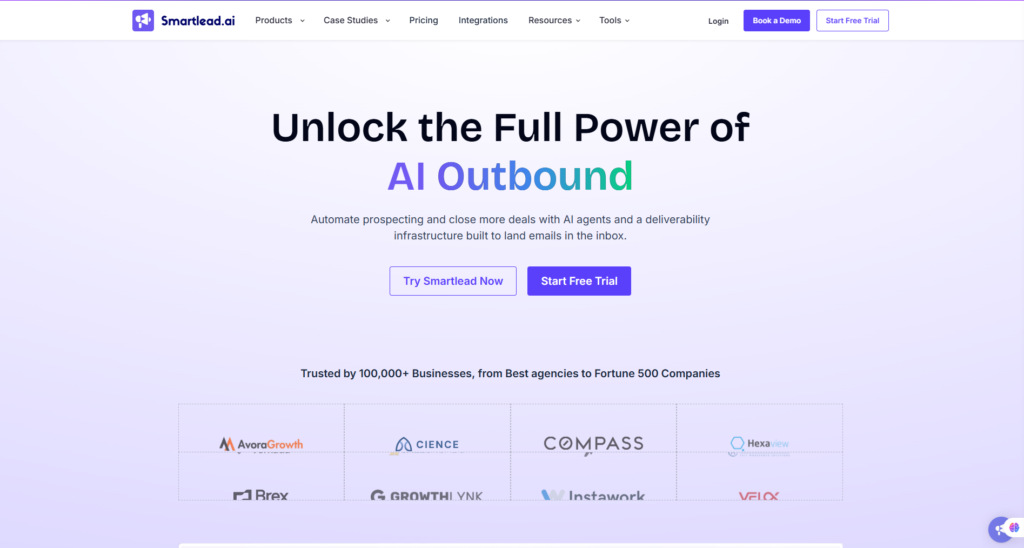
Smartlead Quick Verdict
Quick Info Table
| Item | Information |
| Overall Rating | 4.7/5 |
| Best For | Agencies, B2B sales teams, lead-generation businesses |
| Core Use Case | Cold email outreach and outbound sales |
| Starting Price | From $39/month |
| Email Accounts | Unlimited connections available |
| Email Warm-Up | Yes |
| Campaign Automation | Yes |
| Master Inbox | Yes |
| CRM Features | Available |
| API & Webhooks | Available |
| Platform | Web-based |
Our Verdict
Smartlead is worth considering if your business depends on structured, scalable cold email outreach. Its strongest advantage is not simply the ability to send automated sequences. The platform is built around the infrastructure required to manage many sending accounts, protect sender reputation, organize replies, and operate outbound campaigns at larger volume.
That makes Smartlead particularly appealing to lead-generation agencies, B2B sales teams, and SaaS companies.
However, smaller businesses sending only a limited number of emails may find the platform more advanced than necessary. Smartlead also requires users to understand basic email deliverability concepts such as domains, authentication, sending reputation, and mailbox health.
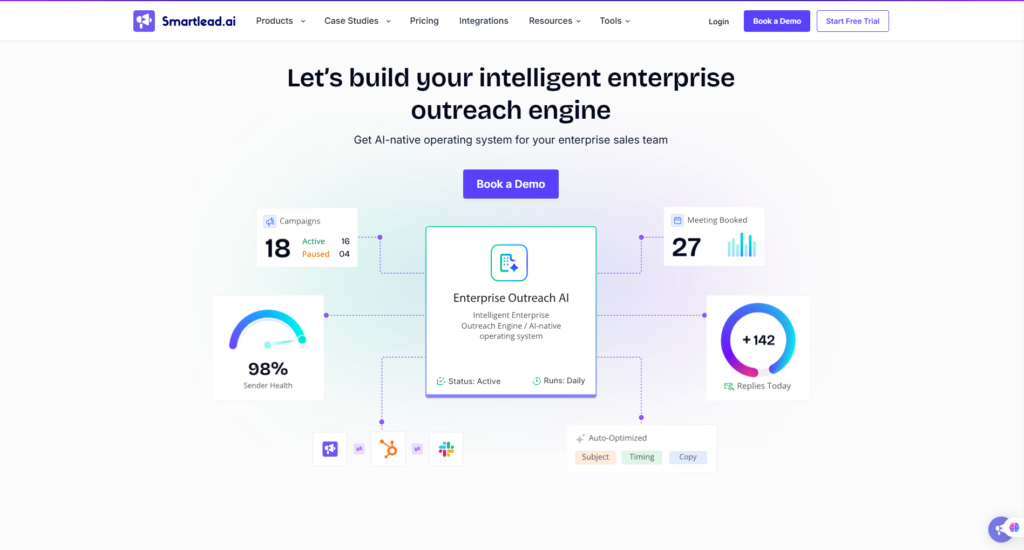
What Is Smartlead?
Smartlead is a sales outreach and cold email automation platform designed to help businesses run outbound email campaigns across multiple sending accounts.
Instead of functioning like a traditional email marketing service used for newsletters, promotions, or subscriber broadcasts, Smartlead focuses primarily on prospecting.
The typical Smartlead user is trying to reach potential customers who have not yet entered a traditional marketing funnel.
For example, a B2B SaaS company may use Smartlead to contact hundreds or thousands of targeted prospects. A lead-generation agency may manage campaigns for several clients at the same time. A sales team may use the platform to automate follow-up sequences while distributing email volume across multiple inboxes.
This distinction is important.
Smartlead competes more directly with platforms such as Instantly, Lemlist, Saleshandy, and certain parts of Apollo rather than conventional newsletter platforms such as Mailchimp or ConvertKit.
What Problem Does Smartlead Solve?
Cold email becomes increasingly complicated as campaign volume grows.
Sending a small number of emails manually from one Gmail or Outlook account is relatively simple. Scaling that process to thousands of prospects introduces several challenges.
These can include:
- Managing dozens or hundreds of sending inboxes
- Maintaining sender reputation
- Monitoring email warm-up
- Avoiding excessive sending volume from a single mailbox
- Scheduling automated follow-ups
- Personalizing outreach at scale
- Handling replies from multiple accounts
- Tracking campaign performance
- Managing campaigns for different clients
Smartlead attempts to bring these functions into one outbound system.
Instead of operating each inbox independently, users can connect multiple sending accounts, create campaigns, distribute sending activity across those accounts, and manage responses from a centralized interface.
For agencies and teams managing large outreach operations, this can reduce a significant amount of manual work.
How Does Smartlead Work?
A typical Smartlead workflow looks like this:
Connect sending accounts → configure warm-up → import prospects → create email sequences → personalize messages → schedule campaigns → rotate sending accounts → manage replies → analyze results
The platform is designed to automate much of this process.
Users can build email sequences that include an initial outreach message followed by multiple automated follow-ups. Campaigns can be scheduled according to specific sending windows and distributed across connected mailboxes.
Smartlead also places a strong emphasis on deliverability.
Rather than pushing large email volumes through one inbox, users can spread sending activity across multiple mailboxes. This can help create a more controlled outbound infrastructure when combined with proper domain setup, authentication, list hygiene, and responsible sending practices.
It is important to understand that no software can guarantee inbox placement.
Deliverability still depends on factors such as:
- Domain reputation
- SPF, DKIM, and DMARC configuration
- Mailbox quality
- Sending volume
- Prospect list quality
- Bounce rates
- Spam complaints
- Message relevance
Smartlead provides infrastructure to help manage these factors, but it cannot eliminate them.
What Makes Smartlead Different?
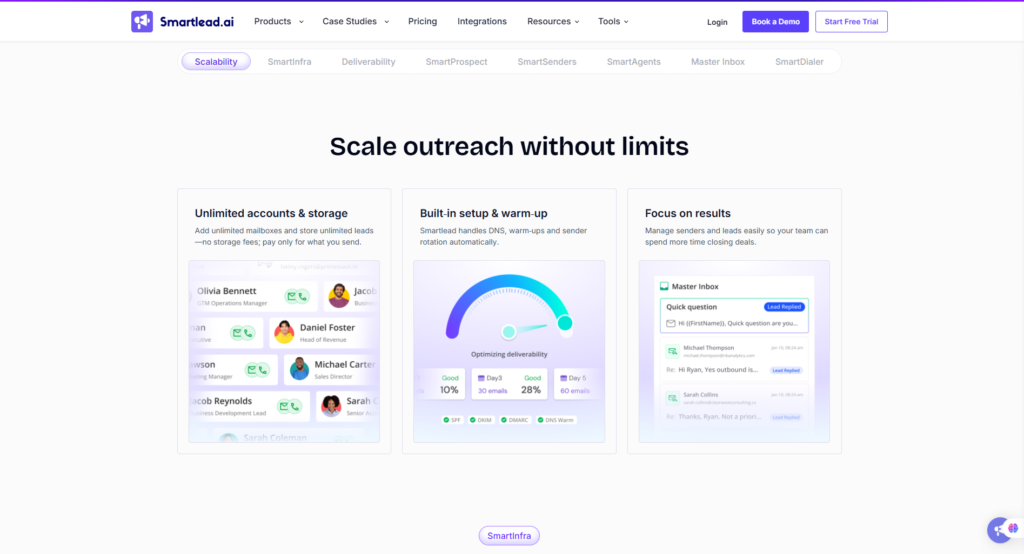
The main difference is scalability.
Many cold email tools can automate outreach, but Smartlead is designed around businesses operating multiple sending accounts and larger outbound systems.
Several capabilities contribute to that positioning:
- Unlimited email account connections
- Automated email warm-up
- Mailbox rotation
- Multi-step cold email sequences
- Centralized reply management
- Agency-oriented workflows
- Lead verification capabilities
- API and webhook support
- Campaign analytics
- CRM-related functionality
For a solo founder sending a few hundred emails each month, some of these capabilities may be unnecessary.
For an agency managing 30, 50, or even more sending inboxes across multiple campaigns, they become much more valuable.
This is why Smartlead is best evaluated as an outbound infrastructure platform, not simply an email automation tool.
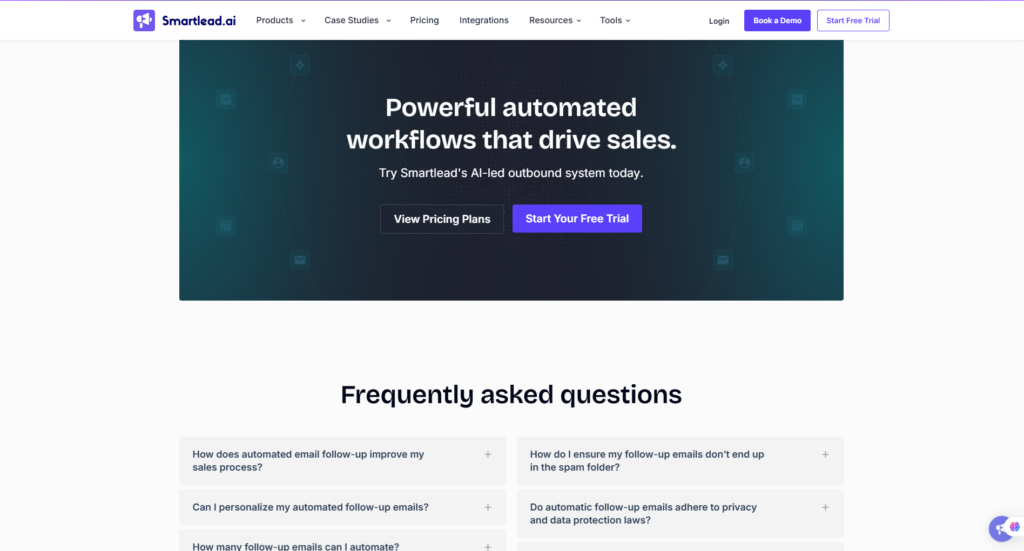
Visit Smartlead Official Website
Who Should Use Smartlead?
Smartlead is not designed for every type of marketer.
Its strongest use cases involve businesses that rely heavily on outbound prospecting.
Best For
Cold Email Agencies
Cold email agencies are one of the clearest Smartlead use cases.
An agency may manage separate campaigns for many clients, each with different domains, inboxes, lead lists, sequences, and reply workflows.
Smartlead can help centralize this infrastructure while allowing the agency to operate campaigns across many accounts.
Lead Generation Agencies
Lead-generation businesses often need to run outreach at significant scale.
The ability to connect multiple inboxes, automate sequences, manage replies, and distribute sending activity can make Smartlead attractive for appointment-setting and lead-generation workflows.
B2B Sales Teams
Sales development representatives and outbound sales teams can use Smartlead to automate repetitive follow-ups while keeping outreach organized.
Instead of manually sending every prospecting email, teams can create structured sequences and focus more attention on qualified replies.
SaaS Companies
SaaS businesses frequently use outbound email to reach:
- Founders
- Marketing teams
- Sales leaders
- Operations managers
- Agencies
- Enterprise buyers
Smartlead can provide the infrastructure required to run these campaigns systematically.
Growth Marketers
Growth teams experimenting with outbound customer acquisition may benefit from Smartlead’s automation and campaign management capabilities.
Experienced Solopreneurs
Smartlead can also work for individual operators who understand cold email and manage several sending inboxes.
However, very small campaigns may not require the full feature set.
Who Should Skip Smartlead?
Smartlead may not be the best option if you primarily need:
- A newsletter platform
- Email broadcasts to subscribers
- Simple email marketing automation
- An all-in-one CRM with a large native B2B database
- LinkedIn-first outreach
- Very low-volume manual prospecting
For example, creators building newsletters may be better served by platforms designed specifically for subscriber email marketing.
Teams primarily searching for contact data may prefer Apollo or another sales intelligence platform.
Users focused on multichannel outreach involving LinkedIn and highly personalized sequences may also want to compare Smartlead with Lemlist.
The right tool depends on where the biggest bottleneck exists in your sales workflow.
Smartlead Setup & User Experience
Account Setup
Getting started with Smartlead usually involves more than simply creating an account and uploading a prospect list.
Users first need to prepare their outbound infrastructure.
This may include:
- Connecting sending inboxes
- Configuring sending domains
- Verifying DNS records
- Setting daily sending limits
- Enabling email warm-up
- Importing prospect lists
- Creating campaign sequences
- Setting sending schedules
For experienced cold email users, this process should feel familiar.
For beginners, there is a learning curve.
Email Account Setup
Email account configuration is one of the most important parts of any cold outreach system.
Before scaling campaigns, users should pay attention to:
- SPF records
- DKIM authentication
- DMARC policies
- Domain reputation
- Mailbox reputation
- Sending volume
- Bounce rates
Smartlead can provide campaign and warm-up infrastructure, but correct technical setup remains essential.
Poorly configured domains or low-quality prospect lists can still damage deliverability regardless of the platform being used.
Learning Curve
We would rate Smartlead’s learning curve as moderate.
The interface itself is not necessarily difficult, but successful cold email involves more than learning where buttons are located.
Users also need to understand:
- Email authentication
- Sending limits
- Deliverability
- Prospect targeting
- List hygiene
- Follow-up strategy
- Campaign optimization
Beginners can learn Smartlead, but teams already familiar with outbound email will extract value faster.
Ease of Use
The platform is structured around common outbound workflows, including campaign creation, account management, prospect lists, inbox management, and reporting.
The main challenge is not necessarily usability.
It is complexity.
As more inboxes, campaigns, clients, and prospects are added, outbound operations naturally become more complicated. Smartlead is designed to organize that complexity rather than eliminate it completely.
Interface Design
Smartlead uses a dashboard-oriented SaaS interface.
Users can move between areas related to:
- Email accounts
- Campaigns
- Leads
- Warm-up
- Replies
- Analytics
- Settings
The structure is more operational than creative.
Users who are accustomed to modern sales and marketing platforms should generally recognize the workflow quickly.
Performance
Smartlead’s value becomes more apparent as campaign volume increases.
For a small campaign using one or two sending accounts, many features may feel excessive.
For larger operations, centralized mailbox management, automated sequences, warm-up functionality, and reply handling can significantly simplify campaign administration.
Our Analysis
Smartlead appears to prioritize scalability, deliverability infrastructure, and outbound operations over extreme simplicity.
That makes sense for its target market.
Agencies and B2B teams usually care less about having the simplest possible interface and more about being able to manage dozens of mailboxes, multiple campaigns, client accounts, and large prospect lists without building a fragmented stack of tools.
For complete beginners, Smartlead may require more setup knowledge than entry-level email tools. For experienced outbound operators, that additional depth can be one of its biggest advantages.
Key Features of Smartlead
1. Unlimited Email Accounts
One of Smartlead’s most important features is support for connecting unlimited email accounts.
This matters because serious cold email campaigns rarely rely on one inbox.
Sending excessive volume from a single account can increase deliverability risk. Instead, many outbound teams distribute campaigns across multiple mailboxes.
Smartlead allows these inboxes to be managed within a centralized environment.
This can be particularly valuable for agencies running campaigns across many domains and client accounts.
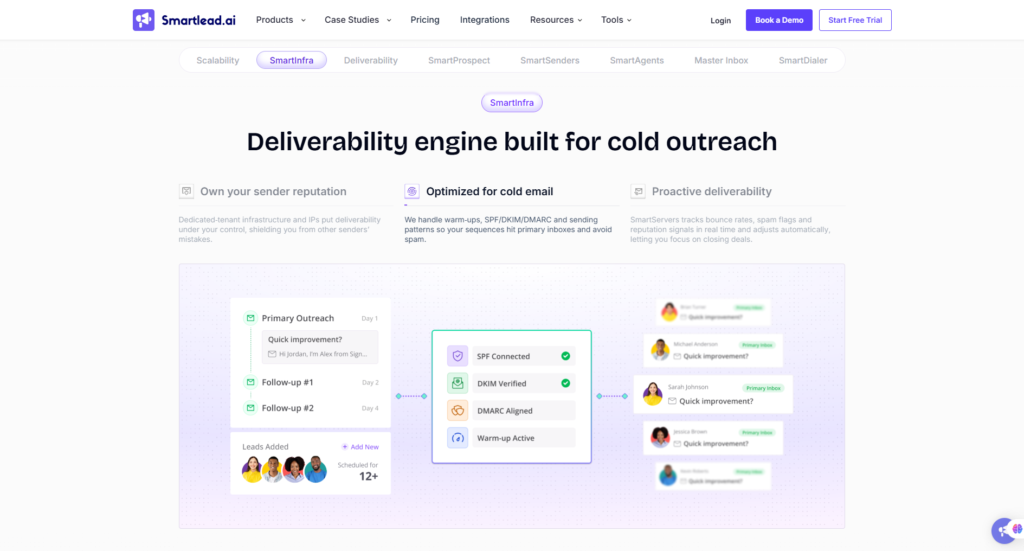
2. Email Warm-Up & Deliverability
Smartlead includes email warm-up functionality designed to help sending accounts establish and maintain positive activity patterns.
Warm-up can be useful when:
- Launching new inboxes
- Preparing new outbound infrastructure
- Managing multiple sending accounts
- Monitoring mailbox health
However, warm-up should never be treated as a guarantee of inbox placement.
Successful deliverability still depends on technical authentication, domain reputation, prospect quality, email relevance, and responsible sending behavior.
3. Automated Cold Email Sequences
Smartlead allows users to create multi-step outreach sequences.
A typical sequence might include:
- Initial cold email
- First follow-up
- Second follow-up
- Final follow-up
Users can define delays between messages and configure sending schedules.
Automation is especially useful because many positive responses to cold outreach occur after follow-ups rather than the first message.
By automating this process, teams can maintain consistent outreach without manually tracking every prospect.
4. Master Inbox
When dozens of sending accounts are involved, checking each inbox individually becomes inefficient.
Smartlead’s Master Inbox is designed to centralize replies from multiple accounts.
This allows users to review conversations, identify interested prospects, and manage responses without constantly switching between mailboxes.
For agencies and sales teams, this can become one of the most practical features in the platform.
5. Lead Verification & Prospecting Ecosystem
List quality directly affects cold email performance.
Invalid email addresses can increase bounce rates, damage sender reputation, and waste campaign capacity.
Smartlead includes lead verification capabilities that can help users identify whether prospect email addresses are likely to be valid before sending.
This may reduce dependence on separate verification tools for certain workflows.
However, users should still maintain strong list-hygiene practices and avoid treating verification as a substitute for proper prospect research.
6. Agency & Client Management
Smartlead is particularly well suited to agencies because outbound campaigns can be organized across multiple clients.
Agency-oriented functionality can make it easier to separate campaigns, monitor performance, and manage different outbound systems within one platform.
For lead-generation businesses, this can reduce operational complexity compared with managing numerous independent tools and inboxes.
7. API, Webhooks & Integrations
More advanced teams can connect Smartlead with other parts of their sales stack through APIs, webhooks, and integrations.
Potential workflows include connecting Smartlead with:
- CRM platforms
- Lead databases
- Enrichment tools
- Workflow automation platforms
- Internal dashboards
- Reporting systems
- Custom applications
These capabilities are especially relevant for agencies and B2B teams building larger outbound systems.
Instead of treating Smartlead as an isolated cold email tool, advanced users can make it part of a broader sales automation workflow.
Smartlead Pros and Cons
Smartlead offers a strong feature set for businesses that take outbound email seriously, but it is not equally suitable for every user.
Its biggest advantages are tied to scalability, account management, and deliverability-focused workflows. Its limitations mostly affect beginners, low-volume senders, and teams looking for broader multichannel prospecting.
Pros
- Unlimited email account connections: This is one of Smartlead’s strongest differentiators for agencies and teams managing many sending inboxes.
- Built for scalable cold email outreach: Smartlead is designed to support larger outbound systems rather than only simple one-inbox campaigns.
- Strong deliverability focus: Warm-up, mailbox rotation, sender management, and sending controls are central parts of the platform.
- Centralized reply management: The Master Inbox can reduce the operational burden of checking many separate mailboxes.
- Automated multi-step sequences: Follow-ups can be scheduled automatically, helping teams maintain consistent outreach.
- Agency-friendly functionality: Smartlead is particularly attractive for lead-generation businesses managing campaigns for multiple clients.
- API and webhook support: Advanced teams can connect Smartlead to other CRM, automation, enrichment, and reporting systems.
- Scalable pricing structure: The higher-tier plans are designed for users who need significantly larger contact and sending limits.
Cons
- Not the simplest tool for beginners: New users may need time to understand domains, DNS authentication, warm-up, mailbox rotation, and deliverability.
- Cold email infrastructure adds extra costs: The monthly Smartlead subscription is only one part of the total outbound budget.
- Entry-level limits may become restrictive: Businesses that begin scaling campaigns can outgrow the lowest plan relatively quickly.
- Not ideal for newsletter marketing: Smartlead is not designed primarily for subscriber newsletters or ecommerce email broadcasts.
- Less suitable for LinkedIn-first workflows: Teams wanting deeply integrated LinkedIn and multichannel sales engagement may prefer other platforms.
- Deliverability is not automatic: Even with warm-up and mailbox management tools, poor targeting or weak technical setup can still hurt inbox placement.
- Advanced agency setups can become operationally complex: More mailboxes, clients, domains, and campaigns require disciplined management.
Overall, Smartlead’s limitations are not necessarily flaws. Most are consequences of the platform being designed for users with more advanced outbound requirements.
Smartlead Pricing 2026
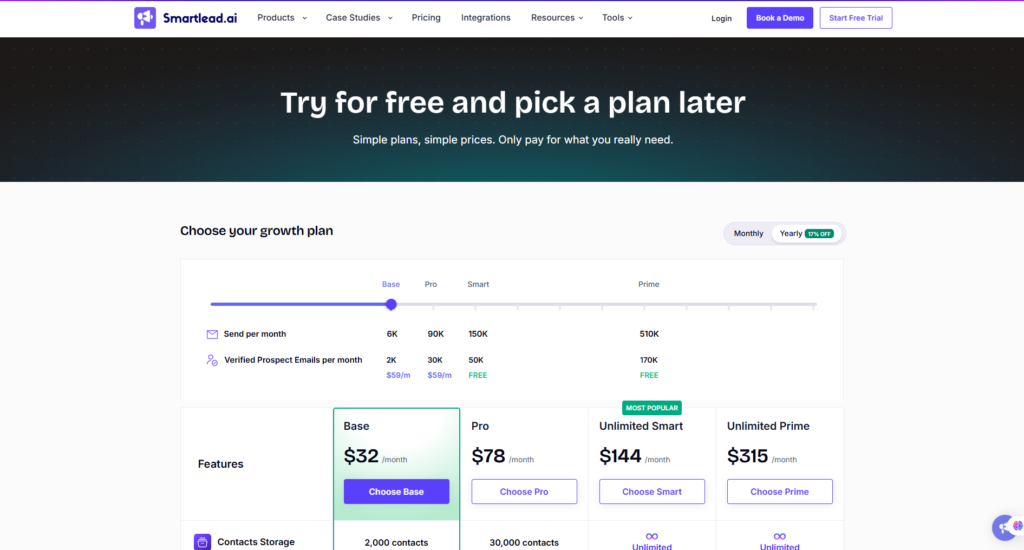
Smartlead uses a tiered subscription model based primarily on contact storage, email sending capacity, and access to advanced features.
At the time of this review, Smartlead’s advertised entry price starts at $39 per month.
Because SaaS pricing can change, readers should always confirm the latest plan limits and billing options on the official Smartlead website before subscribing.
Smartlead Pricing Table
| Plan | Starting Price | Approx. Email Sends | Contact Storage | Best For |
| Base | $39/month | 6,000/month | 2,000 | Small campaigns and testing |
| Pro | $94/month | 90,000/month | 30,000 | Growing sales teams |
| Unlimited Smart | $174/month | 150,000/month | Unlimited | Serious outbound teams |
| Unlimited Prime | $379/month | Up to 500,000/month | Unlimited | Agencies and high-volume operations |
Smartlead may also offer annual billing discounts or additional services depending on the plan and account configuration.
The important point is that businesses should evaluate pricing based on their total outbound volume, not only the headline monthly fee.
Smartlead Base Plan
The Base plan starts at around $39 per month and is the most accessible way to begin using Smartlead.
It is generally best suited to:
- Solo founders
- Small B2B teams
- Early outbound experiments
- Businesses validating a new target market
- Users running relatively small prospect lists
The main advantage is that users can explore Smartlead’s core cold email workflow without immediately committing to a more expensive plan.
However, the Base plan can become limiting if you begin scaling.
A business running multiple campaigns, larger prospect lists, and more aggressive outbound activity may quickly need more contact storage and sending capacity.
For this reason, the Base plan is best viewed as a starting point rather than the ideal long-term plan for a growing agency or outbound team.
Smartlead Pro Plan
The Pro plan represents a significant increase in scale.
At approximately $94 per month, it is better suited to businesses that have moved beyond experimentation and are running cold email as a consistent acquisition channel.
Typical users may include:
- Small lead-generation agencies
- SaaS sales teams
- B2B service companies
- Growth teams
- Experienced outbound operators
The higher sending allowance and contact storage give users considerably more room to operate multiple campaigns.
For many growing teams, the Pro plan may offer a more practical balance between price and capacity than the entry-level plan.
It is particularly relevant for businesses that already know cold email works for their market and now want to increase volume.
Smartlead Unlimited Smart Plan
The Unlimited Smart plan is where Smartlead becomes more interesting for serious outbound operations.
At approximately $174 per month, the plan is designed for users with substantially larger requirements.
Potential benefits can include:
- Unlimited contact storage
- Higher monthly sending limits
- More advanced warm-up functionality
- Verified prospect email capabilities
- CRM-related features
- Greater scalability
This plan is especially relevant to agencies and B2B teams managing many concurrent campaigns.
For a business sending only a few thousand emails each month, the additional capacity may not justify the price.
For a team managing multiple inboxes and larger prospect databases, however, the economics can become much more attractive.
The key question is whether your organization needs infrastructure for scale.
If the answer is yes, Unlimited Smart may provide better value than combining several smaller tools.
Smartlead Unlimited Prime Plan
The Unlimited Prime plan is positioned toward high-volume teams and agencies.
At around $379 per month, it is significantly more expensive than Smartlead’s entry-level offerings, but it also targets a very different user.
Typical use cases may include:
- Established lead-generation agencies
- Large outbound sales teams
- Organizations managing many clients
- Businesses sending hundreds of thousands of emails
- Teams requiring more advanced infrastructure
At this level, buyers should not evaluate Smartlead as a simple SaaS subscription.
They should compare the cost against the operational value of managing large numbers of inboxes, campaigns, client accounts, and replies within a centralized system.
For the right business, the higher monthly fee may still be economical compared with a fragmented stack of multiple outreach, warm-up, CRM, and automation tools.
Additional Costs You Should Consider
One of the most important points in any Smartlead pricing analysis is that the software subscription is not necessarily the total cost of running cold email.
A complete outbound system may also require several additional components.
Sending Domains
Many outbound teams use separate domains or secondary domains rather than sending large cold email volumes from their primary corporate domain.
Each additional domain creates an extra annual cost.
For one or two domains, this may be minor.
For an agency running dozens of domains, it becomes a meaningful expense.
Email Mailboxes
Smartlead may allow unlimited connected email accounts, but those mailboxes usually need to be purchased or provisioned separately.
Depending on the provider, each mailbox may carry a recurring monthly fee.
If an agency operates 50 or 100 inboxes, mailbox costs can exceed the Smartlead subscription itself.
Prospect Data
Smartlead helps manage outbound campaigns, but many businesses still need a source of prospects.
That may involve tools such as:
- Apollo
- LinkedIn Sales Navigator
- B2B databases
- Lead scraping tools
- Data enrichment services
These services increase the total acquisition cost of running campaigns.
Email Verification
Although Smartlead includes verification-related capabilities, some teams may still choose to use dedicated verification tools for certain workflows or larger datasets.
This can add another layer of cost.
Automation & Integrations
Advanced teams may also pay for:
- Zapier
- Make
- CRM software
- Enrichment platforms
- Reporting tools
- Internal automation infrastructure
The total outbound stack can therefore become significantly more expensive than the Smartlead subscription alone.
This does not mean Smartlead is overpriced.
It simply means businesses should calculate the true cost per qualified lead or sales opportunity, rather than focusing only on the monthly software fee.
Is Smartlead Worth the Price?
The answer depends heavily on your business model.
For Solo Founders
Smartlead can be worth it if outbound sales is an important growth channel.
A solo founder who sends targeted campaigns across several inboxes may benefit from automation and centralized management.
However, someone sending only a small number of emails manually may not need the platform.
For Small Businesses
Smartlead becomes more valuable when outreach volume increases.
If a small company is actively prospecting hundreds or thousands of B2B contacts each month, the time saved through automation can justify the subscription.
If the company depends mainly on referrals or inbound marketing, Smartlead may be unnecessary.
For B2B Sales Teams
This is one of the strongest use cases.
Sales teams can use Smartlead to automate repetitive outreach, schedule follow-ups, distribute sending volume, and organize inbound replies.
The platform can help representatives spend less time on campaign administration and more time engaging interested prospects.
For Lead Generation Agencies
Smartlead may offer especially strong value here.
Agencies need to manage:
- Multiple clients
- Many sending accounts
- Separate domains
- Multiple prospect lists
- Campaign performance
- Reply handling
The ability to centralize these workflows can provide substantial operational value.
For Newsletter Creators
Smartlead is usually not the right choice.
Platforms specifically designed for email newsletters, subscriber segmentation, broadcast campaigns, and creator monetization will generally be a better fit.
Smartlead Performance Evaluation
A software review should evaluate more than the number of features available.
For Smartlead, the most important criteria are usability, cold email capabilities, deliverability infrastructure, automation, agency functionality, scalability, and pricing.
Score Table
| Category | Score |
| Ease of Use | 4.3/5 |
| Cold Email Features | 4.8/5 |
| Deliverability Tools | 4.8/5 |
| Automation | 4.7/5 |
| Agency Features | 4.8/5 |
| Integrations & API | 4.6/5 |
| Pricing & Value | 4.5/5 |
| Scalability | 4.9/5 |
| Overall Rating | 4.7/5 |
Ease of Use — 4.3/5
Smartlead is relatively straightforward once the underlying outbound infrastructure has been configured.
The main challenge is that cold email itself is not simple.
Users need to understand mailbox configuration, sending limits, domains, authentication, warm-up, bounce rates, and prospect quality.
Because of this, Smartlead may feel more complicated than traditional email marketing tools.
Cold Email Features — 4.8/5
This is one of Smartlead’s strongest areas.
The combination of multi-step sequences, multiple sending accounts, campaign scheduling, reply management, and scalable outbound infrastructure makes it a strong option for serious cold email users.
Deliverability Tools — 4.8/5
Smartlead places considerable emphasis on deliverability-related workflows.
Features such as warm-up, mailbox management, sending controls, and account rotation can help users build a more disciplined outbound operation.
However, no platform can compensate for poor list quality, spammy messaging, or damaged domain reputation.
Automation — 4.7/5
Automated sequences and follow-up workflows are central to the platform.
For teams running many campaigns, this can significantly reduce repetitive manual work.
Advanced integration options also make it possible to connect Smartlead to larger automation systems.
Agency Features — 4.8/5
Agency users are one of Smartlead’s clearest target markets.
The ability to operate multiple campaigns and sending accounts makes the platform highly relevant to lead-generation businesses and outbound agencies.
Integrations & API — 4.6/5
API and webhook capabilities give advanced teams flexibility to connect Smartlead with other sales and marketing systems.
This is particularly useful when Smartlead is part of a wider outbound stack involving CRM, enrichment, lead sourcing, and reporting.
Pricing & Value — 4.5/5
Smartlead’s pricing is competitive for businesses that fully use its scalability.
The value is less compelling for users running only small campaigns.
As with many cold email platforms, the true cost also depends on mailboxes, domains, data, and external tools.
Scalability — 4.9/5
Scalability is arguably Smartlead’s biggest strength.
The platform is designed for businesses that need to move beyond a few inboxes and simple campaigns.
For agencies and high-volume outbound teams, this is where Smartlead can stand out from more basic outreach tools.
Evaluation Methodology
This Smartlead review does not rely on unsupported claims of personal testing.
Our evaluation is based on a combination of:
- Official Smartlead product information
- Current pricing and plan structure
- Documented feature capabilities
- Market positioning
- Cold email industry standards
- Public customer feedback trends
- Comparisons with competing outbound platforms
- Scalability and intended use cases
The rating reflects how effectively Smartlead addresses the needs of its target audience.
A 4.7/5 rating does not mean Smartlead is the best option for everyone.
It means the platform offers a strong combination of cold email infrastructure, automation, scalability, and agency-focused functionality for businesses that rely heavily on outbound sales.
Users with simpler requirements may find more lightweight alternatives easier and more cost-effective.
Smartlead vs Competitors
Smartlead operates in a highly competitive outbound sales market. Platforms such as Instantly, Lemlist, Apollo, and Saleshandy overlap with Smartlead in different ways, but they are not identical products.
The best option depends on what matters most to your workflow: cold email infrastructure, ease of use, multichannel outreach, prospect data, or price.
Smartlead Alternatives Comparison
| Platform | Best For | Key Strength | Main Difference |
| Smartlead | Agencies and scalable cold email operations | Deliverability infrastructure and mailbox scale | Strong focus on outbound email infrastructure |
| Instantly | Founders, agencies and cold email teams | Simple cold email workflow and broader outbound ecosystem | Strong balance between usability and scalable sending |
| Lemlist | Sales teams needing multichannel outreach | Email, LinkedIn, calling and personalization | More multichannel-focused than Smartlead |
| Apollo | B2B prospecting and sales intelligence | Large prospect database combined with outreach tools | Stronger native lead database and sales intelligence |
| Saleshandy | Budget-conscious cold email teams | Affordable outreach plans | Lower entry cost for smaller teams |
The comparison is not simply about which platform has the longest feature list.
Instead, buyers should ask:
Where is the biggest bottleneck in my outbound system?
If the problem is managing many mailboxes and campaigns, Smartlead becomes highly relevant.
If the problem is finding prospects, Apollo may be more attractive.
If the problem is running email plus LinkedIn and calling in one sequence, Lemlist may fit better.
Smartlead vs Instantly
Smartlead and Instantly are probably among the closest competitors in this comparison.
Both platforms are designed around scalable cold email outreach and support businesses that operate multiple sending accounts.
Instantly currently positions itself as a broader sales engagement and lead intelligence platform, combining automated outreach, a B2B lead database, deliverability tools, CRM functionality, AI features, and email account infrastructure.
Smartlead places particularly strong emphasis on outbound infrastructure, mailbox management, deliverability, campaign automation, and agency workflows.
Smartlead May Be Better If You Need:
- Large-scale mailbox management
- Agency-oriented outbound infrastructure
- Centralized campaign operations
- Strong API and automation flexibility
- Client-oriented workflows
- High-volume cold email operations
Instantly May Be Better If You Need:
- A relatively beginner-friendly interface
- Cold email and prospect data in a broader ecosystem
- Built-in lead database functionality
- AI-powered sales tools
- A simpler path from prospect discovery to outreach
The choice becomes less obvious as both platforms continue adding CRM, data, AI, and deliverability capabilities.
For agencies already operating complex outbound infrastructure, Smartlead may have the stronger appeal.
For founders or smaller sales teams wanting a more integrated prospecting and outreach environment, Instantly may be easier to adopt.
Internal Link Opportunity: Instantly Review
Smartlead vs Lemlist
Smartlead and Lemlist overlap in outbound sales, but their strongest use cases are different.
Smartlead is primarily optimized around scalable email infrastructure.
Lemlist has evolved toward a broader multichannel outbound model.
Current Lemlist plans include capabilities related to:
- Email outreach
- LinkedIn outreach
- Calling
- Lead discovery
- Email and phone enrichment
- AI-powered prospect research
- Unified inbox management
- Deliverability and warm-up
This makes Lemlist particularly attractive to sales teams that do not want to depend entirely on email.
Choose Smartlead If:
- Cold email is your primary outbound channel
- You operate many sending accounts
- You run campaigns for multiple clients
- Deliverability infrastructure is a major priority
- You need highly scalable email operations
Choose Lemlist If:
- You want email plus LinkedIn outreach
- Your sales representatives also make calls
- Multichannel sequences are important
- Personalization is a major part of your strategy
- You prefer a broader sales engagement workflow
For pure cold email infrastructure, Smartlead has a strong case.
For teams wanting to coordinate several outbound channels from the same platform, Lemlist may be more suitable.
Internal Link Opportunity: Lemlist Review
Smartlead vs Apollo
Smartlead and Apollo are less direct competitors than Smartlead and Instantly.
The biggest difference is where each platform starts.
Smartlead starts with outbound execution and email infrastructure.
Apollo starts with B2B prospect data and sales intelligence.
Apollo provides a large prospecting database along with:
- Contact and company search
- Sales intelligence
- Email sequences
- Dialer capabilities
- CRM integrations
- Intent data
- Workflow automation
- AI research tools
This creates a different buying decision.
Choose Smartlead If:
Your biggest challenge is:
- Managing many sending accounts
- Scaling cold email campaigns
- Email warm-up
- Deliverability
- Reply management
- Agency workflows
Choose Apollo If:
Your biggest challenge is:
- Finding B2B prospects
- Building targeted lead lists
- Accessing contact information
- Identifying buying signals
- Combining prospect data with outreach
Some businesses may even use both types of platforms in the same stack.
For example:
Apollo for prospect data → Smartlead for campaign execution
This approach can make sense for teams that prefer specialized tools rather than relying on one platform for everything.
Internal Link Opportunity: Apollo Review
Smartlead vs Saleshandy
Saleshandy is another relevant Smartlead alternative, particularly for users concerned about budget.
Saleshandy offers dedicated cold email outreach plans and positions itself as an affordable platform for businesses running outbound campaigns.
Its entry-level outreach pricing can be lower than many competitors, making it attractive to freelancers, smaller agencies, and businesses beginning to experiment with cold email.
Smartlead Has an Advantage When:
- Scale is a top priority
- You manage many mailboxes
- Agency infrastructure matters
- APIs and automation are important
- You expect campaign complexity to increase
Saleshandy Has an Advantage When:
- Budget is a major factor
- You are beginning with relatively small campaigns
- You want straightforward cold email functionality
- You do not yet need advanced agency infrastructure
For a new solo operator, Saleshandy may be easier to justify financially.
For an agency managing substantial outbound volume, Smartlead may offer a stronger long-term infrastructure model.
Which Smartlead Alternative Should You Choose?
There is no single best cold email platform for every business.
A simple framework can make the decision easier.
Choose Smartlead if:
You prioritize scalable cold email infrastructure, unlimited mailbox management, deliverability workflows, automation, and agency operations.
Choose Instantly if:
You want a relatively accessible combination of cold email outreach, lead data, deliverability, CRM, and AI tools.
Choose Lemlist if:
You want to combine email, LinkedIn, phone, and personalized multichannel outreach.
Choose Apollo if:
Your biggest priority is building prospect lists using a large B2B contact and company database.
Choose Saleshandy if:
You want affordable cold email outreach and do not yet require the more advanced infrastructure of Smartlead.
For serious agencies and outbound teams, Smartlead remains one of the strongest options in this group because its product design is closely aligned with managing high-volume cold email operations.
Frequently Asked Questions About Smartlead
What Is Smartlead Used For?
Smartlead is primarily used for cold email outreach, B2B prospecting, lead generation, and outbound sales automation.
Businesses can connect multiple sending accounts, import prospect lists, create email sequences, automate follow-ups, warm up mailboxes, and manage replies from a centralized system.
It is particularly relevant for lead-generation agencies, SaaS companies, sales development teams, and businesses where outbound email is an important customer-acquisition channel.
How Much Does Smartlead Cost?
Smartlead uses several subscription tiers designed for different levels of outbound volume.
Current official pricing is structured around plans including Base, Pro, Smart, and Prime, with different monthly sending limits, prospect email allowances, and advanced features.
Pricing can change, so buyers should verify the current rates and plan limits directly on Smartlead’s official pricing page before subscribing.
Users should also remember that the subscription itself may not represent the entire cost of cold email.
Domains, mailboxes, prospect data, and other infrastructure may add to the overall budget.
Does Smartlead Offer a Free Trial?
Smartlead currently promotes the ability to start a free trial from its official website.
A trial can be useful for evaluating:
- Dashboard usability
- Mailbox setup
- Campaign creation
- Sequence management
- Master Inbox
- General workflow
However, users should check the latest trial conditions before signing up because SaaS trial terms can change.
Does Smartlead Allow Unlimited Email Accounts?
One of Smartlead’s strongest selling points is its support for unlimited mailbox connections.
This can be particularly useful for agencies and high-volume outbound teams.
Instead of limiting outreach to a small number of inboxes, users can build a larger sending infrastructure and distribute campaigns across multiple accounts.
However, unlimited connections do not mean unlimited sending.
Sending volume still depends on the subscription plan, mailbox configuration, reputation, and responsible outreach practices.
Is Smartlead Good for Cold Email?
Yes, Smartlead is specifically designed around cold email and outbound sales workflows.
Its strongest capabilities include:
- Multiple sending account management
- Email warm-up
- Campaign sequences
- Automated follow-ups
- Mailbox rotation
- Centralized reply management
- Deliverability-focused infrastructure
- Analytics
- API and webhook automation
For agencies and businesses operating outbound email at scale, these features make Smartlead a strong option.
However, software alone does not determine campaign success.
Targeting, offer quality, email copy, prospect data, domain reputation, and follow-up strategy remain equally important.
Is Smartlead Better Than Instantly?
Smartlead is not universally better than Instantly, and Instantly is not universally better than Smartlead.
The right choice depends on the workflow.
Smartlead may be stronger for agencies and teams prioritizing scalable cold email infrastructure and operational control.
Instantly may appeal more to users wanting a broader ecosystem combining cold outreach, prospect data, CRM functionality, deliverability tools, and AI-powered sales features.
For buyers comparing the two, the most useful question is not:
“Which platform has more features?”
It is:
“Which platform fits the way my team actually acquires customers?”
Is Smartlead Suitable for Beginners?
Beginners can use Smartlead, but there is a learning curve.
The interface is only one part of the challenge.
Users also need to understand:
- Sending domains
- Mailboxes
- SPF
- DKIM
- DMARC
- Email warm-up
- Bounce rates
- Deliverability
- Prospect targeting
- Sending volume
Someone completely new to cold email should avoid immediately trying to send thousands of messages.
A better approach is to understand the infrastructure first, start with lower volume, and gradually scale campaigns based on results.
Is Smartlead Safe to Use?
Smartlead is a legitimate outbound sales platform, but users remain responsible for how they use it.
Cold email regulations and privacy requirements can differ between countries and regions.
Businesses should ensure that their outreach practices comply with applicable laws and regulations, including requirements related to commercial email, privacy, identification, opt-out mechanisms, and data processing.
Smartlead should therefore be treated as a campaign infrastructure platform, not as a guarantee that every outreach strategy is legally or operationally appropriate.
What Are the Best Smartlead Alternatives?
The strongest alternatives depend on what you need.
Consider:
- Instantly for scalable cold email with a broader sales ecosystem
- Lemlist for multichannel outreach
- Apollo for prospect data and sales intelligence
- Saleshandy for budget-conscious cold email
- Other specialized outbound platforms depending on your workflow
Smartlead remains particularly compelling when multiple mailboxes, deliverability, automation, and agency-scale infrastructure are the main priorities.
Final Verdict: Is Smartlead Worth It in 2026?
Smartlead is a strong cold email platform, but its value becomes most apparent when outbound sales has moved beyond simple one-inbox campaigns.
Its biggest strength is scalability.
Smartlead combines multiple sending account management, email warm-up, campaign automation, centralized reply handling, analytics, API capabilities, and agency-focused workflows within one outbound environment.
That can eliminate a significant amount of operational friction for teams managing many campaigns.
Best For
Smartlead is especially suitable for:
- Cold email agencies
- Lead-generation agencies
- B2B sales teams
- SaaS companies
- Growth teams
- Appointment-setting businesses
- High-volume outbound operations
- Businesses managing many sending accounts
Not Recommended For
Smartlead may not be ideal for:
- Newsletter creators
- Bloggers sending subscriber broadcasts
- Businesses sending only occasional marketing emails
- Very low-volume prospecting
- Users primarily focused on LinkedIn outreach
- Complete beginners who do not want to learn email deliverability basics
Final Recommendation
The strongest reason to choose Smartlead is not simply that it can automate cold emails.
Many competing platforms can do that.
The more compelling reason is the infrastructure behind those campaigns.
When an outbound operation grows from a few hundred prospects to thousands of leads across multiple inboxes, domains, campaigns, sales representatives, and clients, campaign management becomes increasingly complicated.
Smartlead is designed for that stage.
Its unlimited-mailbox positioning, warm-up capabilities, campaign automation, Master Inbox, analytics, and extensive API and webhook support make it particularly attractive to agencies and serious B2B outbound teams.
The tradeoff is complexity.
A solo founder sending a few emails per week may not need this level of infrastructure. A creator looking for a newsletter platform should choose something entirely different. A sales team that needs prospect data first may also find Apollo more suitable.
But for businesses where cold email is a repeatable and scalable customer-acquisition channel, Smartlead deserves serious consideration.
Overall Rating: 4.7/5
Best For: Agencies, B2B sales teams, lead-generation businesses, and scalable cold email operations
Biggest Strength: Scalable outbound email infrastructure
Biggest Weakness: More complexity than many small users need
Final Recommendation: Recommended for experienced outbound teams and agencies that need to manage multiple sending accounts and campaigns at scale.