

Rewardful Review 2026: Is It Worth It for SaaS Businesses?
Looking for an affiliate management platform that works seamlessly with Stripe? In this Rewardful review, we explore its key features, pricing, strengths, weaknesses, and real-world suitability to help you decide whether it’s the right affiliate software for your SaaS business.
⭐⭐⭐⭐⭐ Overall Rating: 4.6/5
Best For: SaaS Companies • Subscription Businesses • AI Startups • Digital Products • Stripe Users
Starting Price: $49/month
Free Trial: 14 Days
🆕 Last Updated: July 2026
Reviewed by: Team Flowcrai
Quick Verdict
| Category | Details |
| Overall Rating | ⭐⭐⭐⭐⭐ 4.6/5 |
| Best For | SaaS, AI software, Subscription businesses |
| Starting Price | $49/month |
| Free Trial | 14-day free trial |
| Platform | Web-based |
| Integrations | Stripe, Paddle Classic and other supported platforms |
| Affiliate Tracking | Excellent |
| Recurring Commissions | Supported |
| Our Verdict | One of the easiest affiliate management platforms for SaaS companies already using Stripe. Simple to deploy, reliable recurring commission tracking, and a clean affiliate portal make it an excellent choice for growing subscription businesses. |
Evaluation basis: This review is based on the official documentation, publicly available product information, current pricing, platform capabilities, and comparative analysis with competing affiliate management solutions. Hands-on testing should be added in future updates after completing real-world campaign deployment.
Why You Can Trust Team Flowcrai
At Flowcrai, we focus on reviewing AI software, SaaS tools, and digital business platforms that help creators and companies grow online. Instead of simply repeating marketing claims, our reviews aim to explain how each product fits real business scenarios, who it is designed for, and where its limitations become noticeable.
Whenever possible, we combine official product documentation, platform demonstrations, pricing analysis, user feedback patterns, and comparisons with competing software. As our team gains direct hands-on experience with each platform, we continuously update our reviews with screenshots, workflow examples, and practical observations.
Our goal is simple: help readers choose software based on suitability rather than marketing hype.
What Is Rewardful?
Running an affiliate program sounds straightforward until your customer base begins to grow. Tracking referrals, calculating commissions, handling subscription renewals, managing refunds, and paying affiliates manually can quickly become time-consuming. Many SaaS founders initially rely on spreadsheets or basic tracking methods, but these approaches often become difficult to maintain as recurring revenue increases.
Rewardful was built to solve exactly this problem.
Rewardful is a cloud-based affiliate and referral management platform designed primarily for subscription businesses, SaaS startups, digital creators, and online companies that want to launch and manage an affiliate program without building their own tracking infrastructure.
Unlike affiliate marketplaces that connect merchants with thousands of publishers, Rewardful focuses on helping businesses operate their own affiliate program. It provides the tools needed to recruit affiliates, generate referral links, attribute conversions, calculate commissions, and organize payouts—all from a centralized dashboard.
One of Rewardful’s biggest strengths is its deep integration with Stripe. For businesses already using Stripe to process subscription payments, setup is relatively straightforward. Instead of manually importing sales or reconciling invoices, Rewardful can associate customer subscriptions with affiliate referrals, allowing commissions to follow the customer’s lifecycle more accurately.
This becomes especially valuable for Software-as-a-Service businesses that rely on recurring monthly or annual subscriptions. Traditional affiliate tracking often struggles with upgrades, downgrades, cancellations, refunds, and recurring billing cycles. Rewardful is specifically designed to account for these subscription events so that commissions better reflect actual customer revenue.
The typical workflow is simple.
A business first connects Rewardful with its billing platform, such as Stripe. Next, it creates one or more affiliate campaigns and defines commission rules—these might be one-time commissions, recurring percentages, or fixed rewards. Affiliates then receive their own referral links and can begin promoting the product through websites, YouTube videos, newsletters, social media, or other marketing channels.
Whenever a visitor signs up through an affiliate’s referral link, Rewardful attributes the customer according to the selected attribution model and automatically calculates commissions as subscription payments are processed. Business owners can monitor performance, manage affiliates, review conversions, and organize payouts without relying on multiple disconnected tools.
Another important distinction is that Rewardful supports both referral links and coupon-based attribution. This flexibility makes it useful not only for traditional affiliate marketers but also for influencers, podcast hosts, consultants, agencies, and creators who may prefer sharing promotional codes instead of tracking links.
Although Rewardful offers a streamlined experience, it is important to understand what the platform is not.
Rewardful is not an affiliate marketplace like PartnerStack, where businesses can potentially gain exposure to an existing network of partners. Instead, companies are responsible for recruiting and managing their own affiliates. Businesses looking for a built-in partner ecosystem may prefer enterprise-focused alternatives, while those seeking a lightweight and efficient affiliate management platform may find Rewardful a much better fit.
Overall, Rewardful is best suited for:
- SaaS startups using Stripe
- AI software companies
- Subscription-based businesses
- Digital product creators
- Membership platforms
- Marketing agencies managing SaaS clients
- Founders launching their first affiliate program
Its clean interface, recurring commission support, flexible campaign management, and automation features make it particularly attractive for small and medium-sized businesses that want professional affiliate management without the complexity of large enterprise platforms.
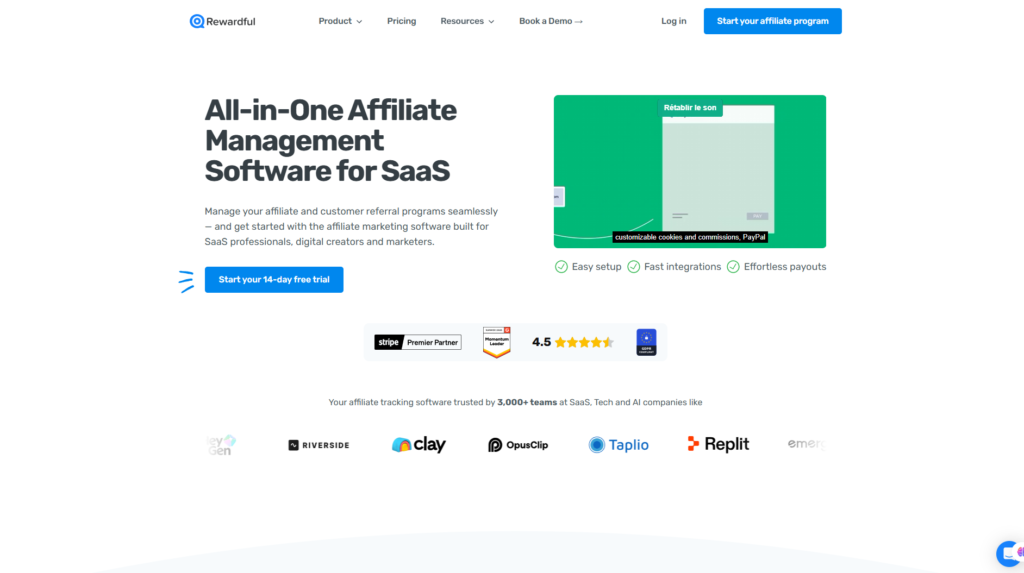
If you’re looking for a straightforward way to launch an affiliate program for your SaaS or subscription business, Rewardful is worth exploring. Its combination of Stripe integration, recurring commission tracking, and easy affiliate management makes it a compelling option for teams that want to get started quickly.
👉 Visit the Official Rewardful Website
Affiliate Disclosure: This article contains affiliate links. If you purchase through our links, Team Flowcrai may earn a commission at no additional cost to you. Our editorial opinions remain independent, and recommendations are based on product features, usability, value, and suitability for different business needs.
Rewardful Pros and Cons
Rewardful is designed to make affiliate program management easier for SaaS and subscription-based businesses, especially those already using Stripe. Its strongest advantage is not simply referral tracking, but the way it handles recurring revenue, subscription changes, refunds, and commission adjustments within a relatively simple workflow.
However, Rewardful is not the right platform for every business. Its pricing may feel expensive for very early-stage startups, and companies that need a built-in affiliate marketplace or advanced enterprise partner management may require a broader platform.
The table below summarizes the main strengths and limitations identified in this Rewardful review.
| Pros | Cons |
| Strong integration with Stripe | Starting price may be high for pre-revenue startups |
| Built for SaaS and recurring subscriptions | No permanent free plan |
| Supports recurring and one-time commissions | Starter plan supports only one campaign |
| Automatically adjusts commissions after refunds or subscription changes | Branded affiliate portal requires a higher-tier plan |
| No percentage-based transaction fee on affiliate-generated revenue | Businesses still need to recruit their own affiliates |
| Affiliate portal reduces manual support work | Less suitable for complex e-commerce programs |
| Supports referral links and coupon attribution | Integration coverage is narrower than some enterprise platforms |
| First-touch and last-touch attribution options | Advanced partner workflows may require another solution |
| Fraud and self-referral controls | Platform value depends on having an active affiliate strategy |
| Suitable for small and mid-sized SaaS teams | Large partner ecosystems may outgrow its feature set |
Rewardful’s Main Advantages
1. Strong Fit for Subscription-Based Businesses
Many affiliate platforms were originally built around one-time purchases. That model works well for physical products or individual digital transactions, but it can become more complicated when customers pay monthly or annually.
Rewardful is better aligned with recurring revenue models.
For example, a SaaS company may offer affiliates a 20% recurring commission for the first 12 months of a customer’s subscription. If the customer continues paying, the affiliate continues earning. If the customer cancels, receives a refund, or changes subscription plans, the commission record may need to be adjusted.
Rewardful is designed to manage these recurring events without requiring the business to recalculate every commission manually.
This is particularly valuable for:
- SaaS startups
- AI software platforms
- Membership businesses
- Subscription communities
- Online course platforms
- Digital products with recurring billing
For businesses operating under these models, Rewardful’s subscription-aware tracking can save substantial administrative time.
2. Straightforward Stripe Integration
Rewardful’s Stripe integration is one of its most important selling points.
Companies already using Stripe may be able to connect their payment data with Rewardful and begin building an affiliate campaign without creating a custom tracking system. This can significantly reduce the technical work required to launch a referral program.
The integration helps associate:
- Affiliate referrals
- New customers
- Subscription payments
- Recurring invoices
- Refunds
- Cancellations
- Upgrades and downgrades
- Commission records
This creates a more connected workflow than managing affiliate links in one platform and subscription payments in another.
For lean SaaS teams without a dedicated affiliate operations department, this simplicity may be more valuable than having a large number of advanced features.
3. Flexible Commission Options
Different affiliate programs require different incentive structures. Rewardful supports multiple commission models so businesses can create offers that match their revenue strategy.
Common options include:
- Percentage-based commissions
- Fixed commissions
- One-time commissions
- Recurring commissions
- Campaign-specific commission rates
- Minimum payout thresholds
For example, a SaaS business could create:
- A 25% recurring commission for content creators
- A $100 one-time reward for consultants
- A lower commission for coupon partners
- A custom campaign for strategic affiliates
This flexibility allows businesses to test different partner incentives without rebuilding the entire affiliate program.
4. Affiliate Portal
Rewardful provides affiliates with access to a dedicated portal where they can manage their activity.
Depending on the plan and configuration, affiliates may be able to:
- Access referral links
- Monitor clicks
- Track conversions
- Review pending commissions
- Check approved commissions
- View payout history
- Access campaign information
- Manage their account details
A self-service portal reduces the number of questions merchants need to answer manually.
Without an affiliate portal, businesses often receive repeated requests such as:
- “Where is my referral link?”
- “How many sales have I generated?”
- “When will I be paid?”
- “Was this customer attributed to me?”
- “How much commission is pending?”
Giving affiliates direct access to this information creates a more professional experience and reduces administrative workload.
5. No Percentage-Based Transaction Fee
Rewardful’s public plans are structured around a monthly subscription rather than taking a percentage from every affiliate-generated sale.
This can make costs easier to predict.
A transaction-fee model may look affordable at the beginning, but it can become expensive as affiliate revenue grows. With a fixed monthly software fee, businesses can estimate their operating costs more accurately.
However, this does not mean Rewardful is always the cheapest option. A business generating little or no affiliate revenue may still find the monthly fee difficult to justify. The value becomes stronger once the affiliate program produces consistent sales or begins saving the team meaningful amounts of administrative time.
6. Referral Links and Coupon Attribution
Traditional affiliate programs rely mainly on tracking links. That method works well for blogs, comparison websites, YouTube descriptions, newsletters, and paid content placements.
However, some partners promote products in situations where clicking a link is less practical. Examples include:
- Podcasts
- Webinars
- Live events
- Social media videos
- Influencer campaigns
- Offline presentations
- Verbal recommendations
Coupon attribution allows the business to assign a unique promotional code to a partner. When a customer enters that code during checkout, the sale may be attributed to the correct affiliate.
This provides another way to measure referrals, although businesses should carefully control coupon distribution and ensure that codes are only published in accordance with program terms.

Rewardful’s Main Limitations
1. Pricing May Be Difficult for Very Early-Stage Startups
Rewardful’s starting price can be reasonable for an established SaaS company, but it may feel expensive for a project that has not yet generated revenue.
A startup with:
- No active affiliates
- Very low website traffic
- No tested commission structure
- No proven customer acquisition channel
- Limited monthly recurring revenue
may not immediately receive enough value to justify a monthly subscription.
In this situation, the business should first consider whether it is ready to operate an affiliate program. Affiliate software does not automatically attract partners or create sales. The company still needs:
- A product that converts
- A clear affiliate offer
- Marketing assets
- Affiliate recruitment
- Partner communication
- Reliable tracking
- A payout process
Rewardful becomes more valuable when these foundations are already in place or when the business is actively preparing to scale them.
2. Rewardful Is Not an Affiliate Marketplace
Rewardful helps businesses manage an affiliate program, but it should not be confused with a marketplace such as PartnerStack.
Installing Rewardful does not automatically provide access to thousands of affiliates.
The merchant is still responsible for finding and recruiting partners through channels such as:
- Existing customers
- Industry creators
- Bloggers
- YouTubers
- Consultants
- Agencies
- Newsletter operators
- Community leaders
- Software review websites
This distinction is important.
A business may have excellent tracking software but still generate no affiliate sales if it does not actively recruit and support suitable partners.
3. Entry-Level Plan Restrictions
The entry-level plan may be sufficient for a simple affiliate program, but growing teams can encounter limitations.
Typical restrictions may include:
- A limited number of campaigns
- A limited number of team members
- No custom affiliate portal domain
- Reduced branding options
- Lower affiliate-generated revenue thresholds
A company running only one standard affiliate campaign may not need more. However, businesses that want separate programs for creators, agencies, customers, influencers, and strategic partners may need to upgrade.
Before choosing a plan, businesses should estimate:
- Number of campaigns required
- Number of internal users
- Expected affiliate-generated revenue
- Branding requirements
- Reporting requirements
- Future program expansion
4. Less Suitable for Complex Enterprise Partnerships
Rewardful focuses mainly on affiliate and referral program management.
Companies with complex partner ecosystems may require additional capabilities such as:
- Reseller management
- Deal registration
- Channel conflict prevention
- Multi-tier partner programs
- Co-marketing funds
- Partner certification
- Lead distribution
- Partner relationship management
- Marketplace recruitment
- Contract workflow automation
These requirements are more common among large B2B software vendors and enterprise companies.
Rewardful may still support the affiliate component of such a program, but a broader partnership platform may be more appropriate when affiliate marketing is only one part of a larger channel strategy.
Rewardful Pricing
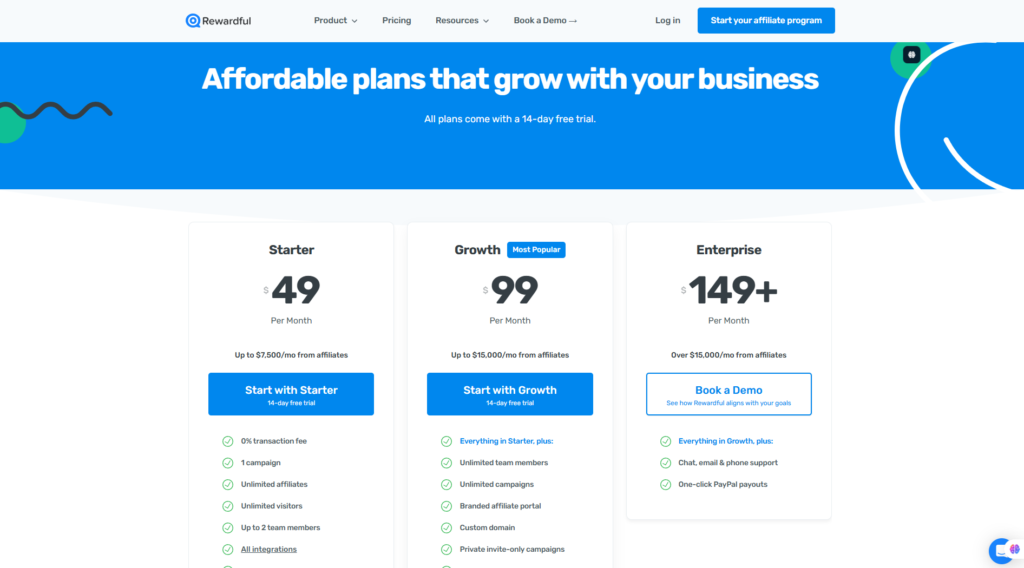
Rewardful uses a monthly subscription model with different plans based on program scale, campaign requirements, branding needs, and affiliate-generated revenue.
Pricing note: Pricing and plan limits can change over time. Check the official Rewardful website before making a purchasing decision.
Rewardful Pricing Overview
| Plan | Starting Price | Best For | Main Limitations |
| Starter | $49/month | New SaaS affiliate programs and small teams | One campaign, limited team access and lower revenue allowance |
| Growth | $99/month | Growing SaaS companies managing multiple campaigns | Higher monthly cost |
| Enterprise | From $149/month | Larger affiliate programs with higher revenue volume | May still be less comprehensive than full enterprise partnership platforms |
Rewardful also offers a trial period, allowing businesses to explore the dashboard and test the platform before committing to a paid plan.
Starter Plan
The Starter plan is designed for businesses launching a relatively simple affiliate program.
It is most suitable for:
- Early-stage SaaS companies
- One main affiliate campaign
- Small internal teams
- Businesses validating affiliate acquisition
- Founders migrating away from spreadsheets
Core capabilities may include:
- Affiliate tracking
- Recurring commissions
- Unlimited affiliates
- Referral link management
- Coupon tracking
- Fraud controls
- Commission reporting
- Access to integrations
- API availability
- Multiple currencies
The main issue is scalability.
A business may outgrow the Starter plan when it needs:
- More campaigns
- More internal users
- A branded affiliate portal
- A custom portal domain
- Higher affiliate revenue capacity
- More advanced program segmentation
For a company running one straightforward affiliate campaign, however, the Starter plan may provide enough functionality to launch professionally.
Growth Plan
The Growth plan is a better fit for businesses that already have an active affiliate strategy or expect to expand quickly.
It may be appropriate for:
- SaaS businesses with multiple products
- Companies running several affiliate campaigns
- Marketing agencies
- Teams with multiple managers
- Programs that require stronger branding
- Businesses with higher affiliate-generated revenue
The Growth plan becomes more attractive when the business wants to create separate campaigns for different partner groups.
For example:
- Content affiliate campaign
- Customer referral campaign
- Agency partnership campaign
- Influencer campaign
- Promotional campaign
- International affiliate campaign
Separating campaigns can help the business apply different commission rates, messages, and conditions to each partner category.
Branding options may also become more important at this stage. A branded portal and custom domain can make the affiliate experience feel more closely connected to the company rather than to a third-party software provider.
Enterprise Plan
The Enterprise plan is intended for larger affiliate programs that exceed the limits of standard plans.
It may be suitable for:
- High affiliate-generated revenue
- Larger partner databases
- Multiple campaign structures
- More complex operational requirements
- Businesses needing additional support
- Companies with more advanced implementation needs
However, businesses evaluating the Enterprise plan should compare Rewardful carefully against enterprise-focused platforms.
Rewardful may remain a good choice when the company mainly needs subscription-aware affiliate tracking. It may be less suitable when the organization also requires a complete partner relationship management system.
Does Rewardful Offer a Free Plan?
Rewardful does not primarily position itself as a permanently free affiliate platform.
Instead, it offers a limited free trial so businesses can evaluate the product before paying.
A trial is useful for checking:
- Dashboard usability
- Stripe connection workflow
- Campaign creation
- Commission configuration
- Affiliate onboarding
- Referral link creation
- Portal experience
- Reporting
- Coupon attribution
- Payout preparation
Businesses should use the trial as an implementation test rather than simply browsing the dashboard. Creating a realistic test campaign provides a better understanding of whether the platform fits the company’s actual workflow.
Is Rewardful Good Value for Money?
Rewardful offers the strongest value when three conditions are met:
- The business uses a supported billing platform, particularly Stripe.
- The company has or plans to recruit active affiliates.
- Subscription-related commission management is creating operational complexity.
For these businesses, Rewardful may reduce the time required to:
- Track recurring subscriptions
- Calculate commissions
- Review refunds
- Handle upgrades and cancellations
- Answer affiliate questions
- Prepare payouts
- Maintain spreadsheets
The platform may offer weaker value for businesses that have not yet validated their product or affiliate acquisition strategy.
A pre-revenue startup with no affiliates may be better served by first developing:
- A strong product offer
- A clear target market
- A commission model
- Affiliate landing pages
- Program terms
- Recruitment outreach
- Sales conversion data
Once these foundations exist, Rewardful can help turn the affiliate program into a more scalable operation.
Rewardful may be worth the cost for SaaS businesses that want subscription-aware tracking without building a custom affiliate system. The trial provides an opportunity to evaluate campaign setup, affiliate onboarding, and commission management before selecting a paid plan.
👉 View Rewardful Plans and Start the Free Trial
Rewardful Performance Evaluation
Because Flowcrai has not yet completed a fully documented hands-on campaign test, the following scores are based on product documentation, demonstrated workflows, pricing structure, SaaS suitability, and comparison with competing affiliate management platforms.
These scores should be updated after testing Rewardful with real referral traffic, subscription events, refunds, and payouts.
Evaluation Method
The platform is evaluated across ten areas that matter most for SaaS affiliate operations:
- Setup process
- Affiliate tracking
- Subscription handling
- Commission flexibility
- Affiliate experience
- Integrations
- Reporting
- Payout workflow
- Value for startups
- Long-term scalability
| Evaluation Area | Score | Assessment |
| Setup Process | 9.0/10 | The workflow appears particularly streamlined for supported Stripe businesses |
| Affiliate Tracking | 8.8/10 | Strong core tracking for links, customers, subscriptions, and commissions |
| Subscription Handling | 9.1/10 | One of Rewardful’s strongest areas, especially for recurring SaaS revenue |
| Commission Flexibility | 8.7/10 | Supports several useful commission structures and campaign rules |
| Affiliate Portal | 8.4/10 | Clean self-service experience, although stronger branding requires a higher plan |
| Integrations | 7.8/10 | Good for its SaaS focus, but not as broad as larger partnership platforms |
| Reporting | 8.2/10 | Suitable for routine affiliate operations without excessive complexity |
| Payout Workflow | 8.1/10 | Helpful payout preparation options, though businesses remain responsible for payment administration |
| Value for Early Startups | 7.3/10 | Monthly pricing may be difficult before the program generates meaningful revenue |
| Scalability | 7.7/10 | Strong for small and mid-sized SaaS businesses, less comprehensive for enterprise partner ecosystems |
Setup Process — 9.0/10
Rewardful appears to offer a relatively straightforward setup process for businesses already operating on Stripe.
A typical setup may involve:
- Creating a Rewardful account
- Connecting the billing platform
- Installing the required tracking code
- Creating an affiliate campaign
- Setting commission rules
- Configuring attribution
- Customizing the affiliate portal
- Inviting the first affiliates
The platform’s focus is an advantage here. Because Rewardful is built mainly for SaaS and subscription businesses, users do not need to navigate many unrelated e-commerce features.
The final setup time will still depend on the company’s website architecture, checkout flow, billing configuration, and technical resources.
Affiliate Tracking — 8.8/10
Rewardful supports the core tracking requirements expected from a SaaS affiliate platform.
These include:
- Referral link attribution
- Affiliate-specific tracking
- Coupon-based attribution
- First-touch attribution
- Last-touch attribution
- Customer conversion records
- Subscription commission tracking
- Refund-related adjustments
The platform’s tracking model appears particularly useful when a customer does not generate only one transaction. A SaaS customer may remain subscribed for several months, change plans, or request a refund. Rewardful is intended to connect these events with the original referral.
Actual tracking reliability should be tested using:
- Multiple browsers
- Different devices
- Cookie expiration scenarios
- Coupon and referral-link combinations
- Subscription upgrades
- Subscription downgrades
- Refunds
- Cancellations
- Repeated purchases
Subscription Handling — 9.1/10
Subscription handling is likely Rewardful’s strongest capability.
Recurring commission programs become difficult when they are managed through spreadsheets because the team must continuously update:
- Monthly renewals
- Annual renewals
- Trial conversions
- Failed payments
- Plan changes
- Cancellations
- Refunds
- Commission eligibility
Rewardful is designed to automate much of this relationship between billing activity and affiliate commissions.
This makes it especially attractive to SaaS businesses whose partners earn commissions over several months rather than only on the initial purchase.
Commission Flexibility — 8.7/10
Rewardful provides enough flexibility for most small and mid-sized SaaS affiliate programs.
Businesses can potentially structure campaigns around:
- One-time percentage commissions
- Recurring percentage commissions
- Fixed cash commissions
- Different affiliate groups
- Campaign-specific incentives
- Custom payout thresholds
The platform may not offer every enterprise-level compensation workflow, but its available options should cover many common SaaS use cases.
Affiliate Portal — 8.4/10
The affiliate portal can help create a more professional partner experience.
Affiliates need clear access to:
- Referral links
- Click statistics
- Conversion records
- Commission balances
- Payment information
- Program details
Rewardful provides these essentials in a centralized interface.
The main limitation is that stronger branding, such as a branded portal or custom domain, may require a higher-tier subscription.
For an early-stage program, standard branding may be sufficient. For a mature SaaS company, a custom portal can improve trust and consistency.
Integrations — 7.8/10
Rewardful’s integration strategy is focused rather than extremely broad.
This is beneficial for SaaS businesses using supported payment platforms because the integration is designed around their actual billing model.
However, businesses using:
- Unsupported payment processors
- Custom billing systems
- Complex e-commerce platforms
- Multiple checkout environments
- Enterprise CRM workflows
may need technical workarounds or a different platform.
Before subscribing, companies should verify compatibility with their entire stack rather than only checking whether their payment processor is listed.
Value for Startups — 7.3/10
Rewardful can save time, but its value depends on program readiness.
For an active SaaS affiliate program, the monthly price may be justified by lower administrative costs and more reliable commission management.
For a startup without affiliates, the cost may not produce an immediate return.
The key question is not simply:
“Is Rewardful affordable?”
A better question is:
“Will Rewardful save enough time or generate enough affiliate revenue to justify its monthly fee?”
The answer depends on the stage of the business.
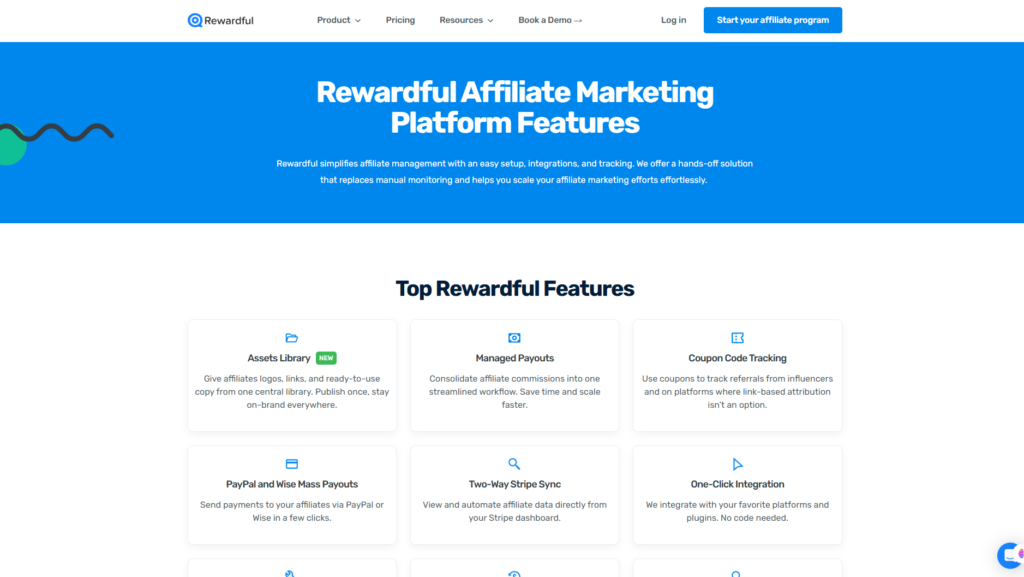
Rewardful Affiliate Program
Rewardful also operates its own affiliate program, allowing creators, marketers, consultants, and SaaS-focused publishers to earn commissions for referring new customers.
This is separate from the software itself.
The Rewardful affiliate program may appeal to:
- SaaS bloggers
- Affiliate marketing educators
- Startup consultants
- Agency owners
- YouTube software reviewers
- Newsletter publishers
- No-code creators
- AI software reviewers
- Stripe implementation consultants
Rewardful is particularly relevant to audiences interested in:
- Affiliate software
- SaaS growth
- Referral programs
- Recurring revenue
- Stripe tools
- Startup marketing
- Partner management
Why Rewardful May Be Suitable for Flowcrai
Rewardful fits the core content direction of Flowcrai because it is a SaaS business tool with clear commercial intent.
Potential article topics include:
- Rewardful Review
- Rewardful Pricing
- Rewardful Alternatives
- Rewardful vs Tolt
- Rewardful vs FirstPromoter
- Rewardful vs PartnerStack
- Best Affiliate Software for SaaS
- Best Stripe Affiliate Software
- How to Start a SaaS Affiliate Program
These topics can form a focused content cluster around SaaS affiliate management.
Instead of publishing only one review, Flowcrai can build several connected articles and internally link them. This creates more useful coverage for readers while strengthening topical relevance.
Important Promotional Considerations
Before promoting Rewardful, affiliates should carefully review the current program terms.
Important questions include:
- Are paid search ads allowed?
- Is bidding on the Rewardful brand name prohibited?
- Can affiliates use direct linking?
- Are coupon pages allowed?
- Which traffic sources are restricted?
- What is the attribution window?
- How long are recurring commissions paid?
- Are self-referrals prohibited?
- When are commissions approved?
- What payout method is used?
- Is there a minimum payout threshold?
Flowcrai should avoid making claims about commission rate, cookie duration, or payout terms unless those details are verified inside the current affiliate agreement.
Program conditions can change, so the article should direct readers to the official terms for the latest information.
Rewardful vs Competitors
Rewardful operates in a competitive category that includes lightweight SaaS affiliate tools, broader affiliate platforms, and enterprise partnership ecosystems. The right choice depends on whether a business prioritizes simple Stripe integration, flexible referral workflows, partner recruitment, extensive integrations, or enterprise-level channel management.
Rewardful’s main advantage is its focus. It is built primarily for SaaS companies, digital creators, and subscription businesses that need to track affiliate referrals alongside recurring billing events. Rewardful connects with Stripe and is designed to follow commissions through renewals, upgrades, downgrades, and cancellations. (Rewardful)
It is therefore most useful to compare Rewardful with four alternatives:
- Tolt
- FirstPromoter
- PartnerStack
- Tapfiliate
Rewardful Comparison Table
| Platform | Best For | Main Strength | Main Limitation |
| Rewardful | SaaS companies using Stripe | Simple subscription-aware tracking | No large built-in partner marketplace |
| Tolt | Early-stage SaaS startups | Accessible pricing and streamlined setup | Smaller enterprise feature set |
| FirstPromoter | SaaS businesses needing detailed referral management | Broad billing integrations and lifecycle tracking | Can require more configuration |
| PartnerStack | B2B SaaS partner ecosystems | Partner marketplace and multi-program management | More complex than most small teams require |
| Tapfiliate | Brands needing broader affiliate and referral flexibility | Wider business-model coverage and integrations | Less specifically centered on SaaS billing |
The comparison above is directional rather than absolute. Each platform offers multiple plans and can change its features over time. Businesses should confirm current compatibility, pricing, and usage limits before selecting a provider.
Rewardful vs Tolt
Rewardful and Tolt are closely matched because both target SaaS companies that want to launch their own affiliate programs without adopting an enterprise partnership platform.
Tolt promotes itself as affiliate software for SaaS startups and supports Stripe and Paddle. Its positioning is particularly attractive to smaller software companies that want an affordable and relatively streamlined platform. (Tolt)
Choose Rewardful when:
- Your company already uses Stripe.
- Subscription lifecycle tracking is a major priority.
- You need recurring commission management.
- You want first-touch or last-touch attribution.
- You need coupon attribution alongside referral links.
- Your business expects to manage upgrades, downgrades, cancellations, and refunds.
Choose Tolt when:
- You operate a small or early-stage SaaS company.
- Starting cost is a major consideration.
- You want a lightweight affiliate portal.
- Your program does not require complex enterprise workflows.
- You prefer a tool aimed specifically at SaaS startups.
Tolt publishes plans starting below Rewardful’s entry point, although plan features and limits should be compared carefully rather than selecting solely on price. (Tolt)
Verdict
Rewardful is likely the stronger choice for a SaaS business that places recurring billing accuracy and Stripe-connected commission tracking at the center of its program.
Tolt may offer better initial value for a smaller startup that needs a straightforward affiliate system and wants to keep monthly software costs lower.
Rewardful vs FirstPromoter
FirstPromoter is one of Rewardful’s closest direct competitors.
Like Rewardful, it is built for SaaS and subscription businesses. FirstPromoter connects affiliate commissions to billing events and supports recurring charges, one-time payments, cancellations, and refunds. Its official materials list native integrations including Stripe, Chargebee, Paddle, Recurly, and Braintree, with API options for custom configurations. (FirstPromoter)
Rewardful’s advantages
Rewardful may be preferable for teams that want:
- A simpler Stripe-centered workflow
- Quick campaign deployment
- Less operational complexity
- Strong recurring commission tracking
- A focused dashboard for small and medium-sized SaaS companies
FirstPromoter’s advantages
FirstPromoter may be preferable for businesses that require:
- More billing-platform integrations
- Affiliate, influencer, and customer-referral programs
- Detailed referral segmentation
- More complex lifecycle attribution
- Additional flexibility for non-Stripe billing stacks
FirstPromoter also provides a 14-day free trial, allowing businesses to test the platform before selecting a paid subscription. (FirstPromoter)
Verdict
Choose Rewardful when Stripe is your primary billing system and ease of implementation matters more than having the broadest integration list.
Choose FirstPromoter when your business uses several billing tools, expects more complex referral structures, or needs broader subscription-system compatibility.
For a typical Stripe-based SaaS startup, Rewardful may feel easier to operate. For a growing subscription company with a more complicated billing environment, FirstPromoter may provide additional flexibility.
Rewardful vs PartnerStack
Rewardful and PartnerStack serve overlapping audiences, but they solve different levels of the partnership problem.
Rewardful is mainly affiliate-management infrastructure. It helps a company operate its own program by tracking referrals, calculating commissions, managing affiliates, and organizing payouts.
PartnerStack is positioned as a broader B2B partnership platform. It supports affiliate partners, co-selling relationships, influencers, referral partners, resellers, and multiple programs operating side by side. (PartnerStack)
PartnerStack also operates a marketplace through which publishers and partners can discover and apply to B2B SaaS programs. (PartnerStack)
Choose Rewardful when:
- You already know how you will recruit affiliates.
- You want to manage a straightforward SaaS affiliate program.
- You need Stripe-related recurring commission tracking.
- You have a small or medium-sized team.
- You do not need reseller or co-selling workflows.
- You want lower operational complexity.
Choose PartnerStack when:
- Partner recruitment is a major priority.
- You want access to a B2B partner marketplace.
- You manage affiliates, agencies, resellers, and referral partners.
- Your company runs multiple partnership motions.
- You need a platform for broader ecosystem growth.
- Your partner program is supported by a dedicated partnerships team.
The most important distinction
Rewardful helps you run an affiliate program.
PartnerStack helps you develop and manage a wider partner ecosystem.
This distinction matters because a company should not pay for enterprise partnership functionality that it will not use. A SaaS startup with 30 content affiliates may be well served by Rewardful. A B2B software company with agencies, consultants, resellers, technology partners, and hundreds of publishers may require PartnerStack.
Verdict
Rewardful is the more practical choice for a focused affiliate program.
PartnerStack is the stronger option for companies that need partner discovery, recruitment, multi-channel relationships, and enterprise ecosystem management.
Rewardful vs Tapfiliate
Tapfiliate is a broader affiliate and referral management platform designed for several types of online businesses. Its official site emphasizes the ability to launch and scale affiliate programs, connect with existing technology stacks, and manage affiliates as well as solution partners and resellers. (Tapfiliate)
Tapfiliate also advertises more than 30 integrations and a 14-day trial. (Tapfiliate)
Choose Rewardful when:
- You run a SaaS or subscription business.
- Stripe billing is central to your operation.
- You need recurring commission adjustments.
- You prefer a narrower product designed around subscription revenue.
- You want fewer unrelated e-commerce features.
Choose Tapfiliate when:
- You operate across SaaS, e-commerce, services, or other business models.
- You need a broader integration ecosystem.
- You want more flexible branding and campaign structures.
- You manage affiliates, influencers, resellers, or ambassadors.
- Your program is not mainly dependent on subscription billing.
Verdict
Rewardful is generally the better fit for a Stripe-based SaaS company.
Tapfiliate may be more suitable for a business with multiple sales models, a broader marketing technology stack, or affiliate requirements that extend beyond subscription software.
Who Should Use Rewardful?
Rewardful is not designed for every type of business. Its value is clearest when the company already has a subscription product, a reliable billing system, and a plan for recruiting affiliates.
1. SaaS Startups Using Stripe
Rewardful is particularly well suited to SaaS startups that already process customer payments through Stripe.
Instead of building custom attribution logic, the company can connect Rewardful, configure its campaign, establish commission terms, and provide affiliates with trackable links.
This is useful for lean teams that do not have:
- A dedicated affiliate engineer
- A large partnership department
- An internal commission system
- Time to reconcile recurring payments manually
Rewardful says supported SaaS teams can launch an affiliate program rapidly, with its setup guidance describing a workflow that can be completed in under 15 minutes in appropriate configurations. (Rewardful)
Actual implementation time may be longer when a website uses a custom checkout, unusual authentication flow, or multiple billing systems.
2. AI Software Companies
AI tools frequently use monthly or annual subscriptions, making them a logical fit for recurring affiliate commissions.
Examples include:
- AI writing software
- Video generation platforms
- Voice-generation tools
- Design applications
- Automation software
- AI research assistants
- Customer-service platforms
These businesses often grow through software reviewers, YouTube creators, educators, consultants, and niche publishers. Rewardful can help connect those partners with recurring subscription revenue.
For an AI startup, the platform may be especially useful when the company wants to launch an affiliate program without applying to a large network or paying for a full partnership ecosystem.
3. Subscription and Membership Businesses
Rewardful may also fit businesses selling:
- Paid communities
- Membership websites
- Premium newsletters
- Subscription-based courses
- Digital resource libraries
- Recurring professional services
- Creator memberships
The key requirement is compatible billing and a business model in which commission tracking needs to follow customer payments over time.
4. Small Marketing Teams
Small marketing teams often need a system that minimizes routine administration.
Rewardful can reduce manual work related to:
- Creating referral links
- Checking affiliate conversions
- Calculating recurring commissions
- Correcting refunds
- Monitoring cancellations
- Preparing payout records
- Responding to affiliate questions
A self-service affiliate portal also allows partners to check their own links, conversions, and balances instead of repeatedly contacting the merchant.
5. Agencies Managing SaaS Clients
Marketing agencies and affiliate consultants may use Rewardful when helping clients build their first partner programs.
Potential agency services include:
- Program strategy
- Commission design
- Rewardful implementation
- Affiliate recruitment
- Partner onboarding
- Content-asset creation
- Campaign monitoring
- Payout administration
- Performance optimization
Rewardful may be easier for an agency to deploy across small SaaS clients than an enterprise partnership platform with lengthy implementation requirements.
6. Founders Moving Away From Spreadsheets
Rewardful becomes particularly valuable when spreadsheet management starts creating operational problems.
Warning signs include:
- Commissions are calculated differently each month.
- Refunds are not properly deducted.
- Affiliate links are difficult to track.
- Partners dispute attribution.
- Subscription renewals require manual calculations.
- Payout records are scattered across several files.
- The team cannot quickly identify its strongest affiliates.
At this stage, paying for affiliate software may cost less than continuing to manage the program manually.

Who Should Not Use Rewardful?
Rewardful may be a poor fit for the following situations.
Businesses Without an Affiliate Recruitment Plan
Rewardful does not eliminate the need to find partners.
A company still needs to recruit affiliates through:
- Customer outreach
- Creator partnerships
- Industry blogs
- YouTube channels
- Consultants
- Agencies
- Newsletters
- Communities
- Direct applications
A technically complete affiliate program may generate no results if no relevant partners join it.
Pre-Revenue Projects With No Validated Product
A founder should be cautious about paying for affiliate software before confirming:
- Customers want the product.
- The landing page converts.
- Pricing is viable.
- Retention is acceptable.
- The commission can be funded.
- Partners have a reason to promote it.
Affiliates cannot solve fundamental product-market or conversion problems.
Complex E-commerce Operations
Rewardful is primarily positioned around SaaS, digital creators, and subscription businesses. (Rewardful)
A large retailer may require features such as:
- Product-level commissions
- SKU-level tracking
- Multiple storefronts
- Large coupon catalogs
- Influencer gifting
- Complex returns
- Marketplace seller attribution
- Omnichannel tracking
A dedicated e-commerce affiliate platform may be more appropriate.
Companies Requiring a Built-In Partner Marketplace
Rewardful can manage affiliates, but PartnerStack provides a dedicated marketplace where partners can discover SaaS programs. (PartnerStack)
A company expecting its software provider to help supply a large pool of partners may therefore prefer a network-oriented platform.
Enterprise Partner Ecosystems
Rewardful may be too focused for organizations requiring:
- Co-selling
- Reseller management
- Deal registration
- Lead distribution
- Partner certifications
- Technology partnerships
- Multi-tier channel programs
- Partner account mapping
- Joint business planning
These organizations should consider broader partner relationship platforms.
Best Rewardful Alternatives
1. Tolt — Best for Early-Stage SaaS Startups
Tolt is a strong alternative for smaller SaaS businesses seeking a modern affiliate platform with Stripe and Paddle support. (Tolt)
Choose Tolt instead of Rewardful when:
- Lower entry pricing is important.
- You run a relatively simple program.
- You want a startup-focused interface.
- You do not need a complex partner ecosystem.
Rewardful may still be preferable when recurring billing adjustments and Stripe-centered program management are the highest priorities.
Internal link opportunity: Tolt Review
2. FirstPromoter — Best for Detailed SaaS Referral Workflows
FirstPromoter is designed for subscription businesses and supports several billing platforms, including Stripe, Chargebee, Paddle, Recurly, and Braintree. (FirstPromoter)
Choose FirstPromoter when:
- You use multiple billing systems.
- You need customer referral and affiliate workflows.
- You require more detailed lifecycle reporting.
- You need greater integration flexibility.
Rewardful may feel more straightforward for a smaller business using Stripe alone.
Internal link opportunity: FirstPromoter Review
3. PartnerStack — Best for B2B Partner Recruitment
PartnerStack is a stronger alternative when a business wants access to a B2B partner network and needs to operate several types of partnership program. (PartnerStack)
Choose PartnerStack when:
- You need marketplace exposure.
- You want to recruit B2B publishers and partners.
- You manage affiliates, resellers, and co-selling relationships.
- You have a dedicated partnership operation.
Rewardful is usually more practical for a smaller company that already has its own recruitment strategy.
Internal link opportunity: PartnerStack Review
4. Tapfiliate — Best for Broader Business Models
Tapfiliate supports affiliate and referral programs across a wider range of business types and promotes extensive integrations and partner-management flexibility. (Tapfiliate)
Choose Tapfiliate when:
- Your business is not exclusively SaaS.
- You need broader integration coverage.
- You manage ambassadors, affiliates, and resellers.
- You require more extensive customization.
Choose Rewardful when subscription billing simplicity is more important than broad platform flexibility.
Internal link opportunity: Tapfiliate Review
5. Impact — Best for Large Partnership Programs
Impact may be worth evaluating when a company requires:
- Large-scale publisher recruitment
- Influencer management
- Multiple partnership types
- Contracting workflows
- Cross-channel tracking
- Enterprise reporting
- Global program administration
However, Impact is not a direct lightweight replacement for Rewardful. It is more appropriate for mature organizations with larger budgets, specialized staff, and advanced partnership requirements.
Frequently Asked Questions
What is Rewardful used for?
Rewardful is used to create and manage affiliate and customer-referral programs. It helps businesses track referral links, attribute customers, calculate commissions, monitor recurring subscription payments, manage affiliates, and organize payouts.
It is designed primarily for SaaS companies, digital creators, marketers, and subscription businesses. (Rewardful)
Is Rewardful only for SaaS companies?
No. Digital creators, membership businesses, subscription services, and other online companies may also use Rewardful.
However, its strongest positioning is around SaaS and recurring revenue. Businesses selling complex physical-product catalogs may find another affiliate platform more suitable.
Does Rewardful work with Stripe?
Yes. Stripe integration is central to Rewardful’s product. The platform is designed to track recurring commissions, upgrades, downgrades, and cancellations associated with subscription customers. (Rewardful)
Can Rewardful track recurring commissions?
Yes. Recurring commission tracking is one of Rewardful’s main features. This allows an affiliate to continue earning according to the merchant’s commission rules when the referred customer makes eligible recurring payments.
Does Rewardful charge transaction fees?
Rewardful states that it does not charge transaction fees on affiliate revenue or payouts. It separately identifies an optional 3% fee for Managed Payouts. (Rewardful)
Businesses should confirm whether payment providers such as PayPal or Wise apply their own processing or currency-conversion fees.
Does Rewardful offer a free trial?
Rewardful currently advertises a 14-day trial across its plans. (Rewardful)
The trial should be used to test an actual campaign workflow, not only to view the dashboard.
Does Rewardful recruit affiliates for my business?
Rewardful is mainly affiliate-management software rather than a large affiliate network. The business remains responsible for recruiting, approving, and supporting its partners.
Companies that prioritize marketplace-based partner discovery may want to compare Rewardful with PartnerStack.
Can Rewardful track coupon codes?
Rewardful lists coupon tracking among its affiliate-program features. (Rewardful)
Coupon attribution can be useful for influencers, podcasts, webinars, and offline promotions. Merchants should nevertheless control how codes are distributed to prevent unauthorized coupon-site promotion.
Is Rewardful suitable for a startup?
Yes, provided that the startup has a validated product and a realistic plan to recruit affiliates.
The platform may be less economical for a pre-revenue project with no partners or customer acquisition strategy.
Is Rewardful better than FirstPromoter?
Neither platform is universally better.
Rewardful may be more attractive for teams wanting a focused Stripe-based experience. FirstPromoter may be more suitable for companies requiring broader billing integrations or more detailed referral workflows. (FirstPromoter)
Is Rewardful better than PartnerStack?
Rewardful is generally more suitable for a focused SaaS affiliate program that does not need a marketplace.
PartnerStack is better positioned for broader B2B ecosystems involving affiliates, resellers, co-selling partners, and marketplace recruitment. (PartnerStack)
Can Rewardful replace manual spreadsheets?
For an active affiliate program, Rewardful can replace many spreadsheet-based tasks, including referral tracking, recurring commission calculations, affiliate reporting, and payout preparation.
Businesses may still need accounting records, tax documentation, partner communication, and internal financial controls outside the platform.
Final Verdict: Is Rewardful Worth It?
Rewardful is a strong affiliate-management platform for SaaS companies and subscription businesses that want to launch a professional referral program without building custom tracking infrastructure.
Its most valuable capabilities are closely connected:
- Stripe integration
- Recurring commission tracking
- Subscription lifecycle adjustments
- Flexible commission structures
- Referral-link attribution
- Coupon-code tracking
- Affiliate self-service portal
- Payout organization
Together, these features address the operational problems that often appear when a SaaS affiliate program outgrows spreadsheets.
Rewardful is especially compelling for a small or mid-sized software company that already uses Stripe and has a clear plan to recruit creators, reviewers, consultants, customers, or agencies. In that scenario, the platform can reduce manual commission work while giving affiliates a more transparent and professional experience.
The main limitation is that Rewardful is an operating platform, not a complete growth engine. It will not automatically provide a large pool of publishers, fix a weak product offer, or generate affiliate traffic without recruitment and relationship building.
Businesses that require a built-in B2B partner marketplace may prefer PartnerStack. Companies needing wider billing-platform support may favor FirstPromoter. Brands operating across multiple commercial models may find Tapfiliate more flexible, while very early-stage SaaS projects may consider Tolt for a lower-cost starting point.
Rewardful Rating
| Evaluation Category | Score |
| Ease of Setup | 4.7/5 |
| Affiliate Tracking | 4.6/5 |
| Subscription Management | 4.8/5 |
| Commission Flexibility | 4.5/5 |
| Affiliate Portal | 4.4/5 |
| Integrations | 4.1/5 |
| Value for Money | 4.2/5 |
| Overall Rating | 4.6/5 |
Best for
- Stripe-based SaaS startups
- AI software companies
- Subscription businesses
- Digital creators
- Small and mid-sized affiliate programs
- Teams moving away from spreadsheets
Consider an alternative when
- You need a built-in partner marketplace.
- You manage complex reseller and co-selling relationships.
- Your business depends on an unsupported billing platform.
- You operate a large physical-product affiliate program.
- You have not yet validated your product or affiliate strategy.
Final Recommendation
Rewardful is recommended for SaaS and subscription businesses that need straightforward, recurring-revenue-aware affiliate tracking.
It is most likely to justify its cost when the business already has affiliates—or is actively recruiting them—and wants to replace manual commission management with a focused SaaS platform.
Start Your Rewardful Affiliate Program
Rewardful offers a 14-day trial, giving teams an opportunity to evaluate campaign setup, Stripe integration, referral tracking, commission rules, and the affiliate portal before selecting a paid plan. (Rewardful)
🚀 Start Your Rewardful Free Trial
🚀 Explore More Affiliate Software Reviews
Affiliate disclosure: This article contains affiliate links. Team Flowcrai may earn a commission if you sign up through our links, at no additional cost to you. This does not influence our editorial evaluation. Pricing, features, and program terms may change; verify current details on the official website before subscribing.