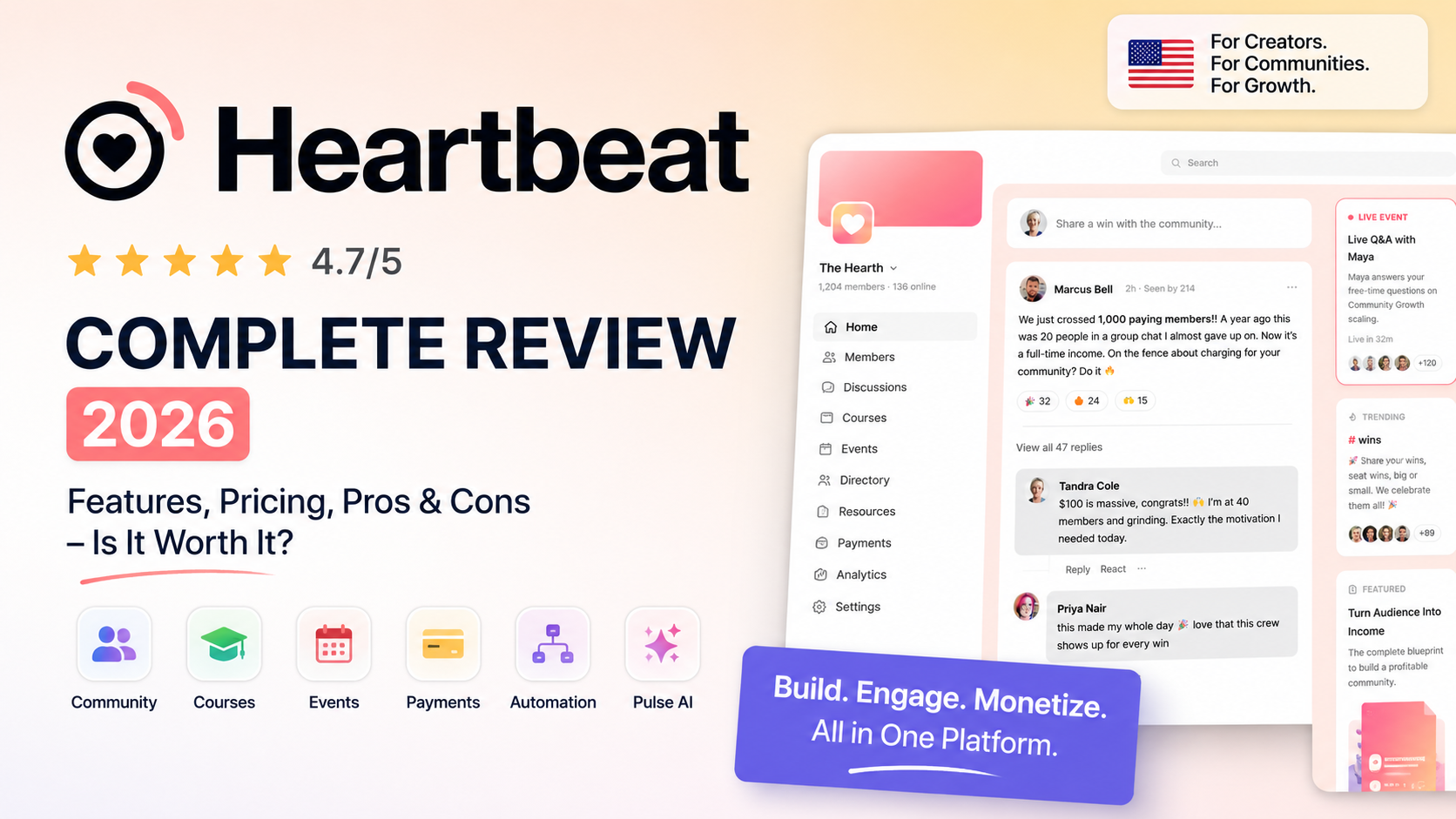
Heartbeat Review 2026: Features, Pricing, Pros & Cons – Is It Worth It?
Last Updated: August 2026
Reviewed By: Team Flowcrai
Overall Rating: ⭐⭐⭐⭐⭐ 4.7/5
Affiliate Disclosure: This article may contain affiliate links. If you purchase through these links, Flowcrai may earn a commission at no extra cost to you. Our reviews are based on publicly available information, official documentation, product capabilities, pricing, and market positioning.
Key Takeaways
- Heartbeat is an all-in-one platform that combines community management, memberships, courses, events, payments, automation, and AI tools in a single ecosystem.
- Pulse AI is one of Heartbeat’s most distinctive features, helping creators build and manage communities more efficiently.
- The platform is particularly well-suited for coaches, educators, consultants, membership businesses, and creators who monetize their audiences.
- Heartbeat offers stronger monetization and automation capabilities than many traditional community platforms.
- While the starting price is reasonable for business users, casual community builders may find simpler and cheaper alternatives more suitable.
Quick Verdict
Heartbeat Quick Info
| Item | Information |
| Overall Rating | 4.7/5 |
| Best For | Creators, Coaches, Educators, Membership Businesses |
| Starting Price | $49/month |
| Free Trial | 14 Days |
| AI Features | Pulse AI |
| Courses | Yes |
| Events | Yes |
| Membership Payments | Yes |
| Automation | Yes |
| Mobile Apps | iOS & Android |
| Custom Domain | Yes |
| Main Competitors | Skool, Circle, Mighty Networks, Kajabi |
Our Verdict
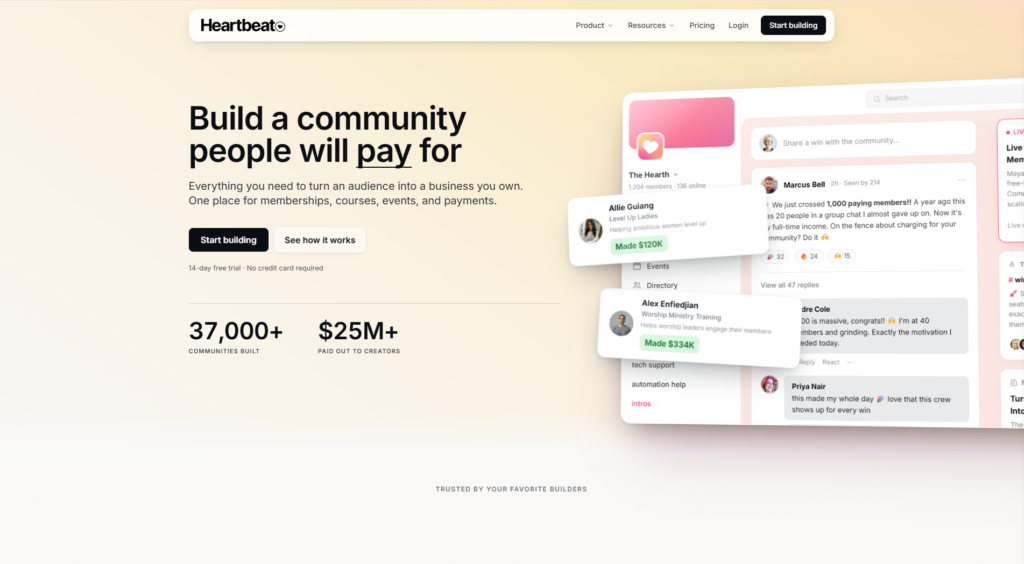
Heartbeat is one of the most interesting community business platforms available in 2026. Instead of focusing solely on discussions and member engagement, it aims to help creators build an entire business around their audience.
The platform combines community spaces, memberships, courses, events, payments, automation, and AI-powered tools under one roof. This makes it particularly attractive for coaches, consultants, educators, and creators who want recurring revenue from memberships or online programs.
Heartbeat may be more powerful than many users actually need, but for those serious about building a community-driven business, it offers a compelling balance between flexibility, automation, and monetization.
👉 Visit the Official Heartbeat Website
What Is Heartbeat?
Heartbeat is an all-in-one community platform designed to help creators, coaches, educators, and businesses build, manage, and monetize online communities.
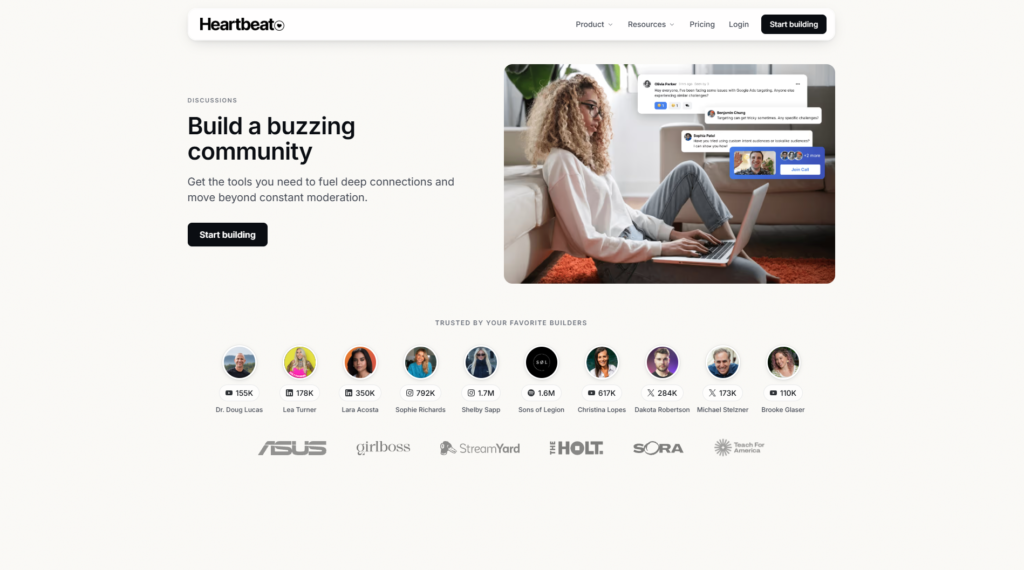
Unlike traditional community platforms that focus mainly on discussions, Heartbeat positions itself as a complete business platform. Users can create member communities, host courses, organize events, collect payments, automate workflows, and even use AI tools to streamline operations.
The platform has grown in popularity among creators looking for alternatives to Facebook Groups, Slack communities, or fragmented software stacks that require multiple subscriptions.
Today, many online businesses rely on a combination of tools such as:
- Slack or Discord for community
- Zoom for live sessions
- Teachable for courses
- Stripe for payments
- Landing page builders
- Automation software
- Email marketing platforms
Heartbeat attempts to consolidate much of this functionality into a single platform.
For businesses focused on memberships and recurring revenue, that consolidation can reduce complexity and improve the member experience.
What Problem Does Heartbeat Solve?
Building an online community sounds simple in theory.
In practice, it often becomes a complicated collection of disconnected tools.
A creator might attract an audience through YouTube, podcasts, newsletters, or social media. Once that audience wants deeper interaction, the creator must decide where the community will live.
Facebook Groups can be noisy and difficult to monetize.
Slack communities often become difficult to organize as they grow.
Discord can be powerful but may feel overwhelming for non-technical audiences.
Meanwhile, courses, events, payments, and memberships often require separate platforms.
As the business grows, managing all these tools can become both expensive and time-consuming.
Heartbeat addresses this challenge by providing a unified environment where community engagement, education, events, and monetization can coexist.
Instead of asking members to move between multiple platforms, creators can keep everything in one place.
This creates a more streamlined experience for both community owners and members.
How Does Heartbeat Work?
Heartbeat follows a relatively straightforward workflow.
A creator begins by setting up a community and organizing spaces for different types of content and discussions.
Once the structure is established, members can be invited through public registration pages, private invitations, or paid offers.
Within the platform, creators can:
- Create discussion channels
- Host online courses
- Schedule live events
- Manage memberships
- Accept payments
- Deliver resources
- Build automated workflows
- Track member activity
The platform essentially acts as a central hub where community members can interact, learn, attend events, and access premium content.
As the community grows, automation features can help reduce manual administrative work.
This allows creators to focus more on delivering value and less on managing systems.
What Makes Heartbeat Different?
The online community software market has become increasingly competitive.
Platforms such as Skool, Circle, Mighty Networks, and Kajabi all compete for creators and membership businesses.
Heartbeat differentiates itself in several important ways.
1. Community-First Business Platform
Many platforms begin with either courses or marketing and later add community features.
Heartbeat takes the opposite approach.
The community itself remains the center of the experience, while courses, memberships, events, and payments are built around it.
This structure helps create stronger engagement and member retention.
2. Flexible Monetization
Heartbeat allows creators to generate revenue through multiple models.
Examples include:
- Monthly memberships
- Annual memberships
- One-time purchases
- Online courses
- Paid events
- Workshops
- Cohort programs
- Bundled offers
This flexibility can be particularly valuable for coaches, educators, and consultants who want to experiment with different revenue streams.
3. Built-In Automation
Automation is often one of the first things growing communities need.
As membership increases, manually welcoming members, granting access, sending reminders, and managing events becomes difficult.
Heartbeat includes workflow automation capabilities that help streamline these processes.
For business owners managing hundreds or thousands of members, automation can save significant time.
4. Pulse AI
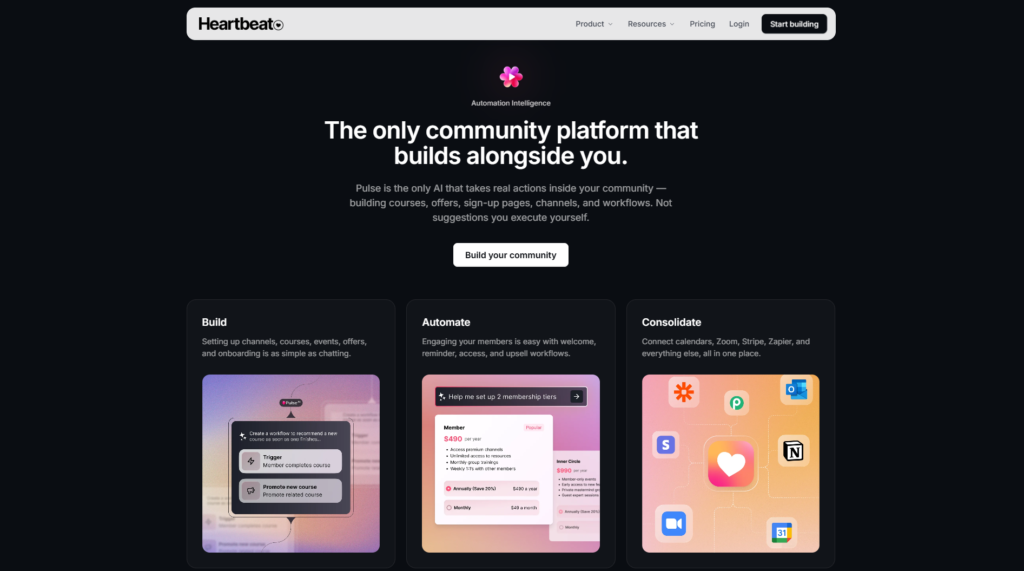
Perhaps the most unique aspect of Heartbeat is Pulse AI.
Rather than functioning as a generic chatbot, Pulse AI acts more like an intelligent assistant built specifically for the Heartbeat ecosystem.
Pulse can help users:
- Create offers
- Build courses
- Set up community structures
- Organize events
- Configure workflows
- Generate content ideas
This AI-powered approach reflects a broader trend in SaaS software where platforms are increasingly integrating AI directly into business workflows.
For creators who are new to community building, Pulse AI may help reduce the learning curve and accelerate setup.
👉 Explore Heartbeat and Start Your Free Trial
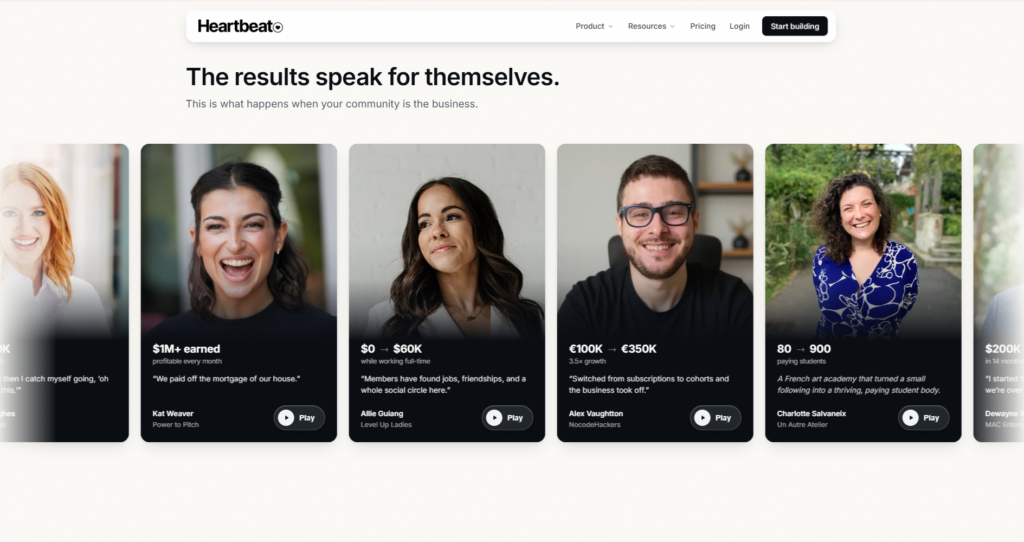
Who Should Use Heartbeat?
Heartbeat is not designed for every type of community.
Its strongest value comes from helping people turn communities into sustainable businesses.
The platform is especially appealing for users who need more than simple discussion forums.
Best For
Coaches and Consultants
Coaches often rely on recurring interaction with clients.
Heartbeat allows them to combine:
- Community engagement
- Group coaching
- Resources
- Courses
- Events
- Membership billing
inside a single platform.
This can simplify client delivery while creating recurring revenue opportunities.
Course Creators
Many course creators discover that content alone is not enough to keep students engaged.
Communities often increase completion rates and improve retention.
Heartbeat supports both community interaction and educational experiences, making it attractive for creators selling online learning programs.
Membership Businesses
Businesses built around subscriptions can benefit from Heartbeat’s focus on member engagement and retention.
Rather than managing multiple systems, owners can centralize much of their operation within a single platform.
Educators and Training Organizations
Educational organizations increasingly use cohort-based learning, workshops, and ongoing learning communities.
Heartbeat supports these use cases through a combination of courses, discussions, events, and memberships.
Content Creators
YouTubers, podcasters, newsletter publishers, and social media creators often seek ways to own their audience relationships.
Instead of relying entirely on social platforms, they can build private communities where engagement and monetization are under their control.
Heartbeat offers a strong foundation for this transition.
Community Entrepreneurs
Some businesses are built around the community itself.
Mastermind groups, networking communities, industry associations, and professional groups often require sophisticated member management and monetization.
Heartbeat is particularly well-suited for these types of organizations.
Who Should Skip Heartbeat?
No software is perfect for everyone.
Heartbeat may not be the best choice for certain users.
Casual Hobby Communities
If your goal is simply to create a free discussion group for friends or hobby enthusiasts, Heartbeat may be more platform than you need.
Less expensive options may be sufficient.
Budget-Conscious Beginners
The platform starts at $49 per month.
For creators who are still validating an idea and have no monetization plan, this cost may be difficult to justify initially.
Users Seeking Maximum Simplicity
Heartbeat offers considerable flexibility, but flexibility often comes with additional complexity.
Users who prioritize simplicity above all else may prefer a platform such as Skool.
Businesses Already Deeply Invested Elsewhere
Organizations that already operate successfully on Kajabi, Circle, or another integrated ecosystem may not gain enough additional value to justify migration.
Switching platforms always carries some cost and disruption.
Setup & User Experience
Account Setup
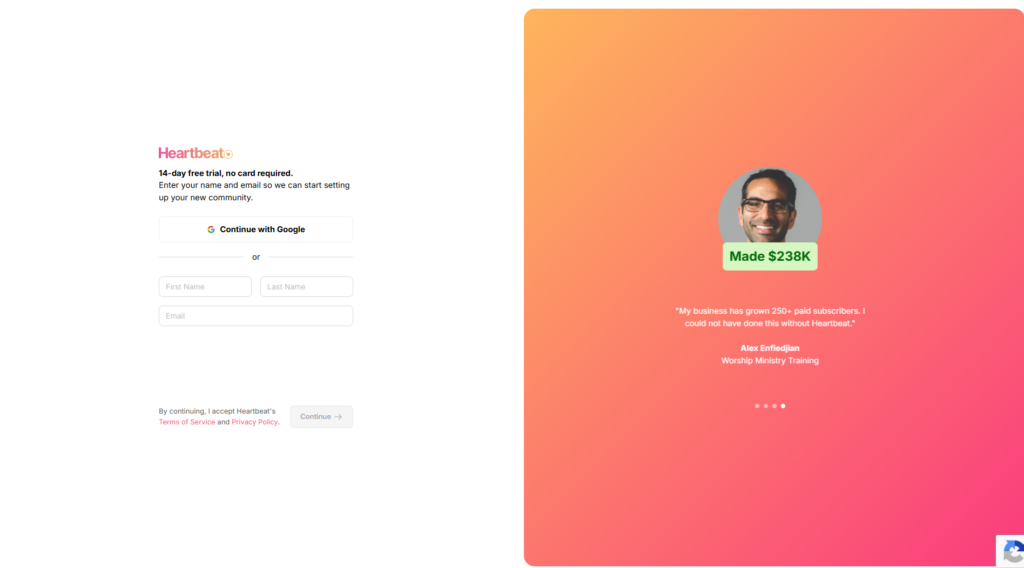
Heartbeat offers a relatively straightforward onboarding process.
New users can begin with a free trial and create a community without immediately committing to a paid subscription.
The setup process generally includes:
- Naming the community
- Choosing branding elements
- Creating discussion spaces
- Configuring memberships
- Setting up events
- Creating offers
- Connecting payment systems
The platform guides users through these foundational steps before inviting members.
Learning Curve
Heartbeat is not difficult to learn, but it is more comprehensive than some competitors.
A platform that combines community management, courses, memberships, payments, events, and automation naturally includes more settings and options.
Fortunately, Pulse AI and onboarding resources help reduce some of the initial complexity.
Most creators familiar with modern SaaS tools should be able to become comfortable within a relatively short period.
Interface Design
Heartbeat uses a modern interface that balances functionality with usability.
The platform organizes discussions, courses, events, members, and business tools into clearly defined areas.
Navigation appears designed around how community businesses actually operate rather than forcing users to jump between multiple disconnected systems.
Mobile access is also available, allowing members to engage with communities while away from their desktop devices.
Our User Experience Analysis
Based on Heartbeat’s documented capabilities, product positioning, and publicly available information, the platform appears to strike a strong balance between flexibility and usability.
Its biggest advantage is that it combines several business-critical tools into a single ecosystem. This can reduce operational complexity for creators running memberships, courses, and community programs.
The tradeoff is that Heartbeat may feel more feature-rich than necessary for users who simply want a basic discussion platform. However, for serious community businesses, the additional functionality is likely to be a worthwhile investment.
Key Features of Heartbeat
Heartbeat is best understood as more than a community chat platform. Its real value comes from combining community engagement, courses, events, payments, automation, and AI-assisted community building in one ecosystem.
For creators running a paid membership business, this can reduce the need to connect several separate SaaS products.
Below are the Heartbeat features that matter most.
1. Community Discussions and Member Experience
At its core, Heartbeat is still a community platform.
Creators can organize conversations using channels, private spaces, direct messages, member profiles, groups, scheduled posts, and notifications. Heartbeat also supports voice and video rooms, with up to 256 attendees according to its current pricing documentation.
The platform includes:
- Unlimited channels
- Unlimited private channels
- Direct messages
- Group messaging
- Member profiles and directory
- Moderation permissions
- Scheduled posts
- Weekly email digests
- In-app and push notifications
- Manual and automated groups
- Member match-ups
This structure is useful because community businesses often need different access levels.
For example, a coach could create a public welcome area, private channels for paying members, a premium mastermind group, and separate spaces for different courses.
Heartbeat also offers iOS and Android apps, allowing members to participate without relying entirely on a desktop browser.
2. Courses and Cohort-Based Learning
Heartbeat also functions as an online learning platform.
Creators can build courses directly inside their communities instead of sending students to a separate LMS.
Heartbeat currently supports unlimited evergreen, drip, and cohort-based courses across its plans.
This makes the platform particularly relevant for:
- Coaches
- Online educators
- Consultants
- Bootcamp operators
- Professional training businesses
- Membership communities
Courses can contain lessons, assignments, discussions, and learning activities while remaining closely connected to the wider community.
That integration is important.
In a traditional course platform, students may log in only when they want to watch a lesson. In Heartbeat, the course can become a gateway into ongoing discussions, events, accountability groups, and paid memberships.
Heartbeat itself positions courses as part of a recurring-revenue ecosystem rather than an isolated digital product.
Pulse AI can also help users design a course structure and organize lessons, which may be particularly useful for first-time course creators.
3. Events and Live Community Experiences
Events are another important part of Heartbeat’s community model.
Creators can use events for:
- Coaching calls
- Webinars
- Workshops
- Office hours
- Mastermind sessions
- Networking events
- Paid classes
- Community meetups
Heartbeat supports public event pages, event access controls, calendar integrations, and Zoom integration.
This creates an interesting acquisition funnel.
A creator might run a public webinar, invite attendees into a free or paid community, then use follow-up workflows to promote a membership, course, or premium offer.
That means events can function not only as engagement tools but also as customer-acquisition opportunities.
For businesses built around live education or coaching, having events integrated into the same environment as the community can simplify both operations and the member experience.
4. Memberships, Payments and Monetization
Monetization is one of Heartbeat’s strongest areas.
An Offer is the mechanism used to sell access to a Heartbeat community or digital product. Current options include paid memberships, freemium memberships, and digital products such as courses, events, or documents.
This allows creators to build several business models, including:
- Monthly memberships
- Annual memberships
- Freemium communities
- One-time digital products
- Paid courses
- Premium events
- Tiered access
- Bundled offers
Heartbeat even supports a Name Your Price option, where creators can specify a minimum or suggested price while allowing buyers to choose what they pay.
This flexibility is useful for creators experimenting with different monetization strategies.
However, one important limitation deserves attention: Heartbeat charges its own payment processing fee in addition to the payment processor’s fee.
The current Heartbeat fee is:
- Build: 5%
- Grow: 2.5%
- Scale: 1.25%
Heartbeat states that Stripe’s own transaction fees are charged separately.
For a small community, this may be manageable.
For a community generating substantial monthly revenue, however, these fees can become an important part of the platform’s overall cost.
5. Workflows and Community Automation
Automation is one of the features that makes Heartbeat particularly interesting for serious community businesses.
As a community grows, manually handling every onboarding message, reminder, access change, and follow-up becomes inefficient.
Heartbeat’s workflows allow creators to automate actions based on member behavior.
Potential use cases include:
- Welcome sequences
- Member onboarding
- Engagement reminders
- Course-completion follow-ups
- Event follow-ups
- Access changes
- Re-engagement campaigns
- Upsells
- Retention workflows
Heartbeat specifically positions its workflows around turning member activity into timely engagement or revenue actions.
For example:
Member completes Course A → automatically recommend Course B
or:
Member becomes inactive → trigger a re-engagement sequence
or:
Member registers for an event → provide access to the appropriate group
These automations can reduce repetitive administrative work while making the community experience more personalized.
Grow and Scale become particularly attractive here because they provide unlimited automation workflows and additional automation controls.
6. Pulse AI
Pulse AI is arguably the most distinctive feature in the current Heartbeat product.
Rather than acting simply as another AI writing assistant, Pulse is designed to help creators actually build and configure elements inside Heartbeat.
According to Heartbeat’s current documentation, Pulse can help with tasks such as:
- Creating courses
- Setting up offers
- Creating pricing tiers
- Building discussion channels
- Designing onboarding flows
- Creating documents
- Configuring landing pages
- Building waitlists
- Creating events
- Creating automated workflows
- Configuring access controls
- Reviewing community structure
Heartbeat describes Pulse as an AI co-builder that can help plan the structure of a community, build pages, create offers, configure courses and events, and automate subsequent actions.
That distinction matters.
Many SaaS platforms add AI primarily for generating text.
Heartbeat is attempting to use AI as an operational layer inside the product.
For a creator who understands what they want but does not know how to configure every setting, this could reduce the setup burden considerably.
Pulse AI is currently available across Heartbeat’s main paid plans.
Heartbeat Pros and Cons
Pros
After examining Heartbeat’s current feature set, several strengths stand out.
- All-in-one community business platform: Community discussions, memberships, courses, events, payments, and automation can operate in one ecosystem.
- Strong monetization flexibility: Creators can sell subscriptions, courses, events, digital products, and different membership tiers.
- Pulse AI is integrated into actual workflows: It can help configure community infrastructure rather than simply generate copy.
- Strong course functionality: Heartbeat supports evergreen, drip, and cohort-based courses.
- Useful automation tools: Workflows can automate onboarding, engagement, access, retention, and upselling.
- Integrated events: Community owners can combine live sessions with memberships and courses.
- Custom domain support: Available across the current main plans.
- Mobile access: Members can use Heartbeat on iOS and Android.
- Good scalability path: Creators can move from a small paid community to thousands of members without migrating platforms.
Cons
Heartbeat also has several meaningful limitations.
- $49/month may be expensive for hobby communities.
- The Build plan supports only 350 members.
- Heartbeat charges transaction fees on member payments.
- Stripe fees are added separately from Heartbeat’s own payment fee.
- The broad feature set creates a larger learning curve than simpler platforms.
- Several advanced business features require the Grow plan.
- Native video hosting is not included in Build.
- Scale at $849/month is a significant commitment for smaller organizations.
- Creators needing only a discussion community may be paying for functionality they do not use.
The payment fee deserves particular attention because it changes the economics as revenue grows.
For example, a community generating substantial recurring membership revenue should compare the lower transaction fees of Grow or Scale against the additional monthly subscription cost.
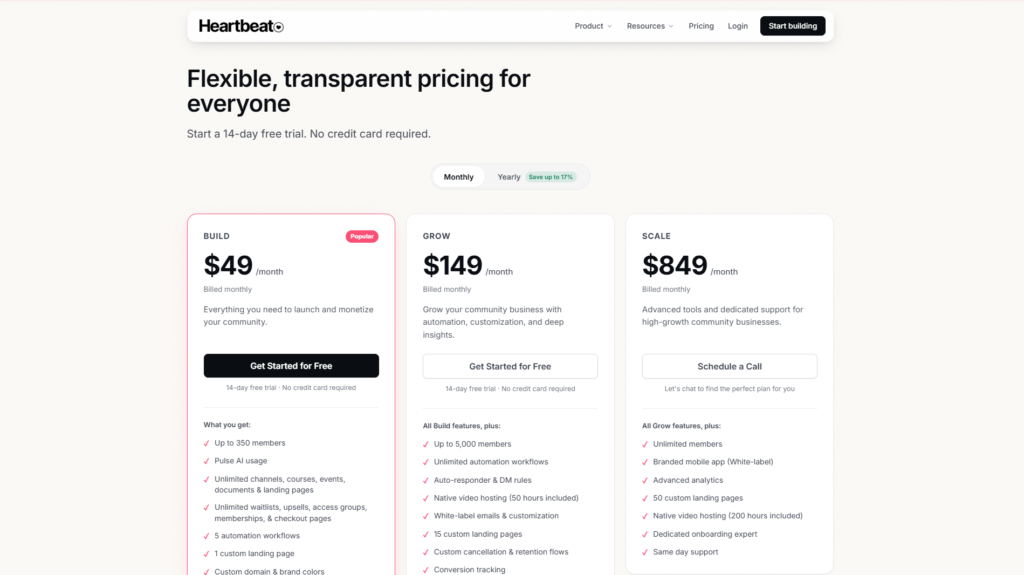
Heartbeat Pricing 2026
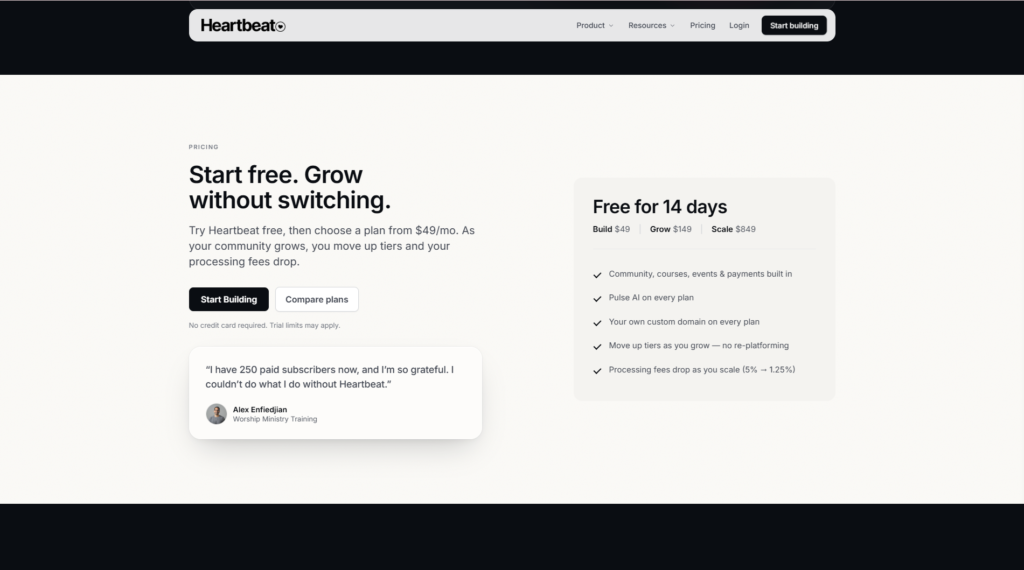
Heartbeat currently offers three main pricing tiers:
Build, Grow, and Scale.
All plans currently include a 14-day free trial with no credit card required.
Heartbeat Pricing Table
| Plan | Monthly Price | Member Limit | Heartbeat Fee | Best For |
| Build | $49/month | 350 | 5% | New community businesses |
| Grow | $149/month | 5,000 | 2.5% | Established paid communities |
| Scale | $849/month | Unlimited | 1.25% | High-growth community businesses |
Pricing and features were checked in August 2026 and may change. Always verify the latest terms on the official Heartbeat website before subscribing.
Build — $49/Month
Build is Heartbeat’s entry-level plan and is designed for creators launching or validating a community business.
It currently includes up to 350 members.
Notable functionality includes:
- Unlimited admins and moderators
- Unlimited channels
- Unlimited private channels
- Unlimited courses
- Unlimited events
- Custom domain
- Member profiles
- Direct messaging
- iOS and Android app access
- Signup and checkout pages
- Custom onboarding
- Integrations with Zapier, Zoom, Google Calendar, Outlook Calendar, and Notion
The main drawback is the 5% Heartbeat transaction fee.
That fee can make Build less attractive once a community starts generating meaningful revenue.
For someone testing whether customers are willing to pay for a community, however, Build provides most of the core infrastructure required to get started.
Grow — $149/Month
Grow is where Heartbeat becomes considerably more powerful as a business platform.
It currently supports up to 5,000 members and reduces Heartbeat’s transaction fee to 2.5%.
Grow includes everything from Build plus features such as:
- Unlimited automation workflows
- Auto-responder and DM rules
- Native video hosting
- White-label emails
- 15 custom landing pages
- Custom cancellation and retention flows
- Conversion tracking
- Advanced offer settings
- API access
- Priority support
- Ability to remove Heartbeat branding
Native video hosting currently includes up to 50 hours on Grow.
For established coaches, educators, and creators generating recurring revenue, Grow is likely to be the most relevant plan.
It offers a much better balance between automation, branding, member capacity, and transaction costs.
Scale — $849/Month
Scale is positioned for larger community businesses.
Its biggest advantages include:
- Unlimited members
- Branded white-label mobile app
- Advanced analytics
- 50 custom landing pages
- 200 hours of native video hosting
- Dedicated onboarding
- Same-day support
Heartbeat’s processing fee drops to 1.25% on this tier.
The jump from $149 to $849 per month is substantial, so Scale is unlikely to make sense for a small creator.
It becomes more relevant when the community already has enough members and recurring revenue to justify premium branding, unlimited membership capacity, and lower payment fees.
Does Heartbeat Have a Free Plan?
No.
Heartbeat currently does not advertise a permanent free plan.
Instead, users receive a 14-day free trial, and no credit card is required to begin.
That should provide enough time to explore the interface, create a basic community structure, test courses and events, and determine whether the platform fits the intended business model.
However, creators should remember that Heartbeat is fundamentally designed as paid business software rather than a free community solution.
Is Heartbeat Worth the Price?
For the right type of user, yes.
The key question is not simply whether $49 or $149 per month sounds expensive.
The better question is:
How many separate tools could Heartbeat replace?
A creator might otherwise pay separately for:
- Community software
- Course hosting
- Event management
- Membership payments
- Automation software
- Landing pages
- Video hosting
- Member-management tools
If Heartbeat replaces several of these subscriptions, its monthly pricing becomes easier to justify.
However, transaction fees complicate the calculation.
A creator earning only a small amount each month may find Build perfectly acceptable.
As membership revenue increases, the 5% Build fee can become increasingly expensive, potentially making Grow more economical even before reaching the 350-member limit.
Best Plan for Beginners
Build
Best for validating a community idea before making a larger commitment.
Best Plan for Growing Community Businesses
Grow
For most serious paid-community operators, Grow appears to offer the strongest balance of functionality and price.
Best Plan for Large Communities
Scale
Most appropriate when member volume, advanced analytics, white-label mobile branding, and lower transaction fees justify the much higher subscription cost.
👉 Try Heartbeat Free for 14 Days
Heartbeat Performance Evaluation
Because this review does not claim laboratory-style or long-term hands-on testing, the following scores are based on Heartbeat’s documented capabilities, current product structure, pricing, market positioning, and comparison with competing community platforms.
Score Table
| Category | Score |
| Ease of Use | 4.5/5 |
| Community Features | 4.8/5 |
| Course Features | 4.7/5 |
| Monetization | 4.8/5 |
| Automation | 4.8/5 |
| AI Capability | 4.7/5 |
| Integrations | 4.5/5 |
| Pricing & Value | 4.3/5 |
| Scalability | 4.7/5 |
| Overall Rating | 4.7/5 |
Evaluation Methodology
Our Heartbeat review evaluates the platform using five primary criteria:
Product capabilities: What Heartbeat officially supports across community management, courses, events, payments, workflows, and AI.
Official documentation: Features and limitations were checked against Heartbeat’s current product and Help Center documentation.
Pricing structure: We considered subscription prices, member limits, transaction fees, and the functionality available at each tier.
Market positioning: Heartbeat was evaluated as a community-business platform rather than simply a chat application.
Competitive context: Scores also consider how Heartbeat fits within the broader market that includes Skool, Circle, Mighty Networks, and Kajabi.
The resulting 4.7/5 overall rating reflects a platform with an unusually strong combination of community engagement, monetization, automation, courses, events, and AI.
Its biggest weakness is not functionality.
It is cost economics.
The platform becomes more attractive when the community generates revenue and uses several of Heartbeat’s business features. For a basic free community, the same level of functionality may be unnecessary.
Heartbeat’s feature set makes a much stronger case for the platform when it is viewed as a community business operating system rather than another alternative to Facebook Groups or Discord.
The combination of community discussions, courses, events, memberships, automation, and Pulse AI provides creators with multiple ways to attract, engage, retain, and monetize members.
The tradeoff is pricing complexity.
The Build plan offers an accessible starting point, but its 350-member limit and 5% Heartbeat payment fee mean successful communities may eventually need to move to Grow.
For serious creators building recurring revenue around a community, however, Heartbeat’s consolidation of multiple business functions could outweigh those disadvantages.
Next, we’ll compare Heartbeat directly with Skool, Circle, Mighty Networks, and Kajabi, answer the most important FAQs, and determine who should — and should not — choose Heartbeat in 2026.
Heartbeat vs Competitors
Heartbeat operates in an increasingly competitive community-platform market. Some alternatives prioritize simplicity and gamification, while others focus on premium community experiences, courses, marketing, or complete creator-business ecosystems.
The most relevant Heartbeat alternatives include Skool, Circle, Mighty Networks, and Kajabi.
There is no universal winner. The best choice depends on whether your priority is community engagement, courses, monetization, automation, marketing, or ease of use.
Heartbeat Competitor Comparison
| Platform | Best For | Key Strength | Potential Limitation |
| Heartbeat | Paid community businesses | Monetization + automation + Pulse AI | Transaction fees |
| Skool | Simple membership communities | Simplicity + gamification | Less flexible business tooling |
| Circle | Premium creator communities | Polished community experience | Can become expensive as needs grow |
| Mighty Networks | Community-led businesses | Community + courses + memberships | Broader feature set can take time to learn |
| Kajabi | Digital-product businesses | Marketing + courses + funnels | Higher cost if community is your main need |
Competitor pricing and features can change. Always check each platform’s official website before making a purchasing decision.
Heartbeat vs Skool
Heartbeat vs Skool is arguably the most important comparison for creators considering Heartbeat.
Both platforms help entrepreneurs monetize online communities, but they approach the problem differently.
Skool has built its reputation around simplicity. Community discussions, courses, points, levels, leaderboards, and gamification are presented in an interface that is relatively easy for both administrators and members to understand.
Heartbeat takes a more flexible approach.
It combines community functionality with courses, events, payments, landing pages, workflows, access controls, and Pulse AI.
This makes Heartbeat particularly attractive when the community business has multiple products or membership tiers.
Choose Heartbeat If You Need:
- Flexible membership offers
- Advanced community automation
- Paid and public events
- Cohort and evergreen courses
- Multiple access levels
- Landing pages
- More complex monetization
- Pulse AI assistance
Choose Skool If You Need:
- Maximum simplicity
- Strong gamification
- Points and leaderboards
- Straightforward course delivery
- A relatively simple paid community structure
The decision therefore comes down to business complexity.
Skool may be easier to operate, while Heartbeat provides more tools for building a sophisticated community business.
For a coach selling one membership with a course and community, Skool may be sufficient.
For a creator running memberships, multiple courses, workshops, events, automated onboarding, and different offers, Heartbeat may provide more room to grow.
Internal Link Opportunity: Heartbeat vs Skool: Which Community Platform Is Better?
Heartbeat vs Circle
Circle is another major competitor frequently considered by professional creators, educators, and community businesses.
Both platforms combine discussions, memberships, courses, events, and monetization, but their positioning differs.
Circle has developed a strong reputation for delivering a polished community experience and is widely used by professional creator businesses and brands.
Heartbeat places greater emphasis on combining community operations with flexible monetization, workflows, and AI-assisted setup.
Pulse AI is particularly relevant here because Heartbeat is attempting to make AI part of the actual community-building process rather than treating it simply as a content-generation feature.
Choose Heartbeat If:
- Automation is important to your business
- You want Pulse AI
- You need flexible offers and access structures
- Your business combines community, courses, and events
- You want community monetization to remain central
Choose Circle If:
- A polished member experience is the highest priority
- You prefer Circle’s established ecosystem
- Your team already uses Circle-compatible workflows
- You need features that specifically align with Circle’s higher-tier offerings
For many smaller creator businesses, Heartbeat deserves consideration because its entry-level positioning gives users access to a broad set of community-business tools.
However, businesses should compare the total cost, not just the subscription price. Heartbeat’s transaction fees can materially affect the economics of a successful paid community.
Internal Link Opportunity: Heartbeat vs Circle: Features, Pricing & Best Use Cases
Heartbeat vs Mighty Networks
Mighty Networks has long focused on community-led businesses and offers community spaces, courses, events, memberships, and mobile experiences.
This makes it one of the closer conceptual competitors to Heartbeat.
Mighty Networks may appeal to organizations that want to build a highly branded community experience, while Heartbeat stands out through its combination of workflows, monetization flexibility, and Pulse AI.
Heartbeat May Be Better For:
- Automation-heavy community businesses
- Coaches and consultants
- Creators experimenting with different paid offers
- Businesses interested in AI-assisted community setup
- Operators who want courses, events, and workflows tightly connected
Mighty Networks May Be Better For:
- Community-first brands already familiar with its ecosystem
- Organizations prioritizing a branded member experience
- Businesses whose specific requirements align more closely with Mighty Networks’ plans and apps
Neither platform should be chosen solely on a feature-count comparison.
The better question is how each platform supports your actual membership model and how much it will cost at your expected number of members.
Heartbeat vs Kajabi
Heartbeat and Kajabi overlap, but they are fundamentally built around different centers of gravity.
Heartbeat is community-first.
Kajabi is creator-business and marketing-first.
Kajabi is particularly strong for businesses built around:
- Online courses
- Digital products
- Landing pages
- Email marketing
- Sales funnels
- Coaching programs
- Marketing automation
Heartbeat is stronger conceptually when the community itself is a major part of the product.
For example, imagine a creator selling a $99-per-month professional membership where members join weekly calls, take courses, participate in discussions, attend events, and network with each other.
Heartbeat is naturally aligned with that business model.
A creator whose main business is selling digital courses through email funnels may find Kajabi more appropriate.
Choose Heartbeat:
When community → engagement → retention → recurring membership revenue is the core business model.
Choose Kajabi:
When content → funnel → email → digital-product sale is the core business model.
This distinction is more useful than simply asking which platform has more features.
Which Community Platform Should You Choose?
The easiest way to make a decision is to start with your primary business objective.
Choose Heartbeat if you want to build a sophisticated paid community combining memberships, courses, events, automation, and AI-assisted operations.
Choose Skool if simplicity and gamification matter more than advanced automation.
Choose Circle if you prioritize a polished premium community experience and its established creator ecosystem.
Choose Mighty Networks if you are building a community-led membership brand and its feature set matches your specific requirements.
Choose Kajabi if courses, marketing funnels, email campaigns, and digital-product sales are more important than community functionality.
For many coaches, educators, consultants, and professional creators, Heartbeat occupies an interesting middle ground between an ultra-simple community platform and a much larger creator-business software stack.
Frequently Asked Questions About Heartbeat
What Is Heartbeat Used For?
Heartbeat is an online community platform designed to help creators and businesses build and monetize communities.
It combines discussions, member management, courses, events, memberships, payments, workflows, and AI-assisted community building.
Typical users include coaches, consultants, educators, course creators, membership businesses, and professional communities.
Is Heartbeat Free?
Heartbeat does not currently offer a permanent free plan.
It offers a 14-day free trial, and no credit card is required to start the trial.
After the trial, users need a paid plan to continue operating their Heartbeat community.
How Much Does Heartbeat Cost?
At the time of this Heartbeat review, the main monthly plans are:
- Build: $49/month
- Grow: $149/month
- Scale: $849/month
Build supports up to 350 members, Grow supports up to 5,000, and Scale supports unlimited members.
Heartbeat also charges transaction fees on payments processed through the platform. These currently decrease from 5% on Build to 2.5% on Grow and 1.25% on Scale, excluding separate payment-processing fees.
Because SaaS pricing can change, always verify current pricing on the official Heartbeat website before subscribing.
What Is Heartbeat Pulse AI?
Pulse is Heartbeat’s AI co-builder.
Rather than functioning only as a general writing assistant, Pulse is designed to help users build and manage elements within the Heartbeat ecosystem.
It can assist with tasks such as creating:
- Courses
- Offers
- Community spaces
- Events
- Landing pages
- Documents
- Workflows
- Access structures
This makes Pulse one of the more interesting differentiators in the Heartbeat platform.
Can You Sell Courses on Heartbeat?
Yes.
Heartbeat supports online course creation within the community environment, including evergreen, drip, and cohort-based learning experiences.
Creators can combine courses with community discussions, events, assignments, memberships, and paid offers.
This makes Heartbeat particularly attractive for educators who want students to participate in an ongoing community instead of simply watching prerecorded lessons.
Can You Charge for a Heartbeat Community?
Yes.
Monetization is one of Heartbeat’s core capabilities.
Creators can build paid memberships and sell access to products such as courses, events, and community experiences.
This allows Heartbeat to support both recurring subscription businesses and one-time purchases.
Is Heartbeat Better Than Skool?
It depends on what you need.
Heartbeat may be better for creators who need advanced automation, flexible monetization, events, multiple offers, and AI-assisted community management.
Skool may be better for creators who prioritize simplicity, gamification, points, and leaderboards.
Neither platform is universally better.
The right choice depends on your business model.
What Are the Best Heartbeat Alternatives?
The most notable Heartbeat alternatives include:
- Skool
- Circle
- Mighty Networks
- Kajabi
Skool is particularly attractive for simplicity and gamification.
Circle is strong for polished professional communities.
Mighty Networks focuses heavily on community-led businesses.
Kajabi is more appropriate for creators who prioritize courses, funnels, email marketing, and digital-product sales.
Final Verdict: Is Heartbeat Worth It in 2026?
After evaluating its community functionality, courses, events, monetization options, workflows, Pulse AI, pricing, and competitive positioning, Heartbeat earns an overall Flowcrai rating of:
⭐ 4.7/5
Heartbeat is particularly compelling when community is not simply an add-on to a business but an important part of the product itself.
Its strongest advantage is consolidation.
Instead of operating separate tools for community discussions, courses, events, payments, membership access, landing pages, and automation, creators can manage much of that infrastructure inside Heartbeat.
Pulse AI makes the proposition even more interesting.
Rather than merely generating content, Pulse is designed to help users construct parts of the community business itself.
That could make Heartbeat especially attractive to solo creators and small teams that want sophisticated functionality without building a complicated technology stack.
Heartbeat Is Best For
- Coaches
- Consultants
- Course creators
- Online educators
- Membership businesses
- Professional communities
- Mastermind operators
- Content creators with established audiences
- Community entrepreneurs
- Businesses combining courses, events, and memberships
Heartbeat Is Not Recommended For
Heartbeat is less compelling for:
- Small hobby groups
- Casual free communities
- Creators with no monetization strategy
- Users needing only basic discussion features
- Extremely budget-sensitive beginners
- Creators primarily interested in gamification
- Businesses already deeply integrated into another creator platform
If all you need is a simple place where people can post messages and interact, paying for Heartbeat’s broader business infrastructure may not make financial sense.
Final Recommendation
The biggest strength of Heartbeat is not any single feature.
It is the way the platform connects:
Community + Courses + Events + Memberships + Payments + Automation + Pulse AI
into one community-business ecosystem.
For coaches, consultants, educators, and creators building recurring membership revenue, that combination can eliminate several disconnected tools while creating a more unified experience for members.
The main weakness is cost economics.
The $49/month Build plan provides an accessible entry point, but the 350-member limit and 5% Heartbeat transaction fee can become significant as revenue grows.
Grow at $149/month is therefore likely to be the more attractive long-term option for successful community businesses that need greater capacity, advanced automation, white-labeling, and lower transaction fees.
Ultimately, Heartbeat is not the cheapest or simplest community platform.
But it does not need to be.
Its strongest use case is for people who want to turn an audience into a structured, monetized community business.
If that describes your goal, Heartbeat is one of the community platforms worth considering in 2026.
👉 Start Your 14-Day Heartbeat Free Trial
No credit card required. Explore Heartbeat’s community, courses, events, automation, and Pulse AI before deciding whether it fits your business.
Read more reviews of other tools on Flowcrai.