
AirOps Review 2026: Is It Worth It for AI Search?
Overall Rating: 4.7/5 ⭐⭐⭐⭐⭐
Best For: SEO teams, content teams, growth marketers, agencies, and companies managing content at scale
Category: AI Search Optimization & Content Operations
Last Updated: August 2026
Reviewed by: Team Flowcrai
Affiliate Disclosure: This article may contain affiliate links. If you purchase or sign up through our links, Flowcrai may earn a commission at no additional cost to you.
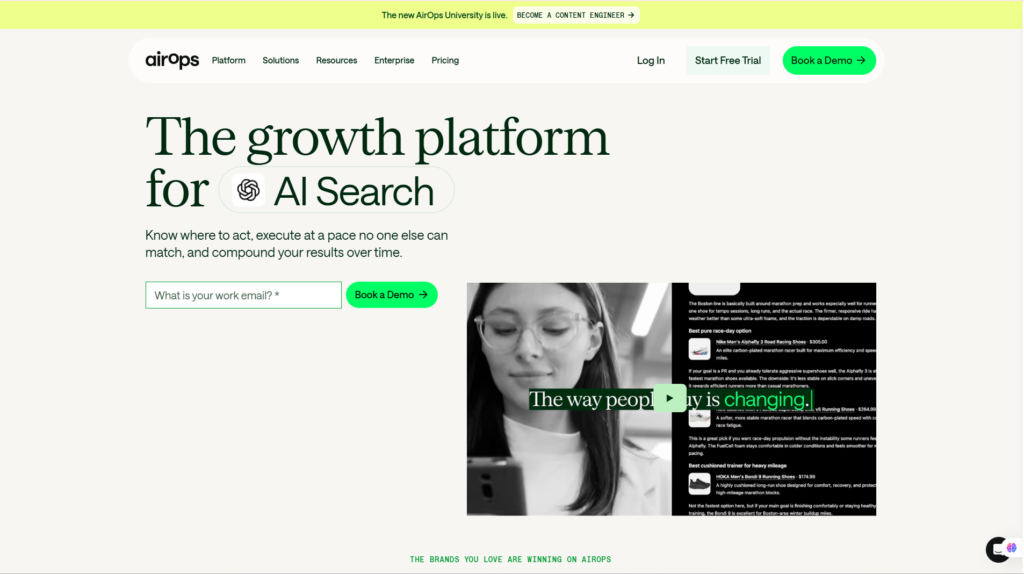
AI-powered search is changing how brands approach content marketing. Ranking on traditional Google search results is still important, but businesses increasingly need to consider how their content appears across AI-driven discovery platforms such as ChatGPT, Gemini, Claude, and Perplexity.
This shift has created demand for a new generation of platforms designed not only to produce content, but also to help businesses understand AI search visibility, identify content opportunities, optimize existing pages, and execute content strategies at scale.
AirOps is positioned directly within this emerging category.
Rather than functioning as another basic AI writing assistant, AirOps combines AI search intelligence with scalable content workflows, content optimization, programmatic content creation, and integrations with existing SEO and CMS tools.
In this AirOps review, we’ll examine what the platform does, who it is designed for, its key strengths and limitations, pricing approach, major features, and how it compares with popular alternatives.
The central question is simple:
Is AirOps worth using in 2026, especially for businesses investing in SEO and AI Search optimization?
Key Takeaways
- AirOps combines AI Search intelligence with content execution, allowing teams to move from identifying opportunities to creating or optimizing content through repeatable workflows.
- Its biggest strength is scalable content operations, making it particularly relevant for organizations managing hundreds or thousands of pages.
- AirOps is best suited to SEO, content, growth, and agency teams rather than casual bloggers looking for a simple AI writing tool.
- The platform supports content creation, optimization, refresh workflows, programmatic SEO, AI visibility analysis, and integrations with existing marketing technology.
- Its main trade-off is complexity: smaller teams may find simpler SEO or AI writing platforms easier and more cost-effective.
AirOps Quick Verdict
AirOps sits somewhere between an AI Search optimization platform, an AI-powered content operations system, and a workflow automation solution for SEO and content teams.
That combination makes it considerably different from traditional AI writers.
AirOps Quick Info
| Item | Information |
| Overall Rating | 4.7/5 |
| Best For | SEO, Content & Growth Teams |
| Category | AI Search & Content Operations |
| Main Use | SEO, AEO, content creation, optimization & automation |
| Pricing Model | Usage/task-based packages |
| Free Trial | 14-day trial currently referenced by AirOps |
| CMS Integrations | WordPress, Webflow, Contentful & more |
| Skill Level | Intermediate to Advanced |
| Platform | Web-based |
Our Verdict
AirOps is one of the more interesting platforms for businesses moving beyond traditional SEO toward a combined SEO + AI Search strategy.
Its strongest advantage is not simply generating AI content. The real value comes from connecting research, AI search intelligence, content creation, optimization, human review, and publishing into scalable workflows.
That makes AirOps particularly attractive to agencies, SaaS companies, publishers, and marketing teams managing substantial content libraries.
However, the same capabilities that make AirOps powerful may also make it excessive for individual bloggers or small businesses that only need occasional AI-generated articles.
For teams serious about scaling content operations and improving visibility across both traditional and AI-powered search environments, AirOps deserves serious consideration.
→ Visit AirOps Official Website
What Is AirOps?
AirOps is an AI Search and content operations platform designed to help marketing teams understand search opportunities and turn those insights into scalable content workflows.
Traditional content production often requires marketers to move between multiple disconnected tools.
A typical SEO workflow might involve keyword research in one platform, competitor analysis in another, content briefs in spreadsheets, AI writing in a separate application, optimization in another SEO tool, manual editorial review, and finally publishing through a CMS.
Managing this process becomes increasingly difficult as a website grows.
AirOps attempts to bring more of these activities together through AI-powered workflows.
Instead of treating artificial intelligence as a standalone writing assistant, the platform allows teams to build repeatable processes for researching, creating, optimizing, refreshing, reviewing, and managing content.
What Problem Does AirOps Solve?
The fundamental problem AirOps addresses is content operations at scale.
Producing ten articles manually is relatively manageable.
Managing hundreds or thousands of product pages, landing pages, comparison pages, knowledge-base articles, or SEO posts is much more complicated.
Teams must continually answer questions such as:
- Which existing pages should be refreshed?
- Where are competitors outperforming the brand?
- What topics are becoming important in AI Search?
- Which pages need additional information?
- How can content updates be performed consistently?
- How can AI-generated output remain aligned with brand guidelines?
- How can repetitive SEO tasks be automated without eliminating human oversight?
AirOps provides workflows designed to help teams systematize these processes.
A simplified AirOps content operation might look like:
Research & Data → AI Workflow → Content Creation or Optimization → Human Review → CMS Publishing → Performance Measurement → Content Refresh
This workflow-oriented approach is one of the most important distinctions between AirOps and conventional AI writing tools.
How Does AirOps Work?
At the center of AirOps is the idea of transforming repetitive content tasks into reusable AI workflows.
A team might, for example, create a workflow that analyzes an existing URL, identifies content gaps, collects relevant information, generates recommended updates, applies brand guidelines, and prepares the revised content for editorial review.
Instead of repeating the same process manually for every page, the workflow can potentially be applied across a much larger content library.
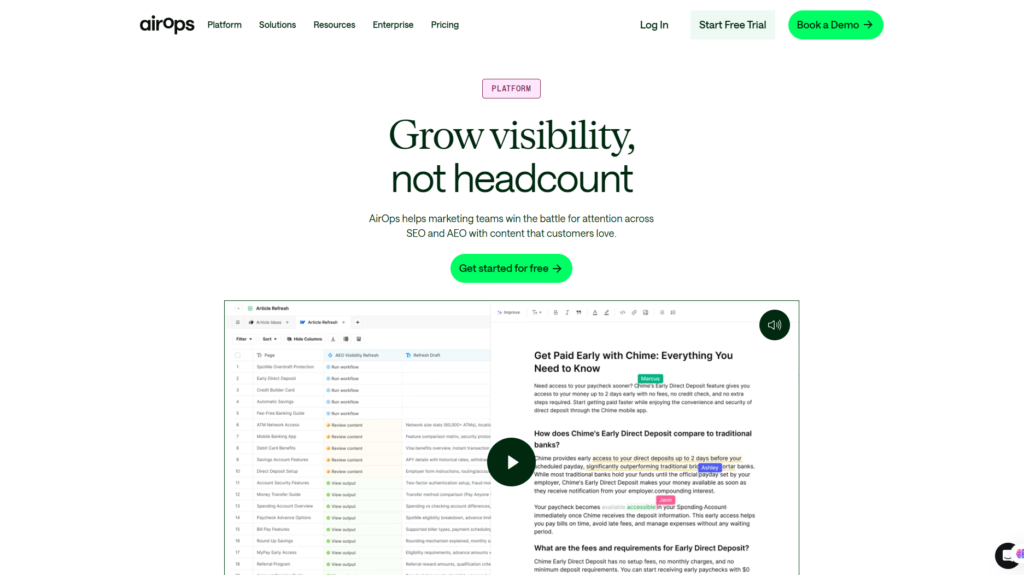
AirOps also provides Grid, an environment designed to help teams organize and execute workflows at scale.
Grid can serve as an operational workspace where content teams manage inputs, run AI-powered processes, review outputs, and maintain human oversight before content moves into production.
This is particularly valuable for organizations where AI is being integrated into an existing editorial process rather than being allowed to publish content automatically without supervision.
What Makes AirOps Different?
AirOps’ key differentiator is the connection between intelligence and execution.
Many SEO platforms are excellent at identifying problems.
They can tell marketers that competitors rank for certain keywords, that an article lacks particular topics, or that a page has lost organic traffic.
Other AI tools are excellent at generating text.
AirOps attempts to connect these two sides of the process.
Its platform can support activities such as:
- AI Search visibility analysis
- SEO and AEO content optimization
- Content creation
- Content refreshing
- Programmatic content
- Reusable AI workflows
- Brand knowledge and governance
- Human-in-the-loop review
- CMS integrations
- SEO data integrations
This creates an important distinction:
AirOps is designed not only to tell teams what content opportunities exist, but also to help them execute those opportunities at scale.
That positioning makes the platform particularly relevant as search evolves beyond traditional blue-link Google results toward AI-generated answers and recommendation systems.
Who Should Use AirOps?
AirOps is not designed equally for every type of user.
Its strongest value proposition appears when content production and optimization become operational challenges rather than occasional tasks.
AirOps Is Best For
SEO Teams
SEO professionals managing large websites can use AirOps to systematize content optimization, refresh existing pages, research opportunities, and incorporate AI Search into broader organic search strategies.
Content Marketing Teams
Organizations producing significant volumes of content can build repeatable workflows instead of manually repeating the same research, briefing, optimization, and updating processes.
Growth Marketing Teams
AirOps can be useful when organic growth depends on continuously identifying new search opportunities and turning them into executable content strategies.
Digital Marketing Agencies
Agencies often manage similar SEO and content processes across multiple clients. Reusable workflows may help standardize those processes while maintaining human review.
SaaS Companies
Software companies frequently maintain large collections of landing pages, integration pages, comparison pages, use-case pages, help documentation, and blog content. These environments are well suited to scalable content operations.
Publishers and Large Websites
Websites containing hundreds or thousands of URLs can benefit more from automation than businesses managing only a small number of pages.
Programmatic SEO Teams
Companies building structured landing pages around products, locations, integrations, categories, or datasets may find AirOps’ workflow-oriented approach particularly useful.
Teams Investing in AI Search and AEO
AirOps is also relevant to businesses that want to understand and improve how their brands appear across AI-powered search and discovery environments rather than relying exclusively on traditional Google rankings.
Who Should Skip AirOps?
Despite its capabilities, AirOps will not be the right choice for everyone.
Casual bloggers who publish only a few articles per month may not need a sophisticated content operations platform.
Complete beginners may also prefer simpler tools with fewer workflow concepts and a shorter learning curve.
Likewise, a small business that only wants to generate an occasional blog post or social media caption would probably gain more value from a straightforward AI writing assistant.
AirOps may also be less attractive to users who want a simple, predictable low-cost subscription without needing to think about workflow volume or task usage.
The key question is therefore not simply whether AirOps is powerful.
It clearly offers substantial capabilities.
The more important question is whether your content operation is large or complex enough to benefit from those capabilities.
For organizations managing substantial SEO programs, large content libraries, programmatic pages, or emerging AI Search strategies, the answer may increasingly be yes.
For smaller users, a simpler platform may provide better value.
Key Features of AirOps
The feature set is where AirOps begins to separate itself from conventional AI writing platforms.
Instead of focusing primarily on generating individual articles, AirOps is designed around a broader content operations model. It combines AI Search intelligence, workflow automation, content creation, optimization, refreshing, brand governance, and integrations to help teams execute content strategies at scale.
Here are the most important AirOps features to consider.
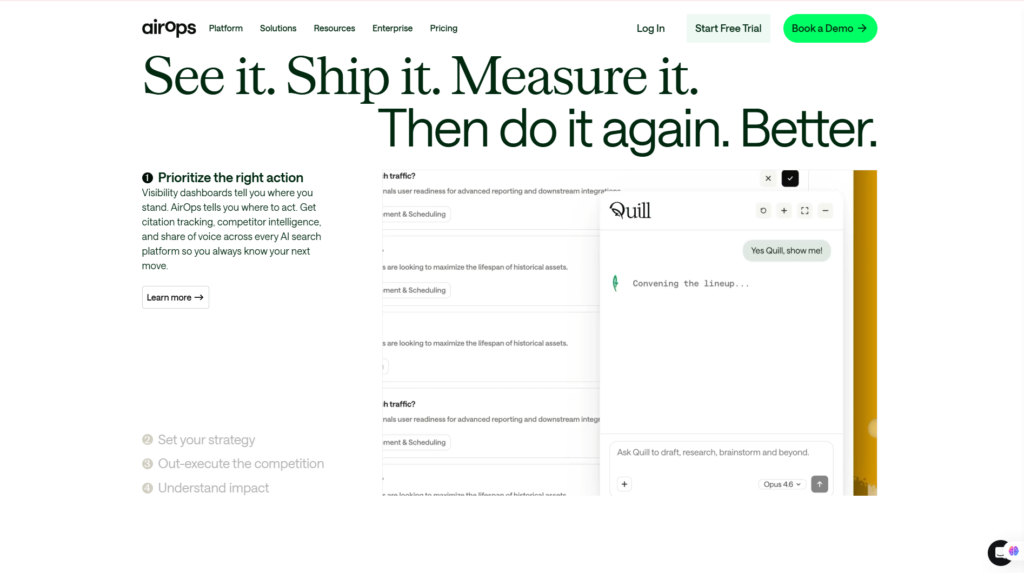
1. AI Search Visibility and Competitive Intelligence
One of the most relevant AirOps capabilities in 2026 is its focus on AI Search visibility.
Traditional SEO strategies have largely focused on rankings, organic traffic, backlinks, and keyword positions in Google. However, users increasingly discover brands and products through AI-generated answers from platforms such as ChatGPT, Gemini, Claude, and Perplexity.
That creates a new challenge for marketers: understanding whether their brand is being mentioned, cited, or recommended within AI-generated responses.
AirOps is designed to help teams investigate this emerging search environment.
The platform can help marketers analyze AI visibility, understand where competitors may be outperforming their brand, identify relevant topics, and convert those insights into actionable content opportunities.
For SEO teams, the real value is the connection between analysis and execution.
Instead of simply discovering that a competitor has stronger visibility around a particular topic, teams can use AirOps workflows to create new content or improve existing pages intended to close that gap.
2. AI-Powered Content Workflows
Workflow automation is arguably the core of the AirOps value proposition.
Most marketers already know how to ask an AI assistant to create an article, summarize a page, generate a title, or suggest keywords. The problem appears when those tasks need to be repeated hundreds or thousands of times while maintaining consistent standards.
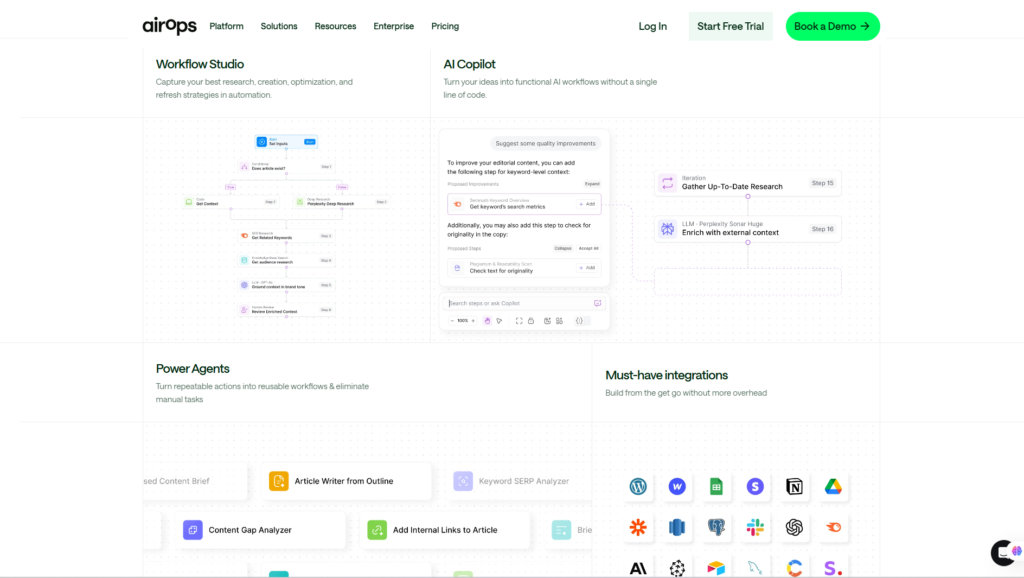
AirOps allows teams to turn repeatable content processes into structured AI workflows.
For example, a content optimization workflow could potentially follow a sequence such as:
Import URL → Analyze Existing Content → Gather Relevant Data → Identify Content Gaps → Generate Recommendations → Update Content → Apply Brand Guidelines → Human Review
The benefit is not simply speed.
Standardized workflows can also improve consistency because teams define how tasks should be completed instead of relying on individual prompts created from scratch every time.
Potential workflow applications include:
- Content research
- Article briefs
- Content creation
- Existing-page optimization
- Content refreshes
- Data extraction
- Content enrichment
- Metadata generation
- Product or category descriptions
- Programmatic SEO pages
- Internal content operations
For organizations managing substantial content libraries, this reusable workflow architecture may provide considerably more value than standalone AI generation.
3. AirOps Grid
AirOps Grid provides an operational workspace for managing AI-powered content processes at scale.
A simple AI chat interface works well when one person is handling one prompt at a time. It becomes much less practical when a team needs to process hundreds of URLs, products, keywords, or content records.
Grid addresses this problem by giving teams a structured environment where inputs and outputs can be organized and workflows can be executed across larger datasets.
For example, an SEO team could maintain a collection of existing URLs inside Grid and run a content-refresh workflow across selected pages. The resulting recommendations or updated content could then be reviewed before being moved into the publishing process.
This model is especially important for human-in-the-loop AI.
Rather than treating automation as a replacement for editors, AirOps can be incorporated into workflows where AI handles repetitive or data-intensive stages while humans remain responsible for reviewing important outputs.
That distinction matters for businesses concerned about content quality, brand reputation, factual accuracy, and large-scale AI publishing.
For agencies, publishers, SaaS companies, and enterprise content teams, Grid may be one of the strongest reasons to consider AirOps over a basic AI writer.
4. Content Creation and Programmatic SEO
AirOps can also support the creation of new content at scale.
This is particularly relevant for programmatic SEO, where businesses generate structured pages based on repeatable templates and datasets.
Potential examples include:
- Product pages
- Integration pages
- Location pages
- Industry pages
- Comparison pages
- Use-case pages
- Category pages
- Glossaries
- Directory content
The objective is not simply to generate thousands of pages because AI makes it technically possible.
Effective programmatic SEO still requires useful data, differentiated content, appropriate search intent, quality control, and a legitimate reason for each page to exist.
AirOps’ workflow model can help teams combine structured information, AI generation, brand instructions, and editorial review into a repeatable production process.
This makes the platform potentially useful for companies that need to scale content without manually building every page from the beginning.
However, users should still prioritize content usefulness over volume. Automation does not eliminate the need for editorial judgment or compliance with search-engine quality guidelines.
5. Content Refresh and Optimization
Creating new content receives much of the attention in AI marketing, but updating existing content can often be equally important.
Websites frequently accumulate hundreds of older pages that gradually become outdated.
Statistics change. Products evolve. Competitors publish stronger resources. Search intent shifts. New questions appear. Pages that once performed well can eventually lose visibility.
AirOps can help teams build systematic content refresh workflows.
A simplified process could look like:
Existing Page → Analyze Content → Identify Gaps → Research New Information → Generate Updates → Review → Republish
This becomes especially valuable when a website has a large content inventory.
Instead of manually reviewing every article, teams can prioritize pages based on performance or business value and apply standardized optimization processes.
For established websites, this capability may provide more practical value than continuously producing new AI-generated articles.
It also supports a more sustainable SEO strategy: improve valuable existing assets while creating new pages only when there is a genuine content opportunity.
6. Brand Knowledge and Governance
One of the major risks of scaling AI-generated content is inconsistency.
Without clear guidance, different AI workflows can produce content with different tones, terminology, positioning, and quality standards.
AirOps addresses this through brand context and governance capabilities designed to help teams keep AI-assisted outputs aligned with their organization.
Depending on the workflow, teams can incorporate elements such as:
- Brand voice
- Writing style
- Company information
- Product positioning
- Preferred terminology
- Editorial instructions
- Content rules
This is particularly useful for organizations where multiple employees or workflows contribute to the same website.
AI can accelerate production, but brand governance helps prevent scale from becoming inconsistency.
For agencies managing multiple clients, maintaining separate brand contexts may also help ensure that content does not sound identical across different businesses.
7. Integrations With Your Existing Content Stack
A content automation platform becomes significantly more useful when it can work with the tools a company already uses.
AirOps provides integrations across several parts of the modern content and SEO technology stack.
Relevant examples include CMS platforms such as:
- WordPress
- Webflow
- Contentful
- Sanity
- Ghost
- Strapi
It can also work alongside SEO and data tools such as:
- Google Search Console
- Ahrefs
- Semrush
Additional integrations can connect content operations with tools used for project management, databases, and communication.
The practical benefit is reduced manual copying between applications.
For example:
CMS Content → AirOps Workflow → AI Optimization → Human Review → CMS
This can make AirOps more valuable to established marketing teams than isolated AI applications that require users to manually move information between multiple systems.
AirOps Setup and User Experience
AirOps offers significantly more operational depth than a basic AI writing assistant, and that naturally affects the learning curve.
Account Setup
Getting value from AirOps is not simply a matter of opening a chat window and entering a prompt.
Teams first need to understand what they want to automate.
That may involve identifying repetitive content processes, deciding what information should enter each workflow, determining where human review is required, and connecting relevant CMS or SEO tools.
This requires more planning upfront, but the investment becomes easier to justify when the same workflow will be repeated many times.
Learning Curve
For beginners, AirOps may initially feel more complicated than tools designed around a simple prompt-and-response interface.
Concepts such as workflows, data inputs, structured processes, Grid operations, integrations, and content governance require some familiarity.
However, this complexity is closely connected to the platform’s scalability.
A useful way to think about AirOps is:
The more complex your content operation becomes, the more valuable structured workflows become.
Solo bloggers publishing a handful of posts may never need this level of infrastructure. An agency or SaaS company managing thousands of URLs may view the same capabilities very differently.
Interface and Workflow Design
AirOps is built around structured content operations rather than isolated AI conversations.
This means users can think in terms of systems:
Input → Research → Transformation → AI Generation → Quality Control → Output
That approach can provide greater consistency and repeatability than manually prompting an AI assistant for every individual task.
Our UX Analysis
We rate the overall AirOps user experience highly for its intended audience, but it should not be confused with beginner-level simplicity.
The platform appears most valuable when users invest time in designing repeatable workflows and connecting AirOps to their existing content stack. Teams familiar with SEO operations, CMS platforms, spreadsheets, structured data, and automation concepts should adapt more quickly.
Beginners may need additional onboarding before they can take advantage of the platform’s more advanced capabilities.
Ease of Use Score: 4.2/5
AirOps Pros and Cons
No AirOps review would be complete without examining where the platform performs well and where potential buyers should be cautious.
Pros
- Strong AI Search focus: AirOps is positioned for the shift from traditional SEO toward Google plus AI-driven discovery.
- Powerful content workflows: Repetitive processes can be transformed into reusable AI-assisted workflows.
- Excellent scalability: Particularly relevant for organizations managing large content libraries.
- Content refresh capabilities: Useful for systematically improving existing SEO assets.
- Programmatic content support: Suitable for structured content strategies involving large numbers of pages.
- Human-in-the-loop workflows: Teams can retain editorial oversight instead of relying on uncontrolled automated publishing.
- Brand governance: Helps maintain consistency when AI content production expands.
- Strong integrations: Connections with CMS and SEO platforms can reduce repetitive manual work.
- Combines intelligence with execution: AirOps aims to help teams act on search opportunities rather than merely identify them.
- Suitable for professional teams: The platform is particularly compelling for agencies, SaaS businesses, publishers, and growth organizations.
Cons
- Steeper learning curve: AirOps is more complex than basic AI writers.
- Potential overkill for small websites: Bloggers publishing only a few articles each month may not need workflow infrastructure.
- Pricing is less immediately transparent: Users looking for a simple fixed monthly subscription may prefer platforms with conventional public pricing tiers.
- Workflow setup requires planning: The platform becomes most valuable when teams know which processes they want to automate.
- Value increases with scale: Smaller content operations may struggle to justify the same level of investment as agencies or enterprise teams.
Overall, these limitations do not necessarily indicate weaknesses in the platform itself. They largely reflect the type of customer AirOps is designed to serve.
AirOps Pricing and Value for Money
AirOps pricing deserves careful consideration because it does not follow the simple model used by many consumer AI applications.
How AirOps Pricing Works
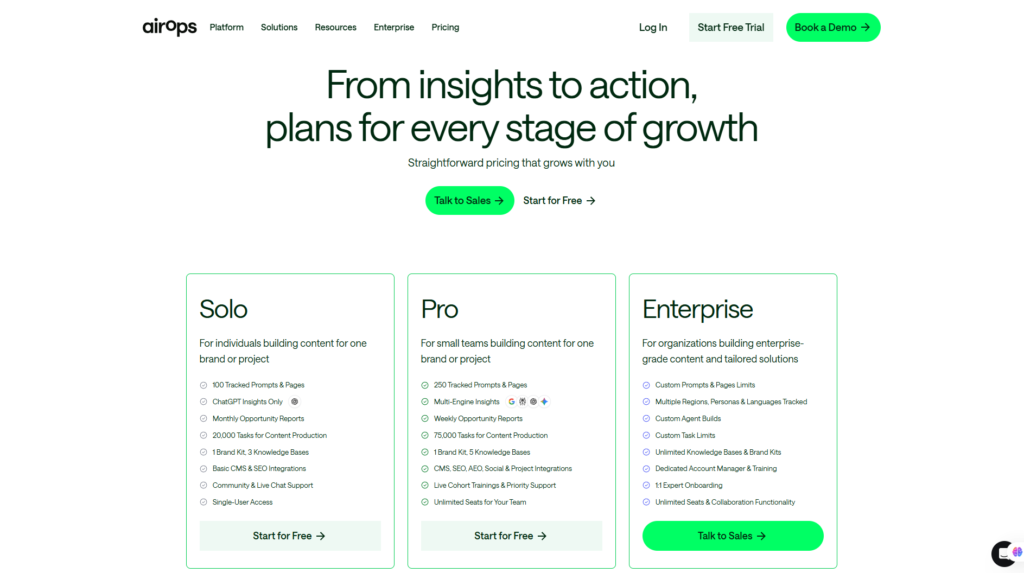
AirOps currently uses a model based around tasks and usage requirements, with packages depending on factors such as the volume and complexity of the work being performed.
A task can represent an operation performed through the platform, such as generating content or processing information within a workflow.
This model makes sense for a platform designed around large-scale automation because two companies can have dramatically different requirements.
A small content team refreshing dozens of pages has different infrastructure needs from an enterprise organization processing thousands of content assets.
The trade-off is pricing transparency.
Users accustomed to seeing a straightforward “$20/month” or “$49/month” subscription may need to evaluate their expected workflow volume before understanding the real cost of AirOps.
Because SaaS pricing can change, businesses should always check the current official AirOps pricing information before making a purchasing decision.
Does AirOps Have a Free Trial?
AirOps currently references a 14-day free trial, giving prospective customers an opportunity to explore the platform before making a longer-term commitment.
Trial conditions and availability can change, so users should verify the latest offer directly on the official website.
Is AirOps Worth the Price?
The answer depends heavily on scale.
For an individual blogger producing four articles per month, AirOps may provide far more functionality than necessary.
For an agency managing dozens of clients, a SaaS company maintaining hundreds of landing pages, or an enterprise team responsible for thousands of URLs, the economics can look very different.
The platform becomes easier to justify when automation reduces repetitive research, content production, optimization, and updating work across a substantial content library.
In that environment, the relevant calculation is not simply:
“How much does AirOps cost per month?”
A better question is:
“How much time and operational cost can AirOps save across our entire content workflow?”
AirOps Value Assessment
| User Type | Value |
| Casual Blogger | ★★☆☆☆ |
| Solo Content Creator | ★★★☆☆ |
| Small SEO Team | ★★★★☆ |
| SaaS Company | ★★★★★ |
| SEO Agency | ★★★★★ |
| Large Publisher | ★★★★★ |
| Enterprise Content Team | ★★★★★ |
| Programmatic SEO Team | ★★★★★ |
For the right organization, AirOps has the potential to replace or streamline multiple manual steps rather than simply adding another AI subscription to the technology stack.
That is ultimately where its value proposition becomes strongest.
→ Explore AirOps Pricing and Features on the Official Website
AirOps Performance Evaluation
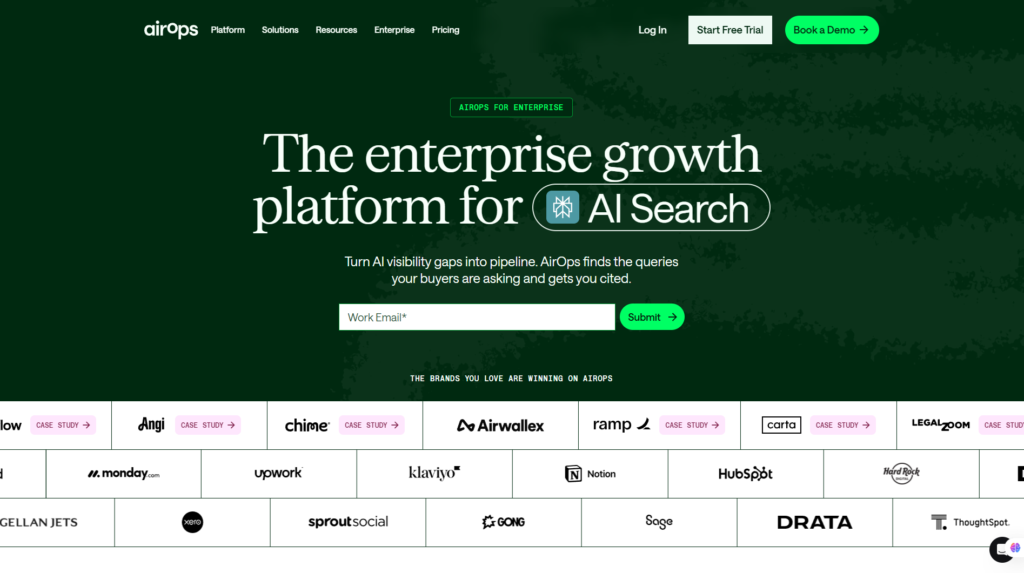
AirOps is difficult to evaluate using the same criteria as a conventional AI writing tool because its value extends beyond text generation. The platform is designed to connect AI Search intelligence, content workflows, optimization, automation, and publishing processes.
For this AirOps review, our assessment focuses on the platform’s documented capabilities, workflow architecture, integration ecosystem, market positioning, and suitability for different types of content teams.
AirOps Score Breakdown
| Category | Score |
| Ease of Use | 4.2/5 |
| Content Workflows | 4.9/5 |
| AI Capability | 4.8/5 |
| SEO & AEO | 4.9/5 |
| Integrations | 4.8/5 |
| Scalability | 4.9/5 |
| Pricing Transparency | 3.8/5 |
| Overall Rating | 4.7/5 |
The strongest areas are content workflows, scalability, and the platform’s increasing emphasis on AI Search.
Ease of use receives a slightly lower score because AirOps is fundamentally more sophisticated than a typical prompt-based AI writer. That complexity can be an advantage for professional teams but may create a higher barrier to entry for beginners.
Pricing transparency is another area where some potential customers may want more clarity before committing, particularly when compared with SaaS products offering simple fixed monthly plans.
Evaluation Methodology
Flowcrai’s evaluation is based on publicly available information rather than unsupported claims of extensive hands-on testing.
Our assessment considers:
- Official AirOps product information
- Official feature documentation
- Pricing information
- Workflow capabilities
- CMS and SEO integrations
- AI Search positioning
- Content operations functionality
- Market positioning
- Suitability for different customer segments
- Comparison with competing SEO and content platforms
Scores should therefore be interpreted as an editorial assessment of AirOps’ capabilities and overall value proposition rather than laboratory benchmarks.
AirOps vs Competitors
AirOps operates across several software categories, which means there is no single perfect alternative.
Some competitors focus primarily on SEO content optimization. Others provide keyword and competitive intelligence, while some specialize in AI writing or workflow automation.
The right AirOps alternative therefore depends on what you actually need.
AirOps Comparison Table
| Platform | Best For | Main Strength | Learning Curve |
| AirOps | Content teams operating at scale | AI Search + content workflows | Medium–High |
| Surfer | SEO writers & content teams | On-page content optimization | Medium |
| Clearscope | Professional editorial teams | Content optimization | Medium |
| Frase | Bloggers & small content teams | Research + optimization | Low–Medium |
| Semrush | SEO & digital marketing teams | Broad SEO intelligence suite | Medium–High |
These platforms should not be considered exact substitutes. Instead, each solves a different portion of the SEO and content operations problem.
AirOps vs Surfer
Surfer is primarily known for helping writers and SEO teams optimize individual pages around search intent and competing content.
Its workflow is relatively straightforward: analyze the SERP, understand recommended topics and terms, write or optimize content, and improve the page’s content score.
AirOps approaches the problem from a broader operational perspective.
Rather than concentrating mainly on optimizing one article at a time, AirOps is better suited to organizations that want to build repeatable processes across many URLs.
Choose Surfer if: your priority is optimizing individual SEO articles through a structured content editor.
Choose AirOps if: your priority is automating and scaling content research, creation, optimization, refreshing, and AI Search workflows across a larger content operation.
AirOps vs Clearscope
Clearscope is another respected content optimization platform used by professional SEO and editorial teams.
Its strengths center on content research, relevance, and helping writers produce pages that comprehensively address a topic.
AirOps extends further into workflow automation.
For example, a team may use AirOps not only to identify what should change on a page but also to build a reusable process for analyzing, updating, reviewing, and managing hundreds of pages.
Choose Clearscope if: your main requirement is high-quality content optimization within an editorial workflow.
Choose AirOps if: you need broader automation and want to operationalize content optimization at scale.
AirOps vs Frase
Frase may be more approachable for bloggers, freelancers, and smaller content teams.
It combines content research, briefs, optimization, and AI-assisted writing within an interface designed around producing individual pieces of content.
That makes Frase attractive when simplicity and accessibility are priorities.
AirOps is likely to appeal to a different customer profile.
Its workflow infrastructure, Grid environment, integrations, content refresh capabilities, and AI Search focus make it better suited to larger and more sophisticated content operations.
Choose Frase if: you want an easier content research and optimization platform for individual articles.
Choose AirOps if: you want to transform recurring SEO and content processes into scalable AI workflows.
AirOps vs Semrush
Semrush is the broadest platform in this comparison.
It covers a large range of digital marketing activities, including keyword research, competitive analysis, backlinks, site auditing, rank tracking, content marketing, and advertising research.
AirOps has a narrower but more operational focus.
A useful distinction is:
Semrush helps teams understand the search landscape. AirOps focuses more heavily on turning content opportunities into repeatable AI-assisted workflows.
The two platforms may therefore complement each other rather than compete directly.
A marketing team could use SEO intelligence from established platforms while using AirOps to execute content workflows based on that information.
Choose Semrush if: you need a comprehensive SEO and competitive intelligence toolkit.
Choose AirOps if: you already understand what needs to be done but need a scalable system for executing content and AI Search strategies.
Which AirOps Alternative Should You Choose?
The decision becomes easier when matched to the primary use case:
Choose AirOps → AI Search optimization + scalable content operations.
Choose Surfer → SEO optimization for individual articles.
Choose Clearscope → professional editorial content optimization.
Choose Frase → simpler research, briefs, and AI-assisted content production.
Choose Semrush → comprehensive SEO, competitive research, and digital marketing intelligence.
For organizations managing large content libraries, AirOps has one major advantage: it is designed around repeatable execution at scale, not simply analysis or page-by-page optimization.
Frequently Asked Questions About AirOps
What Is AirOps Used For?
AirOps is an AI Search and content operations platform designed to help marketing teams research opportunities, create and optimize content, refresh existing pages, automate repetitive content processes, and manage AI-powered workflows at scale.
It is particularly relevant for SEO, content, growth, agency, and enterprise marketing teams.
Is AirOps an AI Writing Tool?
AirOps can use AI for content generation, but describing it simply as an AI writer understates the platform.
Its broader value comes from combining AI with structured workflows, content optimization, programmatic content, brand governance, integrations, AI Search intelligence, and large-scale content operations.
Users who only need basic AI writing may find simpler tools more appropriate.
Is AirOps Good for SEO?
AirOps can be particularly useful for SEO teams managing large content inventories.
Potential applications include creating new content, optimizing existing pages, refreshing outdated content, scaling programmatic SEO initiatives, and integrating external SEO data into repeatable workflows.
However, AirOps should be considered part of an SEO technology stack rather than a replacement for every specialized SEO platform.
Can AirOps Help With AI Search and AEO?
Yes. AI Search has become an increasingly important part of AirOps’ positioning.
The platform is designed to help businesses understand visibility across AI-driven discovery environments and connect those insights with content execution.
This makes AirOps particularly interesting for companies expanding beyond conventional SEO into AEO (Answer Engine Optimization) and broader AI Search strategies.
Does AirOps Integrate With WordPress?
Yes. AirOps supports WordPress integrations alongside other content management systems.
CMS connectivity can be especially useful for teams that want to bring existing content into automated workflows, process or optimize it, conduct human review, and move completed content back toward publishing.
Is AirOps Suitable for Beginners?
AirOps can be used by less technical marketers, but complete beginners may face a steeper learning curve than they would with a basic AI writer.
The platform becomes easier to understand when users already have experience with SEO workflows, content operations, CMS platforms, structured data, or automation concepts.
For users who only want to generate occasional articles, AirOps may provide more functionality than necessary.
What Are the Best AirOps Alternatives?
Some of the strongest alternatives include Surfer, Clearscope, Frase, and Semrush, depending on the use case.
Surfer and Clearscope are strong options for content optimization, Frase offers a simpler research and content workflow, while Semrush provides a much broader SEO and competitive intelligence ecosystem.
However, businesses specifically looking for scalable AI-powered content workflows and AI Search execution may find AirOps more aligned with their needs.
Final Verdict: Is AirOps Worth It in 2026?
AirOps represents an important shift in how businesses can think about AI for content marketing.
The first generation of generative AI tools largely focused on one question:
How can AI generate content faster?
AirOps addresses a broader question:
How can AI improve and scale the entire content operation?
That distinction is important.
Best For
AirOps is particularly well suited to:
- SEO teams
- Content marketing teams
- Growth teams
- Digital marketing agencies
- SaaS companies
- Large publishers
- Enterprise marketing organizations
- Programmatic SEO teams
- Websites managing large content libraries
- Companies investing in AI Search and AEO
Not Recommended For
AirOps may be less suitable for:
- Casual bloggers
- Very small websites
- Complete beginners
- Users who only need occasional AI-generated articles
- Budget-sensitive solo creators
- Anyone looking primarily for a simple AI writing assistant
Final Recommendation
The biggest strength of AirOps is its ability to connect AI Search intelligence with content execution.
Instead of stopping at keyword research, competitor analysis, or content recommendations, AirOps allows teams to build repeatable workflows for creating, optimizing, refreshing, and managing content at scale.
Its Grid environment, workflow automation, programmatic content capabilities, brand governance, and integrations make the platform particularly compelling for organizations where content has become a genuine operational system rather than an occasional marketing activity.
There are trade-offs.
AirOps has a steeper learning curve than basic AI writing tools, and its usage-oriented pricing approach may require more evaluation than a simple fixed monthly subscription. Smaller websites may therefore struggle to justify the additional complexity.
But for agencies, SaaS companies, publishers, SEO teams, and organizations managing hundreds or thousands of content assets, those same advanced capabilities can become the platform’s greatest advantage.
As search continues evolving toward a combination of traditional Google SEO and AI-powered discovery, tools that connect visibility analysis with scalable execution are likely to become increasingly valuable.
Flowcrai Rating: 4.7/5 ⭐⭐⭐⭐⭐
Bottom Line: AirOps is worth considering if your goal is not simply to generate more AI content, but to build a scalable system for SEO, AI Search optimization, content creation, and ongoing content improvement.