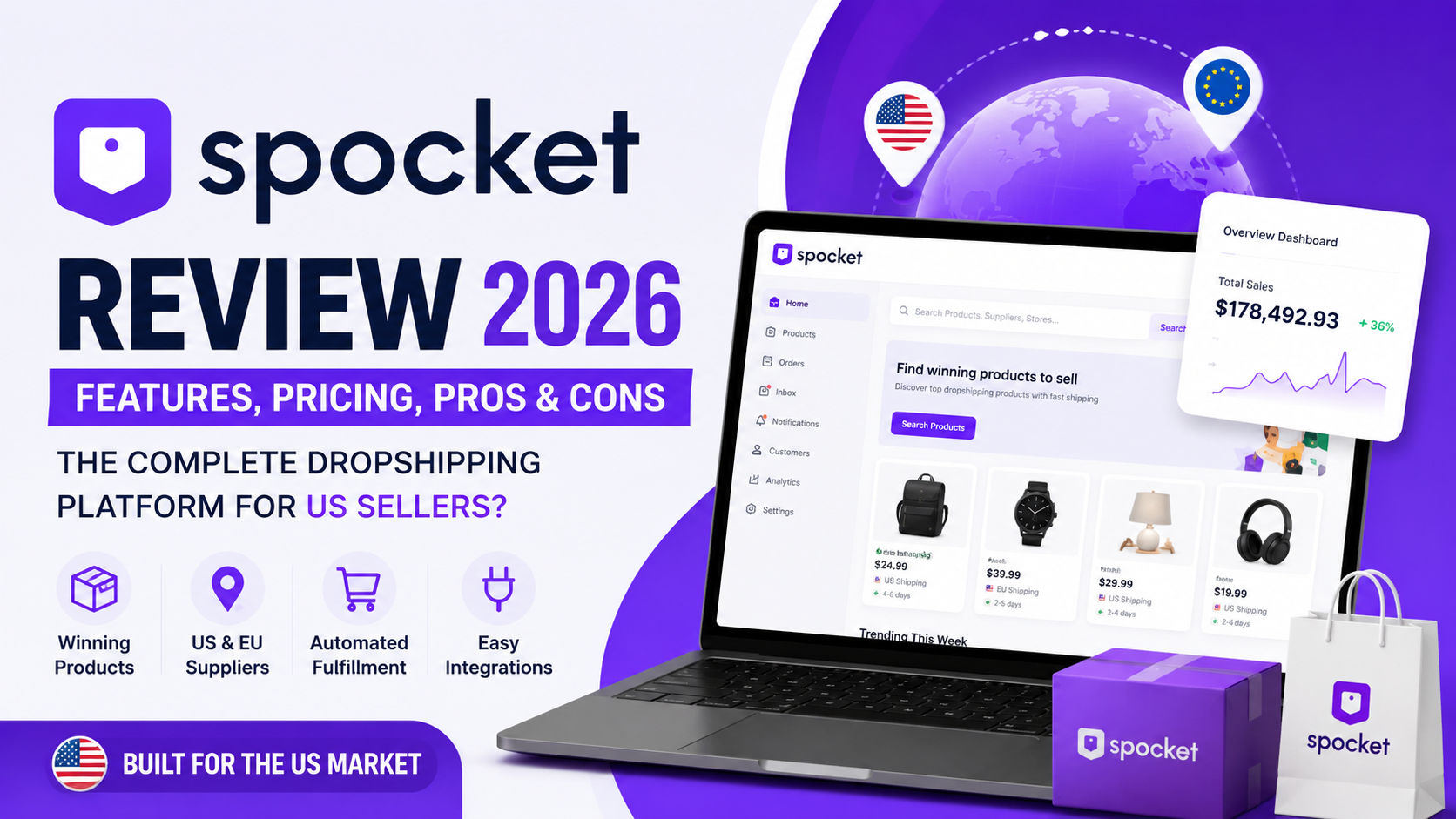
Spocket Review 2026: Features, Pricing, Pros & Cons
Finding products to sell is easy. Finding reliable suppliers, reasonable shipping options, healthy margins, and a system that can actually scale is much harder.
That is the problem Spocket is designed to solve.
Spocket is a dropshipping and eCommerce automation platform that connects online sellers with suppliers from the US, Europe, and other global markets. Instead of manually searching for products, importing listings, tracking inventory, and processing every order separately, sellers can manage much of the workflow from one platform.
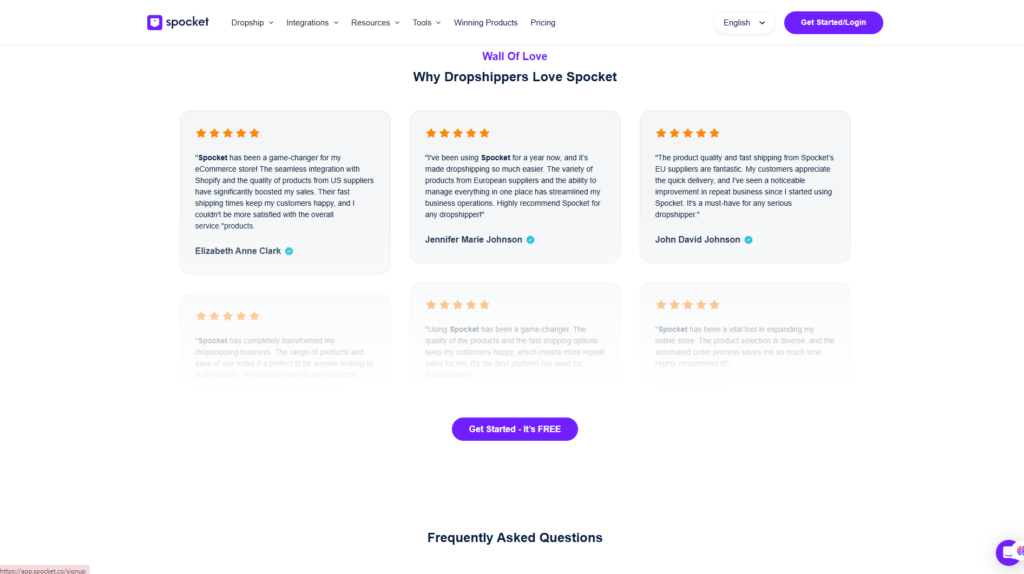
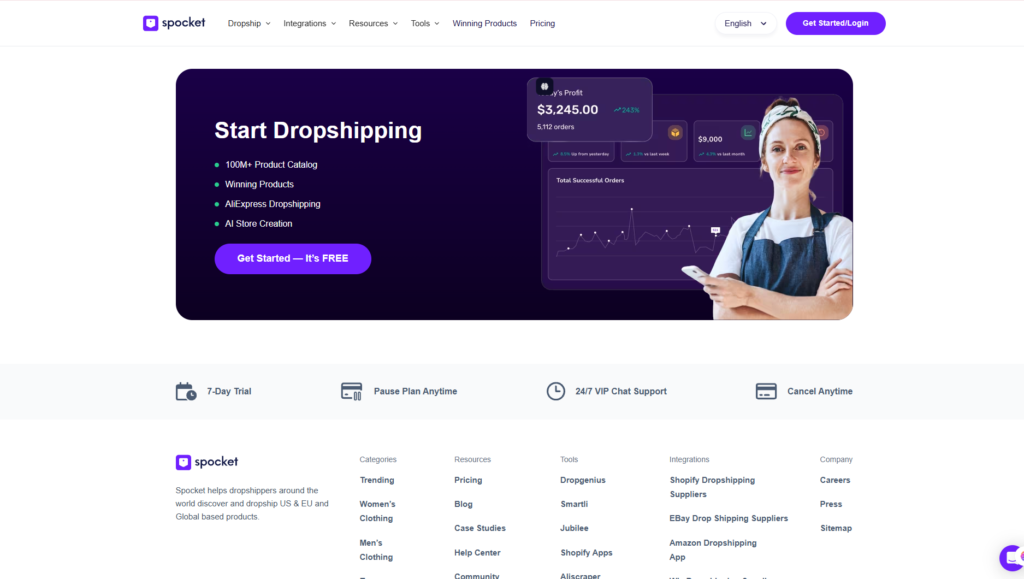
Spocket currently promotes a large product catalog, product research tools, automated dropshipping, US and EU suppliers, and integrations with popular eCommerce platforms such as Shopify, WooCommerce, Wix, BigCommerce, Squarespace, Ecwid, Square, eBay, and others.
But does that make Spocket a good choice for building a dropshipping business in 2026?
In this Spocket Review, we examine its core capabilities, supplier model, target users, advantages, limitations, pricing, and major alternatives to help you decide whether it fits your eCommerce strategy.
Overall Rating: 4.5/5
Best For: Dropshippers targeting US and European customers
Category: Dropshipping & eCommerce Automation
Free Trial: Available
Reviewed by: Team Flowcrai
Last Updated: 2026
Affiliate Disclosure: This article may contain affiliate links. If you sign up or purchase through one of these links, Flowcrai may earn a commission at no additional cost to you. Our reviews are designed to provide balanced information to help readers make informed decisions.
Key Takeaways
- Spocket combines product sourcing, supplier discovery, store integrations, and dropshipping automation in one platform.
- Its emphasis on US and EU suppliers can make it particularly attractive to sellers targeting customers in Western markets.
- Spocket supports major eCommerce platforms, including Shopify, WooCommerce, Wix, BigCommerce, Squarespace, Ecwid, Square, and eBay.
- The platform can simplify operational tasks, but it does not guarantee profitable products or a profitable dropshipping store.
- Spocket is likely to provide more value to sellers building a serious eCommerce business than to users simply experimenting with dropshipping.
Spocket Quick Verdict
Quick Info Table
| Item | Information |
| Overall Rating | 4.5/5 |
| Best For | Dropshippers and eCommerce entrepreneurs |
| Main Use | Product sourcing and dropshipping automation |
| Supplier Focus | US, Europe, and global |
| Product Research | Yes |
| Store Integrations | Shopify, WooCommerce, Wix, BigCommerce and more |
| Order Automation | Yes |
| Free Trial | Available |
| Beginner Friendly | Yes |
| Category | Dropshipping Software |
Our Verdict
Spocket is worth considering if you want to build a dropshipping business without relying entirely on manual product sourcing or a single marketplace such as AliExpress.
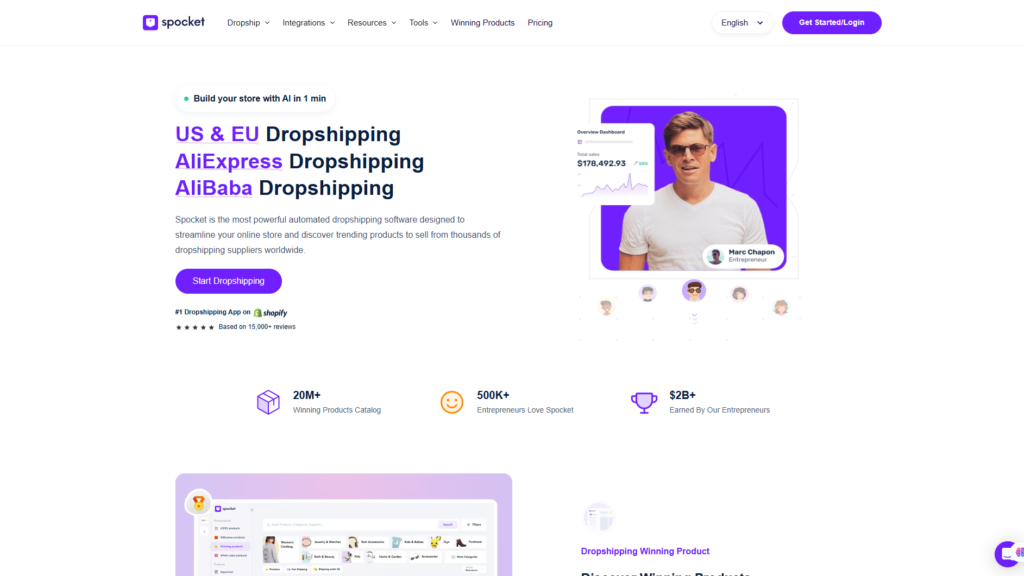
Its biggest advantage is the combination of product discovery, supplier access, store integration, and order-management tools within one ecosystem. Spocket also places strong emphasis on suppliers located in the US and Europe, which may be useful for merchants selling primarily to customers in those regions.
However, Spocket should be viewed as business infrastructure rather than a shortcut to easy income. Profitability will still depend heavily on product demand, supplier costs, shipping charges, advertising costs, pricing, conversion rates, and customer service.
Start Dropshipping with Spocket
What Is Spocket?
Spocket is a dropshipping sourcing and automation platform that helps online merchants find products from suppliers and connect those products to their eCommerce stores.
The basic dropshipping model works like this:
Supplier → Spocket → Your Online Store → Customer
You do not normally purchase large quantities of inventory upfront.
Instead, you choose products from suppliers, list those products in your online store, and market them to customers. When a customer places an order, you purchase the item from the supplier. The supplier then ships the product directly to your customer.
Spocket’s own Help Center describes the model similarly: the customer pays the retailer, the retailer purchases the product from the supplier, and the supplier ships it directly to the customer.
Spocket sits between the retailer and supplier and provides tools intended to make this process easier to manage.
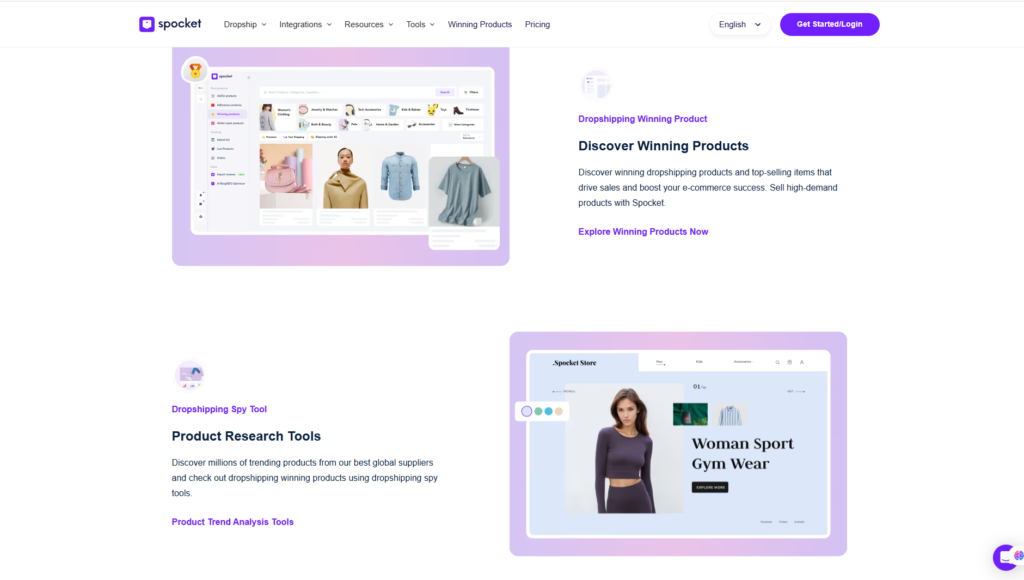
Its current platform focuses on several areas:
- Product sourcing
- Supplier discovery
- US and EU suppliers
- Global suppliers
- Product research
- Trending or “winning” product discovery
- Product importing
- Order management
- Dropshipping automation
- Inventory management
- Store integrations
- Print-on-demand options
- AI-assisted eCommerce tools
Spocket currently markets itself as an automated dropshipping platform with access to a very large product catalog and thousands of suppliers worldwide.
For that reason, it is more accurate to categorize Spocket as a:
Dropshipping & eCommerce Automation Platform
rather than simply an AI tool.
What Problem Does Spocket Solve?
The biggest challenge in dropshipping is not creating a website.
Platforms such as Shopify and WooCommerce have made launching an online store relatively accessible.
The difficult part is what happens afterward.
A typical new dropshipper may need to answer questions such as:
- What products should I sell?
- Where can I find suppliers?
- Is the supplier reliable?
- How much will shipping cost?
- How long could delivery take?
- Can I import products automatically?
- How do I keep inventory information updated?
- What happens when a customer places an order?
- How do I scale from ten products to hundreds of products?
Managing these tasks manually becomes increasingly difficult as a store grows.
Spocket tries to centralize much of that workflow.
Sellers can browse products, review supplier information, connect supported online stores, import products, manage orders, and access fulfillment-related tools from one ecosystem.
Another important problem is supplier reliability.
According to Spocket’s supplier documentation, suppliers are subject to an onboarding and review process. Spocket says its requirements include product-quality standards, supplier-controlled inventory, discounted retail pricing, and adherence to stated processing and shipping time frames.
This does not mean that every order or supplier experience will be identical. Sellers should still evaluate individual products, shipping conditions, supplier reviews, and profit margins before committing significant advertising budget.
How Does Spocket Work?
The basic Spocket workflow can be summarized in several steps.
Step 1: Create a Spocket account
You first register for Spocket and access the platform.
Spocket’s current website advertises a free signup path and a trial for its paid services.
Step 2: Connect your online store
The next step is connecting a supported eCommerce platform.
Spocket supports integrations with major platforms including Shopify, WooCommerce, Wix, BigCommerce, Squarespace, Ecwid, Square, and others.
This connection allows product and order information to move between Spocket and your storefront.
Step 3: Search for products
You can browse the product marketplace and use filters to identify products that fit your niche, target customer, supplier-location preference, and other requirements.
For example, a seller targeting US customers may prioritize products supplied domestically or from locations that provide acceptable shipping terms to the United States.
Step 4: Evaluate the supplier and economics
Finding an interesting product is only the beginning.
You should evaluate:
- Product cost
- Suggested selling price
- Potential gross margin
- Shipping cost
- Supplier location
- Processing time
- Delivery expectations
- Product reviews where available
- Competition
- Customer demand
This is an important step because a popular product is not automatically a profitable one.
Step 5: Import products to your store
Selected products can then be added to the connected eCommerce store instead of building each listing manually from scratch.
Sellers can adjust information such as product titles, descriptions, images, and retail pricing before publishing where the integration supports it.
Step 6: Market the product
After publishing, the merchant still needs to generate traffic.
That may involve:
- Google Ads
- Meta Ads
- TikTok Ads
- SEO
- Influencer marketing
- Email marketing
- Organic social media
Spocket does not replace customer acquisition.
Step 7: Process customer orders
When a customer orders from the connected storefront, order information can appear inside Spocket. Spocket states that its system can synchronize orders from connected stores and support simplified fulfillment workflows.
The supplier then handles the physical shipment to the customer according to the applicable product and shipping terms.
What Makes Spocket Different?
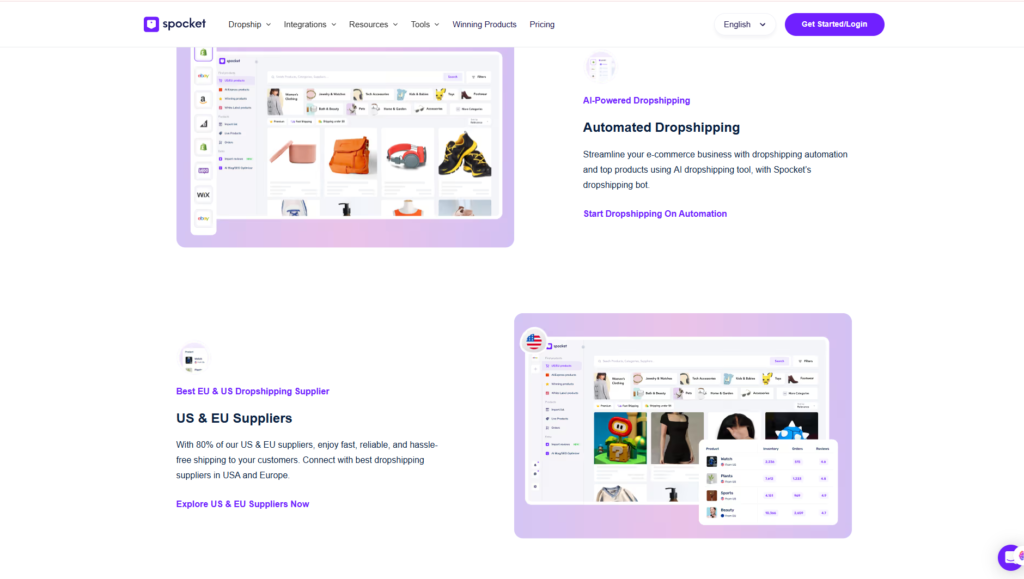
One of Spocket’s strongest positioning points is its focus on US and European suppliers.
Traditional dropshipping has often been associated with sourcing inexpensive products from China and shipping them to customers in North America or Europe.
That model can work, but it introduces potential problems such as:
- Long-distance shipping
- Variable delivery times
- Communication challenges
- Complicated returns
- Inconsistent product quality
- Difficulty creating a more premium customer experience
Spocket attempts to provide merchants with additional options by connecting them with suppliers located in the US, Europe, and other global markets.
Its supplier-vetting documentation says that many approved products are produced and shipped from Europe or North America, although actual availability depends on the specific supplier and product.
For an online store targeting customers in the United States, Canada, the United Kingdom, or European markets, having more regional sourcing choices can be strategically useful.
However, regional sourcing does not automatically mean every Spocket product will have faster or cheaper shipping.
Shipping performance still depends on:
Supplier + Warehouse Location + Product + Customer Location + Shipping Method
That distinction is important when evaluating Spocket objectively.
Another differentiator is that Spocket is not limited to supplier discovery.
The broader value proposition includes:
Product Sourcing + Supplier Network + Store Integration + Order Management + Automation
Spocket also allows users to order product samples directly through the platform, which can help merchants inspect products and supplier performance before scaling a listing.
For merchants who want to create original product photographs, videos, or advertising creatives, sample ordering can also be valuable.
Explore Spocket Products & Suppliers
Who Should Use Spocket?
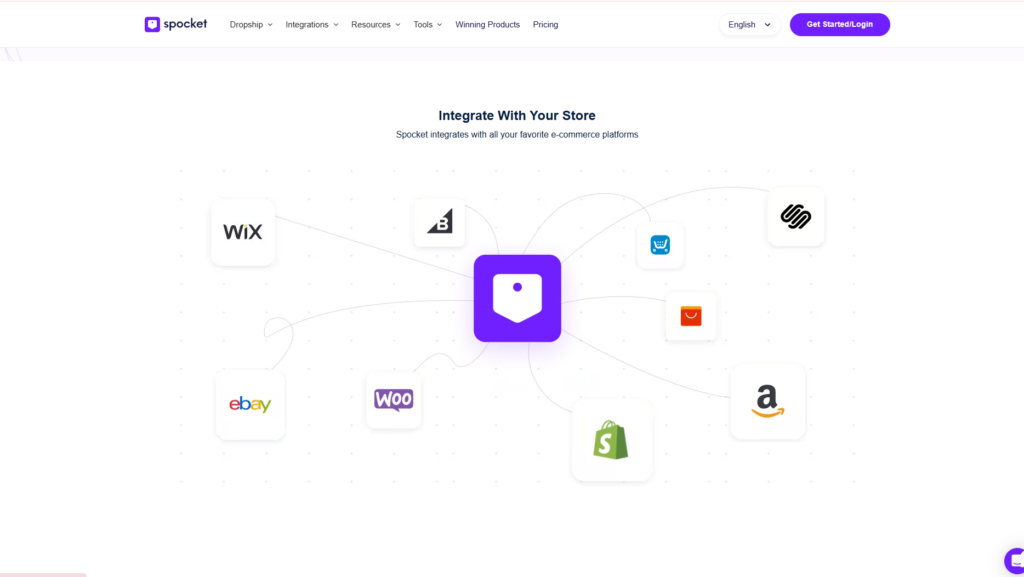
Spocket can serve several types of eCommerce users, but it is particularly relevant to sellers who want to operate a dropshipping model without managing every sourcing and fulfillment task manually.
Beginners Starting a Dropshipping Store
Spocket can be useful for beginners because it brings multiple parts of the dropshipping workflow into one platform.
Instead of separately searching for suppliers, copying product information, and manually transferring order details, beginners can work within a more structured system.
Spocket’s Help Center outlines a simplified launch process built around registration, store integration, product selection, pricing review, and store launch.
That does not eliminate the need to learn eCommerce fundamentals, but it may reduce some of the technical friction involved in getting started.
Shopify Store Owners
Shopify merchants are one of the most obvious target audiences.
A Shopify seller can connect a store with Spocket, source products, publish selected products, and manage orders through the connected workflow.
This can be particularly useful for merchants who want access to more supplier options without operating their own warehouse.
WooCommerce Users
Spocket is also relevant to WordPress and WooCommerce store owners.
WooCommerce offers greater control over the website itself, while Spocket can provide the product-sourcing and dropshipping layer.
This combination may appeal to sellers who want more control over SEO, content, website design, and conversion optimization than a closed eCommerce ecosystem sometimes provides.
Sellers Targeting US and European Customers
This is arguably one of Spocket’s strongest use cases.
Spocket actively positions its marketplace around US, European, and global suppliers.
A merchant selling primarily to customers in the US, UK, Canada, or Europe may therefore find Spocket particularly relevant when supplier location is an important selection criterion.
eCommerce Entrepreneurs Testing Multiple Niches
Spocket may also appeal to entrepreneurs testing different products without buying large quantities of inventory upfront.
Instead of committing capital to a warehouse full of unproven products, a dropshipping model allows merchants to test offers with lower inventory exposure.
The trade-off is usually less control over fulfillment and potentially thinner margins than owning the supply chain directly.
Dropshippers Looking Beyond AliExpress
Spocket may be especially interesting for sellers who do not want their sourcing strategy to depend entirely on AliExpress.
AliExpress remains a major dropshipping ecosystem, but Spocket provides access to a broader marketplace that includes US, European, and global suppliers.
This makes Spocket worth evaluating alongside platforms such as AutoDS, Zendrop, DSers, and other dropshipping solutions.
Who Should Skip Spocket?
Spocket is not the right solution for everyone.
You may want to consider another approach if:
- You need a completely free long-term dropshipping platform.
- You manufacture your own products.
- You require complete control over packaging and fulfillment.
- You operate at very high volume and need custom logistics contracts.
- Your business requires privately negotiated supplier relationships.
- Your only goal is to source the cheapest possible products.
- You expect software to automatically create a profitable dropshipping business.
This last point deserves particular attention.
Spocket can help with infrastructure and operations, but it cannot solve every business problem.
A sustainable dropshipping business still depends on:
Product Demand + Supplier Reliability + Margin + Marketing + Conversion Rate + Customer Experience
Spocket can potentially make the system easier to operate.
It cannot make the economics work for you.
That distinction is critical when deciding whether Spocket is worth paying for in 2026.
Spocket Setup & User Experience
One of the main reasons entrepreneurs use dropshipping software is to reduce the amount of manual work involved in finding products, publishing listings, and managing orders. Spocket is designed around that objective, with a workflow that connects product sourcing with an existing eCommerce store.
The overall process can be summarized as:
Create Account → Connect Store → Find Products → Import Products → Set Pricing → Publish → Manage Orders
The software itself is relatively approachable, but it is important to separate learning Spocket from learning how to run a profitable eCommerce business.
The first may be relatively straightforward. The second requires significantly more knowledge and experience.
Account Setup
Getting started begins with creating a Spocket account and connecting a supported sales channel.
Spocket currently supports integrations with platforms including Shopify, WooCommerce, Wix, BigCommerce, Squarespace, Ecwid, Square, and eBay.
Once the store is connected, users can browse products inside the Spocket catalog and evaluate potential items before adding them to their storefront.
For each potential product, sellers should pay attention to more than the product image or suggested retail price. Important factors include supplier location, shipping options, product cost, expected margin, processing time, and the market demand for the item.
The setup process is therefore technically simple, but choosing the right products still requires business judgment.
Learning Curve
Spocket should be relatively accessible for users who already understand basic eCommerce concepts.
A Shopify or WooCommerce user familiar with adding products and processing orders will likely understand the core workflow quickly.
Complete beginners may need more time because they are learning two things simultaneously:
how to use Spocket and how dropshipping works as a business model.
New sellers should understand concepts such as:
- Product margins
- Shipping costs
- Supplier reliability
- Conversion rates
- Customer acquisition cost
- Returns and refunds
- Advertising costs
- Customer support
Spocket can simplify operations, but it cannot remove these fundamental parts of eCommerce.
Ease of Use
The main advantage of using a dedicated dropshipping platform is centralization.
Instead of searching for suppliers on multiple websites, manually copying product information, and separately managing orders, Spocket brings many of these activities into a unified workflow.
The platform is designed to let sellers search and filter products, review supplier information, import listings, manage connected products, and process orders.
For a growing store, this can become considerably more practical than managing dozens or hundreds of products manually.
Interface Design
Spocket uses a dashboard-based interface centered around product discovery and store management.
For new users, the most important areas are likely to be:
- Product search
- Supplier information
- Imported products
- Store connections
- Orders
- Account and subscription settings
The interface is designed around eCommerce tasks rather than highly technical automation workflows, making Spocket more approachable than software built primarily for developers or enterprise operations.
Our Analysis
From a usability perspective, Spocket’s strongest advantage is not that it makes dropshipping effortless. Instead, it reduces operational friction by bringing supplier discovery, product importing, store integration, and order management into the same ecosystem.
That distinction matters.
Software can reduce repetitive work, but sellers are still responsible for identifying demand, creating competitive offers, generating qualified traffic, managing advertising costs, and providing customer support.
In other words:
Spocket can simplify dropshipping operations, but it cannot automate good business decisions.
Key Features of Spocket
The value of Spocket depends heavily on how much of its ecosystem you actually use.
For some sellers, access to suppliers may be the main attraction. For others, the combination of sourcing, integrations, product research, and fulfillment tools may provide greater value.
Here are the most important Spocket features to consider.
1. Product & Supplier Marketplace
At the center of Spocket is its product and supplier marketplace.
Instead of relying on a single supplier or manually negotiating with manufacturers from the beginning, users can browse products across numerous categories and evaluate options from suppliers available through the platform.
Depending on availability, product categories may cover areas such as:
- Fashion
- Beauty
- Home and garden
- Electronics
- Pet products
- Accessories
- Kids and babies
- Sports and outdoor products
- Automotive accessories
- Gifts and lifestyle products
For a dropshipper, however, having access to a large catalog is not automatically an advantage.
The real challenge is finding products with workable economics.
Before importing a product, consider:
Product Cost + Shipping Cost + Advertising Cost + Transaction Fees + Returns = Real Cost
Your retail price must provide enough margin above those expenses to make the product commercially viable.
This is why Spocket should be treated as a product sourcing tool, not a machine that automatically finds profitable products.
2. US & EU Dropshipping Suppliers
Access to suppliers located in the United States and Europe is one of Spocket’s most recognizable selling points.
This matters because traditional international dropshipping can involve long shipping routes. If the product is stored closer to the target customer, the merchant may have an opportunity to provide a more competitive delivery experience.
For example, a store primarily targeting US consumers may want to prioritize products shipped from US locations when suitable products and economics are available.
The same principle applies to European markets.
Regional sourcing may offer potential advantages such as:
- Shorter shipping routes
- Easier market targeting
- More competitive delivery expectations
- Reduced dependence on long-distance sourcing
- Potentially better customer experience
However, sellers should avoid assuming that a “US supplier” automatically means two-day delivery or that every European supplier offers fast delivery throughout Europe.
Actual shipping performance depends on:
Supplier + Product + Warehouse + Destination + Processing Time + Shipping Method
Always review the shipping information for the specific product before advertising delivery expectations to customers.
3. Winning Products & Product Research
Product selection is one of the hardest parts of dropshipping.
A seller can build an attractive store and create professional advertisements, but if the product has weak demand or poor economics, generating profitable sales can still be difficult.
Spocket includes product-discovery and research functionality intended to help merchants identify potentially interesting products and market opportunities.
This can reduce the amount of time spent browsing random supplier catalogs.
However, the phrase “winning product” should always be treated carefully.
No software can guarantee that a particular product will become profitable for your store.
A better way to evaluate a potential product is:
Demand × Offer × Price × Creative × Traffic Quality × Conversion Rate
A strong product combined with poor advertising can fail.
Likewise, a competitive market does not automatically make a product unprofitable if the seller has a differentiated offer, better creative, or stronger customer acquisition strategy.
Use Spocket’s product research as a starting point for validation, not as proof that a product will sell.
4. Automated Dropshipping & Order Fulfillment
Automation becomes increasingly important as an eCommerce store grows.
Manually transferring customer details, checking inventory, and processing individual orders may be manageable with a handful of sales. It becomes much less practical when order volume increases.
Spocket’s integrations are designed to synchronize key information between the seller’s store and the dropshipping ecosystem.
Depending on the connected platform and workflow, this can help with tasks such as:
- Product importing
- Product management
- Inventory synchronization
- Order synchronization
- Order processing
- Fulfillment workflow
- Shipment tracking
The practical benefit is simple:
less repetitive administration and more scalable operations.
That does not make the business fully passive. Merchants still need to monitor orders, supplier performance, customer issues, refunds, inventory changes, and marketing.
Automation should reduce workload—not remove oversight.
5. eCommerce Integrations
A dropshipping platform becomes much more useful when it can connect directly with the storefront where customers actually purchase products.
Spocket supports integrations across several major eCommerce ecosystems, including Shopify and WooCommerce, along with platforms such as Wix, BigCommerce, Squarespace, Ecwid, Square, and eBay.
This allows merchants to build their storefront using a familiar commerce platform while using Spocket primarily for sourcing and fulfillment-related operations.
For example:
Shopify → Storefront & Checkout
Spocket → Products, Suppliers & Dropshipping Workflow
This separation can be useful because sellers do not need to rebuild their entire business around Spocket.
Instead, Spocket becomes part of the eCommerce technology stack.
6. Branded Invoicing & Sample Orders
Dropshipping businesses often struggle with branding because the retailer does not physically handle the product before it reaches the customer.
Spocket offers branded invoicing with supported suppliers, allowing eligible orders to include elements such as the seller’s store information rather than presenting the experience as a completely generic transaction.
Availability can vary by supplier, so sellers should verify whether a specific supplier supports branded invoicing before treating it as part of their customer experience.
Another useful capability is sample ordering.
Ordering a sample before heavily promoting a product can help a merchant evaluate:
- Product quality
- Packaging
- Shipping experience
- Delivery time
- Product appearance
- Supplier consistency
Samples can also be valuable for marketing.
Instead of relying entirely on supplier images, merchants can potentially create their own:
- Product photography
- TikTok videos
- Meta Ads creatives
- YouTube demonstrations
- Landing-page images
- User-generated-style content
For sellers planning to spend significant money on advertising, ordering a sample before scaling a product can be a sensible risk-management step.
Spocket Pros and Cons
No dropshipping platform is perfect, and Spocket should be evaluated based on whether its strengths match your particular business model.
Pros
- Strong US and EU supplier positioning for sellers targeting Western markets.
- Access to a large ecosystem of dropshipping products and suppliers.
- Integrates with major eCommerce platforms.
- Product sourcing and research tools in one environment.
- Automated workflows can reduce repetitive order-management tasks.
- Relatively beginner-friendly approach to importing products.
- Sample ordering can help sellers evaluate products before scaling.
- Branded invoicing is available through supported suppliers.
- Useful for merchants seeking alternatives to AliExpress-only sourcing.
Cons
- Paid subscription costs can be significant for a new store with little or no revenue.
- Product pricing and shipping costs vary between suppliers.
- US and European products may have higher sourcing costs than ultra-low-cost alternatives.
- Access to a large catalog does not guarantee profitable products.
- Shipping speeds vary by supplier and destination.
- Branded invoicing is not universally available.
- Marketing and customer acquisition remain the seller’s responsibility.
- Dropshipping remains highly competitive.
These limitations are important because the real cost of Spocket is not simply its subscription fee.
A merchant must evaluate the complete business economics.
Spocket Pricing & Value for Money
Pricing is one of the most important considerations in this Spocket Review, especially for beginners.
Spocket uses a subscription-based model with different tiers intended for different stages of a dropshipping business.
Because SaaS pricing, plan names, trial terms, discounts, and product limits can change, always verify the current offer on Spocket’s official pricing page before subscribing.
Spocket Pricing Table
Before publishing this review, insert the latest official information using this structure:
| Plan | Current Price | Product Limits | Key Features | Best For |
| Starter / Entry Plan | Verify current price | Verify | Core sourcing features | Beginners |
| Pro | Verify | Verify | Expanded product access and features | Growing stores |
| Empire | Verify | Verify | Higher limits | Scaling sellers |
| Higher Tier | Verify | Verify | Maximum access/advanced limits | Larger operations |
Editorial Note: Prices should be checked immediately before publication rather than copied from older reviews because promotional pricing and subscription structures may change.
Does Spocket Have a Free Plan or Free Trial?
Spocket promotes a free signup path and trial access, but users should carefully distinguish between creating an account, using trial functionality, and maintaining an active paid subscription.
Before entering payment information, check:
- Trial duration
- Which plan the trial applies to
- Features included during the trial
- Renewal price
- Monthly versus annual billing
- Cancellation conditions
- Any promotional discounts
This is especially important for beginners who are still researching products and have not generated their first sale.
A free trial can be useful for exploring the platform, but it should not be confused with having a permanently free dropshipping business.
Is Spocket Worth the Price?
The answer depends heavily on the stage of your store.
For Complete Beginners
Be conservative.
If your store has no traffic and no validated products, every recurring software subscription increases your break-even point.
Use the trial period to determine whether Spocket’s supplier network and workflow actually fit your planned niche before committing to a larger subscription.
For Growing Stores
Spocket becomes easier to justify when a store starts generating consistent orders.
At this stage, the value is not just access to products.
Automation can save time that would otherwise be spent on repetitive product and order-management tasks.
For Established Dropshippers
Higher-tier plans may make more sense when the business needs larger product limits, more operational flexibility, and broader access to the platform’s features.
At this stage, software should be evaluated primarily through return on investment.
A useful framework is:
Software Value = Time Saved + Operational Efficiency + Supplier Access − Subscription Cost
For example, paying for Spocket may make sense if the platform helps your business source better-fit products, reduce manual operations, and manage growing order volume efficiently.
But paying for an expensive plan while operating an unvalidated store with no traffic will not solve the underlying business problem.
That is why our view of Spocket pricing is straightforward:
Start with the lowest level that genuinely meets your needs, validate your store economics, and upgrade only when the business—not the hope of future sales—justifies the additional cost.
Spocket Performance Evaluation
Spocket should not be evaluated only by the size of its product catalog. For a dropshipping platform, the more important question is whether the overall ecosystem can help merchants source products, connect suppliers with their stores, and manage day-to-day operations more efficiently.
Based on Spocket’s documented capabilities, market positioning, integrations, supplier model, pricing structure, and comparison with major dropshipping platforms, our editorial assessment is as follows.
Spocket Score Table
| Category | Score |
| Ease of Use | 4.6/5 |
| Product Selection | 4.7/5 |
| Supplier Network | 4.6/5 |
| US/EU Supplier Access | 4.8/5 |
| Automation | 4.5/5 |
| Integrations | 4.6/5 |
| Branding Features | 4.2/5 |
| Pricing & Value | 4.1/5 |
| Beginner Friendliness | 4.5/5 |
| Overall Rating | 4.5/5 |
These are Flowcrai editorial scores, not ratings provided by Spocket.
Evaluation Methodology
Our evaluation considers several factors rather than relying on a single feature or marketing claim.
These include:
- Official Spocket product information
- Supplier and product-sourcing capabilities
- Official documentation and Help Center resources
- Supported eCommerce integrations
- Dropshipping automation capabilities
- Pricing and subscription structure
- US and European supplier positioning
- Customer feedback trends
- Market positioning
- Comparison with competing dropshipping platforms
Because supplier performance, shipping times, product quality, and margins can vary by product and destination, these scores should not be interpreted as a guarantee that every seller will have the same experience.
More importantly, we do not treat dropshipping software performance as equivalent to business profitability.
Spocket can help provide the infrastructure.
The merchant still needs to build the business around it.
Spocket vs Competitors
Spocket operates in a competitive dropshipping software market.
Depending on your business model, platforms such as AutoDS, Zendrop, DSers, and SaleHoo may also deserve consideration.
The right choice depends less on which platform has the longest feature list and more on how you plan to source products and operate your store.
Spocket Alternatives Comparison
| Platform | Best For | Supplier/Sourcing Focus | Automation | Main Strength |
| Spocket | US/EU-focused dropshippers | US, EU & global suppliers | Strong | Supplier marketplace + regional sourcing |
| AutoDS | Automation-focused sellers | Multiple sourcing channels | Very Strong | Extensive dropshipping automation |
| Zendrop | Beginners and brand-focused sellers | Global sourcing | Strong | Streamlined dropshipping workflow |
| DSers | AliExpress dropshipping | AliExpress | Strong | AliExpress integration |
| SaleHoo | Supplier research | Global supplier directory | Limited/different model | Supplier discovery |
Pricing and feature sets change over time, so always compare current official plans before choosing a platform.
Spocket vs AutoDS
Spocket and AutoDS overlap in several areas, but their positioning is somewhat different.
Spocket is particularly attractive to merchants who prioritize supplier discovery and access to US and European sourcing options.
AutoDS places stronger emphasis on broad dropshipping automation and managing workflows across multiple sourcing channels.
Choose Spocket if:
- US/EU sourcing is a major priority.
- You want a supplier marketplace integrated with your store.
- You want to browse products and suppliers within the same ecosystem.
- Regional supplier selection matters to your business model.
Consider AutoDS if:
- Advanced automation is your highest priority.
- You want extensive product-importing and monitoring tools.
- You plan to work across multiple sourcing channels.
Neither platform is automatically better for every seller.
The decision depends on whether your priority is primarily supplier sourcing or automation depth.
Spocket vs Zendrop
Zendrop is another popular option for dropshippers, particularly those looking for an accessible system for sourcing and fulfillment.
Both platforms aim to make the dropshipping workflow easier than manually managing suppliers and customer orders.
Spocket’s strongest differentiation is its emphasis on a broad supplier marketplace, particularly US and European suppliers.
Zendrop may appeal to sellers looking for another streamlined dropshipping ecosystem with fulfillment and branding-oriented features.
When comparing the two, evaluate:
- Product availability
- Supplier locations
- Product costs
- Shipping options
- Branding capabilities
- Automation
- Store integrations
- Subscription pricing
A product available on one platform may have completely different economics from a similar product on another.
Therefore, the best platform is not necessarily the one with the most features—it is the one that provides the right combination of product, supplier, shipping, margin, and operational efficiency for your store.
Spocket vs DSers
The difference between Spocket and DSers is easier to understand.
DSers is strongly associated with the AliExpress dropshipping ecosystem and is an official AliExpress dropshipping solution.
This can make DSers attractive to sellers who already rely heavily on AliExpress for sourcing.
Spocket takes a broader supplier-marketplace approach and emphasizes access to suppliers from the US, Europe, and other regions.
Therefore:
Choose Spocket if:
You want to explore supplier options beyond an AliExpress-centered sourcing strategy.
Consider DSers if:
AliExpress is central to your dropshipping operation and you want tools designed around that workflow.
For merchants targeting US or European customers, Spocket’s regional supplier positioning may be particularly worth investigating.
Which Dropshipping Platform Should You Choose?
There is no universal winner.
Your decision should start with your sourcing strategy.
Choose Spocket if you want a combination of supplier discovery, US/EU sourcing options, store integrations, and dropshipping automation.
Choose AutoDS if sophisticated automation across different sourcing workflows is your primary requirement.
Choose Zendrop if you want another beginner-oriented dropshipping ecosystem with fulfillment and branding options.
Choose DSers if your business is built primarily around AliExpress.
Consider SaleHoo if supplier research and directory access are more important than operating everything through a traditional automated dropshipping platform.
Before subscribing to any service, calculate your expected economics:
Selling Price − Product Cost − Shipping − Advertising − Payment Fees − Returns − Software Costs = Potential Profit
This calculation matters more than choosing the platform with the most impressive feature list.
Frequently Asked Questions About Spocket
What Is Spocket?
Spocket is a dropshipping and eCommerce platform that connects online sellers with suppliers and provides tools for product sourcing, store integration, and order management.
It is particularly known for emphasizing suppliers located in the United States and Europe, while also providing access to suppliers and products from other markets.
Is Spocket Legit?
Yes, Spocket is an established dropshipping software platform used by eCommerce entrepreneurs to source products and connect suppliers with online stores.
However, “legit” does not mean every product will be profitable or every supplier will provide an identical experience.
Before selling a product, evaluate its supplier, product information, shipping terms, pricing, potential margin, and return conditions.
Ordering a sample can also be useful before committing significant advertising budget.
Is Spocket Free?
Spocket allows users to get started through its current signup and trial options, while its broader dropshipping functionality is offered through paid subscription plans.
Because trial conditions and subscription structures can change, check the official Spocket pricing page for the latest information before entering payment details.
Do not assume that free signup means all features are permanently available without a subscription.
How Much Does Spocket Cost?
Spocket offers multiple subscription levels designed for different stages of a dropshipping business.
Prices, product limits, promotional discounts, and annual billing offers may change over time.
For that reason, we recommend checking the current official pricing page rather than relying on prices quoted in older Spocket reviews.
For beginners, the most important consideration is not simply the monthly fee but whether the store generates enough value to justify another recurring software expense.
Is Spocket Good for Beginners?
Spocket can be a good option for beginners because it combines product sourcing, supplier discovery, store integration, and order-management tools in a relatively structured workflow.
However, beginners should not confuse easy-to-use software with an easy business model.
You still need to learn product research, advertising, pricing, margins, conversion optimization, and customer service to build a sustainable dropshipping business.
Does Spocket Work With Shopify?
Yes. Shopify is one of the major eCommerce platforms supported by Spocket.
The integration allows merchants to use Shopify as the customer-facing storefront while using Spocket for product sourcing and dropshipping-related operations.
This makes the combination particularly relevant to entrepreneurs who want to launch a Shopify dropshipping store without holding their own inventory.
Does Spocket Work With WooCommerce?
Yes. Spocket supports WooCommerce, making it an option for merchants who prefer to build their stores using WordPress.
This combination can be attractive to sellers who want greater control over their website, content marketing, SEO, landing pages, and conversion optimization while still accessing dropshipping suppliers through Spocket.
What Are the Best Spocket Alternatives?
Some of the most relevant Spocket alternatives include AutoDS, Zendrop, DSers, and SaleHoo.
The best alternative depends on your priorities.
AutoDS may be better suited to automation-heavy workflows, DSers is particularly relevant to AliExpress sellers, while Zendrop offers another streamlined dropshipping ecosystem.
Spocket remains particularly attractive when US and European supplier access is an important part of the sourcing strategy.
Final Verdict: Is Spocket Worth It in 2026?
After evaluating its supplier network, product sourcing capabilities, eCommerce integrations, automation features, and limitations, Spocket remains a compelling option for a specific type of dropshipping entrepreneur.
It is especially relevant to sellers who want to move beyond a purely AliExpress-centered sourcing strategy and explore suppliers located closer to customers in major Western markets.
Best For
Spocket is particularly suitable for:
- Shopify dropshippers
- WooCommerce store owners
- eCommerce entrepreneurs
- Sellers targeting US customers
- Sellers targeting European customers
- Beginners looking for a structured dropshipping platform
- Dropshippers looking beyond AliExpress-only sourcing
- Merchants who value supplier discovery and automation in one ecosystem
Not Recommended For
Spocket may be less suitable for:
- Sellers who need a completely free long-term solution
- Businesses manufacturing their own products
- Companies requiring full control over warehousing and fulfillment
- High-volume businesses with custom logistics agreements
- Sellers whose only priority is finding the lowest possible product cost
- Entrepreneurs without a customer-acquisition strategy
- Anyone expecting dropshipping software to create passive income automatically
Final Recommendation
The biggest strength of Spocket is the combination of product sourcing, supplier discovery, regional supplier options, eCommerce integrations, and dropshipping automation within one platform.
Its emphasis on US and European suppliers is particularly relevant for merchants targeting customers in Western markets and looking for alternatives to a sourcing strategy based entirely on low-cost overseas marketplaces.
But there is an important limitation.
Spocket solves operational problems—it does not solve business economics.
A successful dropshipping store still requires the right combination of:
Good Product + Reliable Supplier + Healthy Margin + Strong Offer + Qualified Traffic + Conversion Optimization
This is why we view Spocket primarily as eCommerce infrastructure, not a shortcut to passive income.
For a beginner, the best approach is to use the available trial period to explore suppliers, research products, calculate realistic margins, and determine whether the platform fits your target market before committing to a higher subscription tier.
For established sellers, Spocket becomes more compelling when its supplier access and automation save enough time or improve operations enough to justify the recurring software cost.
Flowcrai Rating: 4.5/5
Final Verdict: Recommended for dropshippers who value US/EU supplier sourcing, product discovery, and integrated eCommerce workflows.
Start Dropshipping with Spocket
Explore More eCommerce & AI Software Reviews on Flowcrai
References
For the most accurate and current information, readers should verify product features, integrations, pricing, shipping conditions, and subscription terms through authoritative sources before purchasing.
Recommended sources include:
- Spocket Official Website
- Spocket Official Pricing Page
- Spocket Integrations
- Spocket Help Center
- Spocket Supplier Documentation
- Spocket Product and Shipping Documentation
- Shopify Official Documentation
- WooCommerce Official Documentation
Editorial Note: Spocket pricing, subscription plans, product availability, supplier availability, integrations, trial offers, and platform features may change. Always verify current information on the official Spocket website before making a purchasing decision.