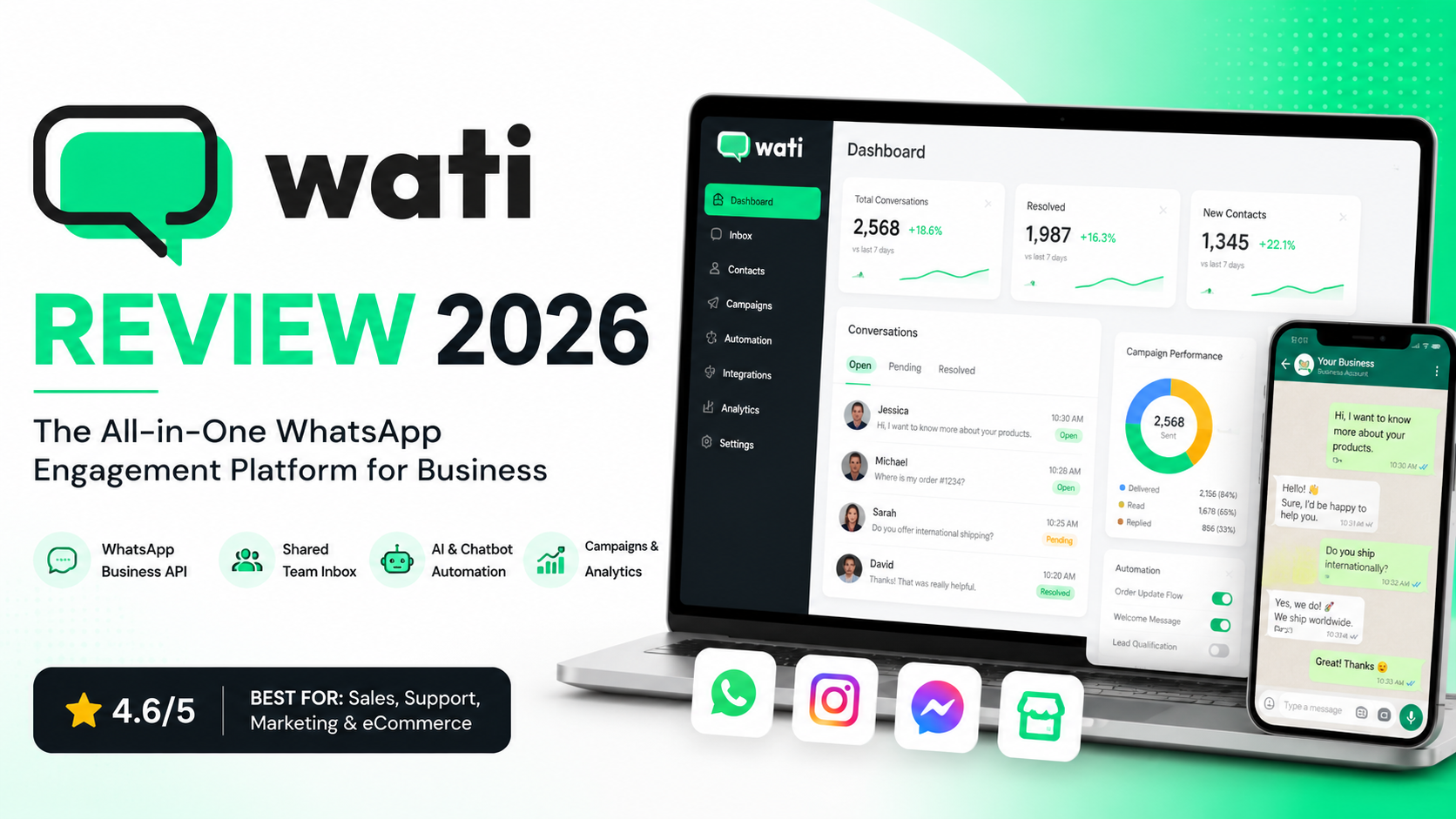
Wati Review 2026: Features, Pricing, Pros & Cons
Last Updated: August 2026
Reviewed By: Team Flowcrai
Overall Rating: 4.6/5
Affiliate Disclosure: This article may contain affiliate links. If you purchase through one of these links, Flowcrai may earn a commission at no additional cost to you. Our review is based on Wati’s official product information, documentation, pricing structure, market positioning, and publicly available customer feedback.
Key Takeaways
- Wati is an AI-powered customer engagement platform built primarily around WhatsApp Business, team inboxes, automation, marketing campaigns, and customer support.
- Its biggest strength is helping businesses move beyond the limitations of the standard WhatsApp Business app and manage customer conversations at scale.
- Wati is especially relevant for ecommerce stores, sales teams, support teams, agencies, and businesses that generate leads through WhatsApp.
- The platform becomes more valuable as message volume and team size grow, but very small businesses may not need its full feature set.
- Wati’s overall cost can be more complex than a simple monthly subscription because WhatsApp messaging charges and optional AI or add-on costs may also apply.
Quick Verdict
Wati Quick Info
| Item | Information |
| Overall Rating | 4.6/5 |
| Best For | Ecommerce, Sales Teams, Support Teams, Agencies |
| Core Use Case | WhatsApp Customer Engagement & Automation |
| WhatsApp Business API | Yes |
| Shared Team Inbox | Yes |
| Broadcast Campaigns | Yes |
| Chatbot Builder | Yes |
| AI Capabilities | Yes |
| Marketing Automation | Yes |
| Ecommerce Integrations | Yes |
| Analytics | Yes |
| Main Competitors | Respond.io, SleekFlow, Interakt, Manychat |
Our Verdict
Wati is a strong option for businesses that already use WhatsApp as an important sales, marketing, or customer-support channel.
Its biggest advantage is that it turns WhatsApp from a basic messaging app into a structured business system. Teams can manage conversations through a shared inbox, automate repetitive interactions, run campaigns, qualify leads, and integrate messaging with ecommerce and CRM workflows.
Wati is most valuable when a business has enough customer volume to justify automation and team collaboration.
For companies receiving only a small number of WhatsApp messages, however, the standard WhatsApp Business app may still be sufficient.
What Is Wati?
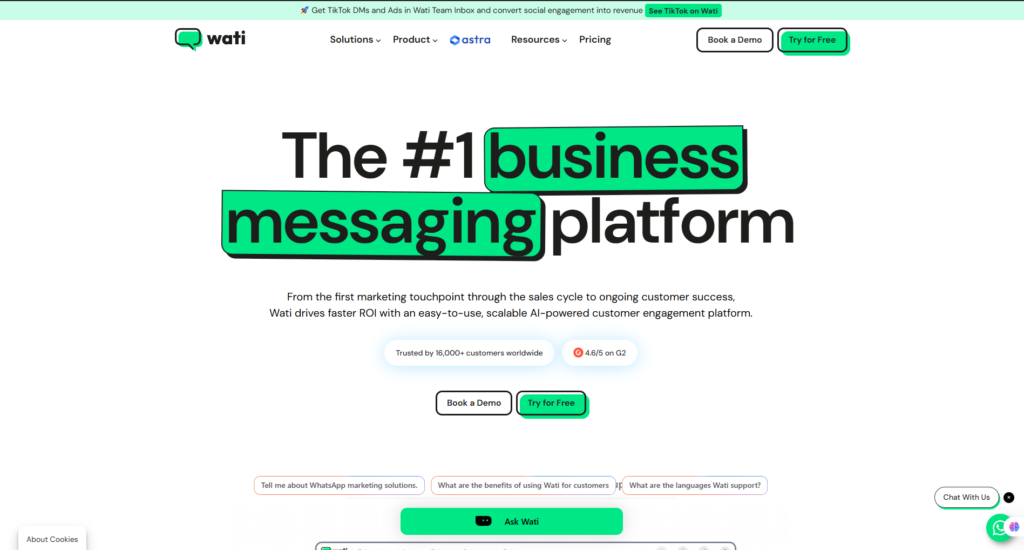
Wati is a cloud-based customer engagement platform designed to help businesses manage conversations, marketing, sales, and customer support through WhatsApp and related digital channels.
Its core strength comes from its deep integration with WhatsApp Business infrastructure.
Instead of relying on a single phone or a basic WhatsApp Business inbox, businesses can use Wati to centralize customer communication across a team.
That means multiple employees can handle customer conversations while managers maintain visibility over interactions, performance, and workflow.
Wati also adds a broader layer of business functionality around those conversations.
Depending on the plan and current feature availability, the platform can support:
- WhatsApp Business messaging
- Shared team inboxes
- Automated workflows
- Chatbots
- AI-powered customer interactions
- Broadcast campaigns
- Lead management
- Customer support
- Sales follow-ups
- Ecommerce workflows
- Integrations
- Analytics
This makes Wati more than a messaging tool.
It is better understood as a customer engagement platform built around conversational commerce.
For many businesses, the goal is simple:
Turn customer conversations into measurable sales, support, and retention outcomes.
What Problem Does Wati Solve?
The regular WhatsApp Business app works well for very small businesses.
A shop owner, consultant, or local service provider may be able to handle customer messages manually from a phone or desktop.
The problem begins when message volume increases.
A growing business may suddenly have:
- Hundreds of customer conversations
- Multiple sales agents
- Separate support employees
- Leads arriving from ads
- Repetitive customer questions
- Order-status inquiries
- Follow-up requirements
- Promotional campaigns
- Customer segmentation needs
At that point, a basic inbox becomes difficult to manage.
One employee may respond to the same customer twice.
Important leads may be missed.
Support conversations may become difficult to track.
Managers may have little visibility into which agent is handling which conversation.
Sales follow-ups may depend entirely on manual reminders.
Wati is designed to solve these operational problems.
Instead of every conversation existing independently inside WhatsApp, Wati creates a structured layer around the messaging channel.
Businesses can centralize conversations, assign them to team members, automate repetitive tasks, and connect customer messaging with other business systems.
This is where Wati becomes particularly useful for ecommerce and lead-generation businesses.
How Does Wati Work?
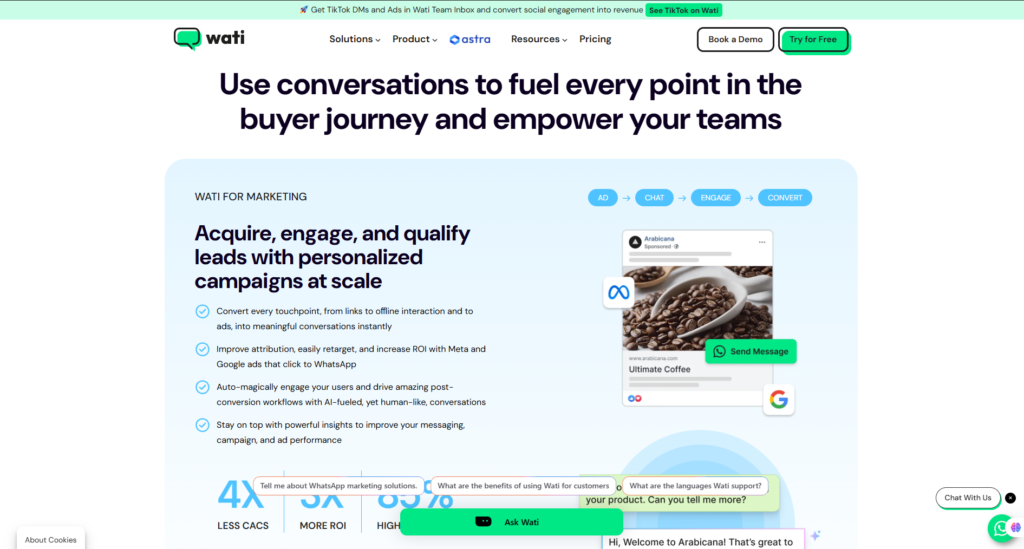
A typical Wati workflow begins when a customer starts a conversation.
That conversation might originate from:
- A website
- A WhatsApp link
- A QR code
- An advertisement
- A product page
- A customer-support request
- A previous marketing campaign
Once the message enters Wati, the business can decide what happens next.
A basic workflow might look like this:
Customer clicks an ad → Opens WhatsApp → Wati receives the message → Chatbot or AI handles initial questions → Lead is qualified → Conversation is assigned to a sales agent → Agent continues the discussion → Customer converts or receives follow-up
For customer support, the workflow might instead be:
Customer asks about an order → Automation identifies the request → Customer data is retrieved → Support agent receives the conversation → Issue is resolved → Follow-up message is sent
The value comes from bringing automation and human interaction into the same workflow.
Routine questions can be automated.
More complex conversations can be handed over to a human employee.
This combination can improve efficiency without forcing businesses to fully automate customer communication.
What Makes Wati Different?
Wati competes with a growing number of customer engagement and conversational marketing platforms.
Its strongest differentiation comes from the way several capabilities work together.
1. WhatsApp-First Architecture
Wati has historically focused heavily on WhatsApp Business.
That matters because WhatsApp has specific technical requirements, message-template rules, customer-consent requirements, and business messaging structures.
A platform designed around these realities can be easier to operate than trying to adapt a generic help-desk or CRM system.
For businesses where WhatsApp is the primary customer channel, this specialization is one of Wati’s biggest advantages.
2. Shared Team Inbox
One of the biggest limitations of basic business messaging is collaboration.
Wati allows multiple employees to work from a centralized inbox.
This can help businesses:
- Assign conversations
- Route leads
- Track ownership
- View customer history
- Collaborate internally
- Reduce duplicate responses
- Improve response times
For a business with several sales or support agents, this can be a major operational improvement.
3. Automation and Chatbots
Repetitive conversations are expensive when handled manually.
Customers repeatedly ask the same questions:
- Where is my order?
- What is the price?
- Do you ship internationally?
- How do I book an appointment?
- Is this product available?
- Can I speak with someone?
Wati’s automation and chatbot capabilities can handle many of these interactions before a human agent becomes involved.
Businesses can use automation for:
- FAQ responses
- Lead qualification
- Customer onboarding
- Appointment booking
- Order-related questions
- Support routing
- Follow-up messages
- Sales reminders
The main benefit is not replacing people.
It is reducing repetitive work so employees can focus on higher-value conversations.
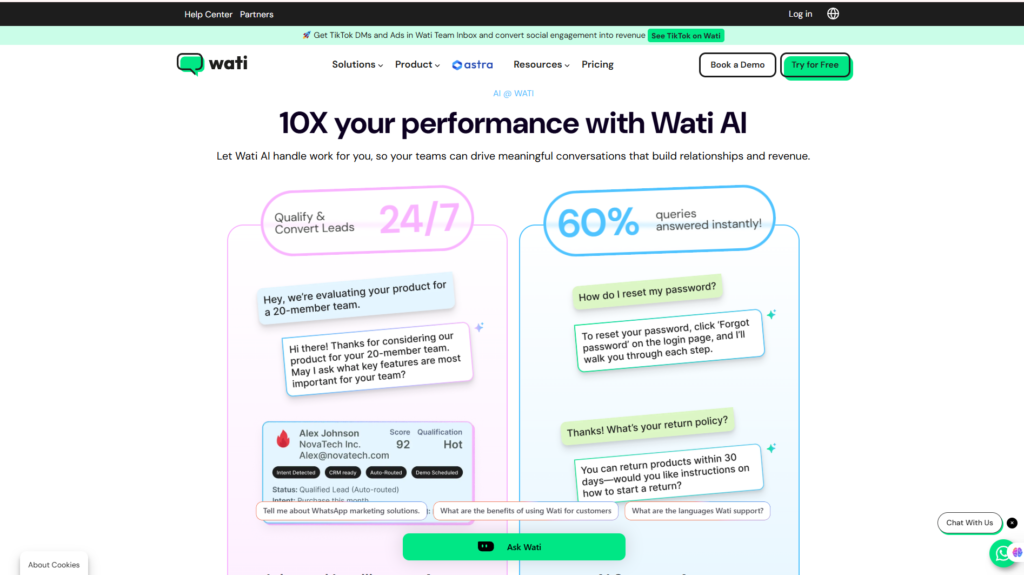
4. AI-Powered Customer Engagement
Wati has also been expanding beyond traditional rule-based chatbot automation.
AI-powered customer engagement is becoming increasingly important because customers expect faster and more natural responses.
Wati’s AI direction includes tools designed to help businesses automate parts of sales and customer support conversations.
This can be especially useful when a company handles large volumes of repetitive questions.
The potential workflow becomes:
Customer question → AI response → qualification → human handoff if needed
That is significantly more useful than a simple keyword-based chatbot.
For businesses evaluating Wati in 2026, its AI capabilities are therefore one of the areas worth examining closely.
Visit the Official Wati Website
Who Should Use Wati?
Wati is most valuable for businesses where customer messaging already plays a meaningful role in revenue or support.
It is not simply a tool for anyone who has a WhatsApp account.
Wati Is Best For
Ecommerce Businesses
Ecommerce is one of the strongest Wati use cases.
Customers frequently use WhatsApp to ask questions about:
- Products
- Availability
- Shipping
- Orders
- Returns
- Discounts
- Delivery status
A platform like Wati can help automate and organize these conversations.
Potential ecommerce workflows include:
- Order notifications
- Abandoned-cart follow-ups
- Product recommendations
- Promotional campaigns
- Customer support
- Repeat-purchase campaigns
For stores already generating meaningful WhatsApp traffic, these workflows can directly support revenue.
Sales Teams
Wati can also act as a conversational sales layer.
When leads arrive through WhatsApp, businesses can distribute them to sales representatives, automate initial qualification, and track conversations more systematically.
This is especially useful for businesses generating leads through:
- Click-to-WhatsApp Ads
- Facebook or Instagram
- Website buttons
- Landing pages
- QR codes
- Referral campaigns
Instead of manually checking messages, sales teams can create a more structured process.
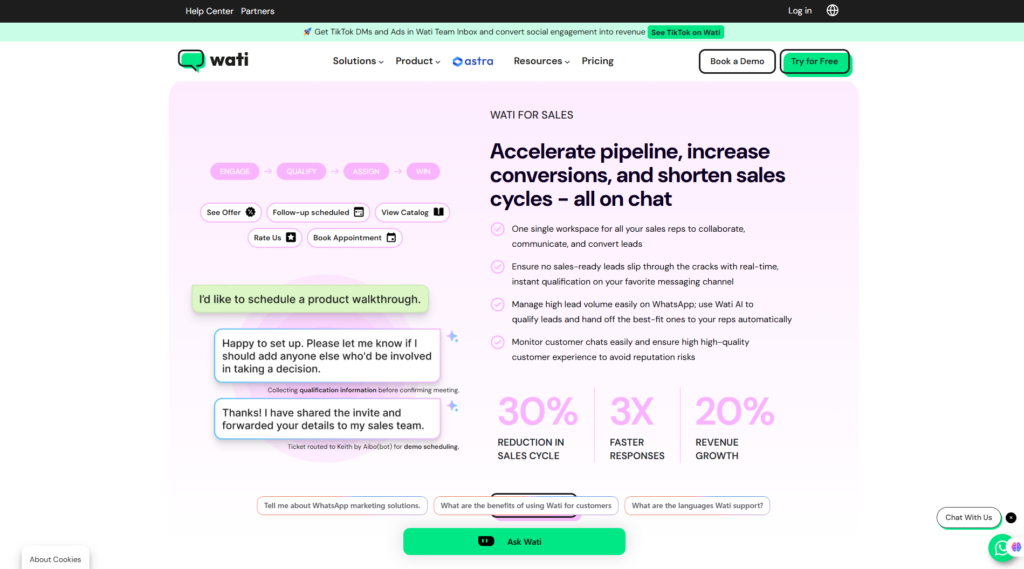
Customer Support Teams
Support departments often deal with repetitive questions at scale.
Wati allows multiple support agents to manage conversations from a centralized environment.
This can help organizations reduce response delays and improve visibility across customer interactions.
Automation can also handle simple requests before escalating more complex issues to human support.
Marketing Teams
WhatsApp can be more than a support channel.
Marketing teams can use it for campaigns, product launches, customer re-engagement, promotions, and segmented communications.
Wati gives businesses additional infrastructure around these activities.
However, businesses must still follow Meta and WhatsApp messaging policies, including relevant opt-in requirements.
Wati should not be viewed as a way to send unrestricted bulk spam.
Agencies
Marketing and automation agencies may also find Wati useful when helping clients implement WhatsApp customer journeys.
Possible agency services include:
- WhatsApp automation setup
- Lead qualification systems
- Chatbot implementation
- Campaign management
- Ecommerce workflows
- Sales automation
- Customer-support systems
This creates both operational and consulting opportunities.
Businesses With International Customers
WhatsApp usage is particularly strong across many international markets.
Businesses serving customers in Europe, Asia, the Middle East, Latin America, and other regions may find WhatsApp especially valuable as a customer communication channel.
For businesses with an international customer base, Wati’s WhatsApp focus can therefore be a major advantage.
Who Should Skip Wati?
Wati is not necessary for every business.
Very Small Businesses With Low Message Volume
If you receive only a handful of WhatsApp messages each week, adding another SaaS platform may create unnecessary cost and complexity.
The standard WhatsApp Business app may be enough.
Businesses That Do Not Use WhatsApp
If customers primarily contact your company through email, phone, live chat, or another platform, Wati may not be the best investment.
A broader customer-support or omnichannel platform may provide better value.
Freelancers With Simple Communication Needs
A freelancer managing a few client conversations manually is unlikely to benefit from advanced routing, automation, and campaign tools.
Businesses Looking Only for Email Marketing
Wati is not designed to replace dedicated email marketing platforms.
If newsletters, email funnels, and email automation are your main priorities, another product category would be more appropriate.
Companies Needing Advanced Enterprise Contact-Center Infrastructure
Larger organizations with complex voice, ticketing, compliance, workforce-management, and omnichannel contact-center requirements may need a more specialized enterprise platform.
Wati is strongest when conversational messaging—particularly WhatsApp—is central to the workflow.
Setup & User Experience
Account Setup
Setting up Wati is more involved than creating an account for a basic SaaS tool because WhatsApp Business infrastructure is part of the process.
Depending on the business and its existing Meta setup, onboarding may involve:
- Creating or connecting a Wati account
- Connecting WhatsApp Business
- Configuring a business phone number
- Completing relevant Meta Business requirements
- Inviting team members
- Setting up the shared inbox
- Creating message templates
- Configuring automations
- Connecting ecommerce or CRM tools
Businesses should therefore expect some setup work before reaching the full value of the platform.
This is normal for business messaging software.
Learning Curve
The learning curve is best described as moderate.
Basic inbox management should be relatively straightforward for employees familiar with modern SaaS interfaces.
More advanced functionality requires additional knowledge.
Examples include:
- Workflow automation
- Message templates
- Campaign rules
- AI configuration
- Integrations
- Lead routing
- Segmentation
For small teams, it may be sensible to begin with the shared inbox and simple automation before building more advanced workflows.
Ease of Use
Wati attempts to simplify a technically complex ecosystem.
WhatsApp Business API, Meta messaging rules, automation, CRM integrations, and multiple-agent access can become difficult when configured manually.
A major part of Wati’s value proposition is packaging these capabilities into a more manageable interface.
This makes the platform more accessible to marketing, sales, and support teams without requiring them to build their own messaging infrastructure.
Interface Design
The Wati interface is organized around practical business workflows rather than just chat.
Core areas typically revolve around:
- Conversations
- Contacts
- Campaigns
- Automation
- Team activity
- Integrations
- Analytics
This structure makes sense for businesses because conversations remain connected to sales, support, and marketing processes.
The shared inbox is likely to be one of the most frequently used areas for customer-facing teams.
Our User Experience Analysis
Based on Wati’s documented capabilities, current product positioning, and publicly available customer feedback, the platform appears to offer a relatively accessible way to manage WhatsApp at business scale.
Its biggest usability advantage is consolidation.
Instead of building a custom WhatsApp Business API setup and connecting separate inbox, chatbot, marketing, and automation tools, businesses can manage much of the workflow from one platform.
The tradeoff is complexity.
Wati becomes more powerful as businesses add campaigns, templates, automation, AI, integrations, and multiple team members. That also means new users may need time to understand the complete system.
For WhatsApp-heavy businesses, that learning curve is likely justified. For very small teams with minimal messaging volume, it may be unnecessary.
Key Features of Wati
Wati becomes much more compelling once you stop viewing it as a simple WhatsApp messaging tool.
Its real value comes from connecting customer conversations, automation, team collaboration, marketing campaigns, ecommerce workflows, and AI inside one customer engagement platform.
For businesses that receive a meaningful volume of WhatsApp messages, these capabilities can turn an otherwise fragmented communication process into a more structured sales and support system.
Below are the Wati features that matter most.
1. WhatsApp Business API and Multi-Channel Messaging
WhatsApp remains at the center of Wati’s product ecosystem.
The platform helps businesses use WhatsApp for more sophisticated workflows than the standard WhatsApp Business app can normally support.
Instead of relying on a single employee or device, companies can create a centralized system for:
- Customer conversations
- Marketing campaigns
- Lead generation
- Sales follow-ups
- Customer support
- Notifications
- Automation
- Team collaboration
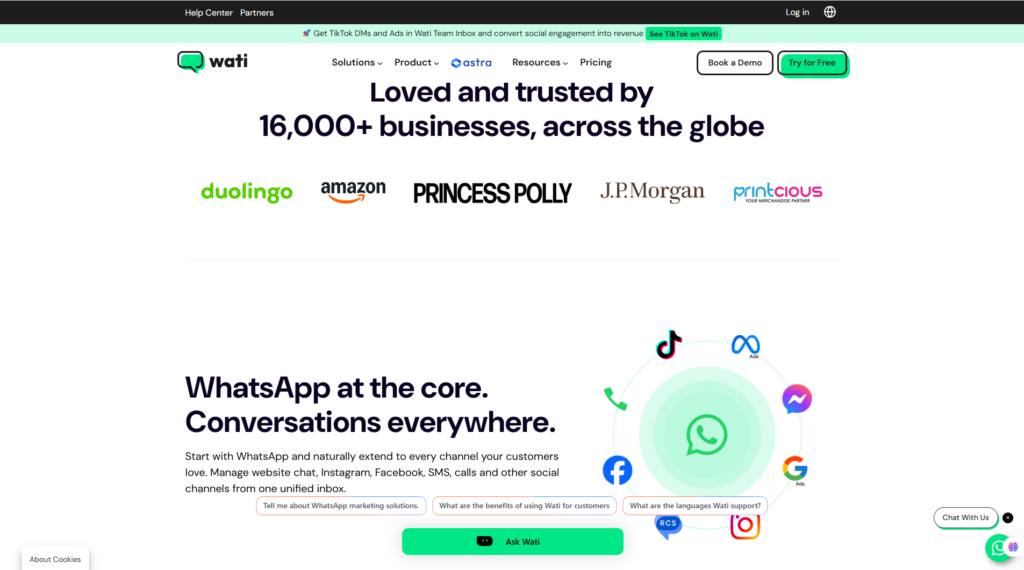
Wati has also expanded beyond WhatsApp.
Its current platform documentation lists support for channels including:
- WhatsApp Business Calling
- SMS
- RCS
- TikTok
- Website chat
This means Wati is becoming increasingly omnichannel, although WhatsApp remains its strongest area.
For businesses where WhatsApp generates a large percentage of customer conversations, this specialization remains one of the main reasons to consider Wati.
2. Shared Team Inbox
The Shared Team Inbox is one of Wati’s most practical business features.
Instead of having customer conversations scattered across employees’ phones or individual accounts, teams can manage incoming conversations in a central inbox.
Businesses can use the inbox to:
- Assign conversations to agents
- Create teams
- Add internal notes
- View conversation history
- Search and filter conversations
- Track chat status
- Route conversations
- Manage permissions
- Monitor agent activity
This becomes increasingly important as a business grows.
Imagine an ecommerce company receiving hundreds of WhatsApp inquiries per day.
Without a centralized system, it is easy for messages to be missed, duplicated, or assigned incorrectly.
With Wati, the workflow can become:
Customer message → Shared Inbox → Routing rule → Assigned agent → Resolution → Follow-up
The Pro plan adds more advanced inbox functionality, including team structures, automatic routing, and operator reporting.
For sales and customer-support teams, this feature alone can significantly improve operational visibility.
3. No-Code Chatbot and Workflow Automation
Automation is another major strength of Wati.
Businesses often receive the same questions repeatedly:
- Where is my order?
- What are your prices?
- Do you ship internationally?
- Can I book an appointment?
- Is this item available?
- Can I speak to a sales representative?
Answering these questions manually takes time and increases staffing requirements.
Wati’s chatbot and automation tools allow businesses to handle many routine interactions without coding.
Potential use cases include:
- FAQ automation
- Lead qualification
- Customer onboarding
- Appointment booking
- Product recommendations
- Order-status inquiries
- Support routing
- Reminder messages
- Follow-up sequences
- Customer-data collection
Wati currently includes automation-trigger allowances in its plans.
For example, Growth includes 1,000 free automation triggers per month, while Pro increases this to 2,000, with higher allowances on Business.
More advanced chatbot functionality is available on higher-tier plans.
This means a company can start with relatively simple automation and expand as message volume and customer journeys become more complex.
4. Campaigns, Broadcasts and WhatsApp Marketing
Wati also provides marketing functionality for businesses that want to engage customers proactively.
The platform allows companies to create campaigns for:
- Promotions
- Product launches
- Customer re-engagement
- Offers
- Abandoned-cart recovery
- Order-related updates
- Event reminders
- Customer retention
Wati previously referred to these as Broadcasts and now increasingly uses the term Campaigns across its documentation.
Growth currently allows up to 15,000 broadcasts per month, while Pro and Business offer unlimited broadcasts subject to applicable messaging charges.
The Pro plan also adds stronger campaign features such as:
- Smart retargeting
- Carousel templates
- Catalog payment options
- CTWA source tags
- Click tracking
- Engagement insights
CTWA refers to Click-to-WhatsApp Ads, which can be useful for businesses running Meta advertising campaigns that send leads directly into WhatsApp.
However, Wati should not be viewed as unrestricted bulk-messaging software.
Businesses still need to comply with WhatsApp and Meta rules around:
- Customer opt-in
- Message templates
- Messaging categories
- User consent
- Marketing communications
That limitation is important.
The power of WhatsApp marketing comes from high-intent communication—not from sending unsolicited messages at scale.
5. AI CoPilot and Astra AI Agents
AI is becoming an increasingly important part of Wati’s positioning.
There are two concepts worth separating.
Wati CoPilot
Wati’s platform includes AI tools designed to assist internal teams.
Current documentation describes capabilities such as:
- AI-generated drafts
- Conversation summarization
- Translation
- Customer Experience Score
- Natural-language workspace queries
- Automated alerts and tagging
- Reporting assistance
These tools help human agents work faster rather than replacing them completely.
Astra AI Agents
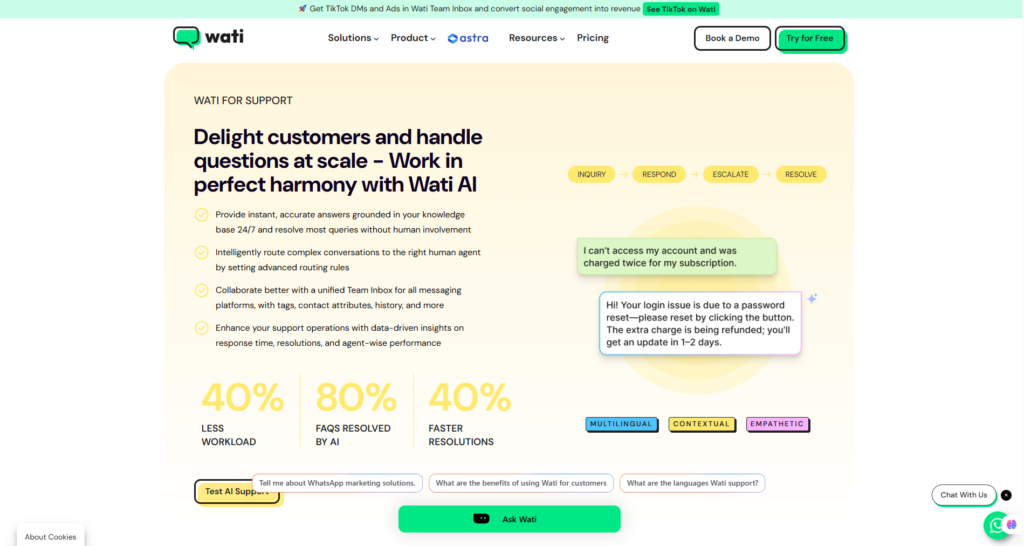
Astra takes the concept further.
Astra is Wati’s autonomous AI-agent product designed to handle customer conversations more independently.
It can be used for tasks such as:
- Lead qualification
- Frequently asked questions
- Customer guidance
- Automated conversations
- Website engagement
- WhatsApp conversations
- Human-agent handoff
One important pricing detail is that Astra is not simply included as an unlimited feature inside Wati plans.
It has its own pricing structure.
At the time of this review:
- Free: $0 with 1 AI agent, 100 monthly credits, and web widget access
- Pro: $99/month monthly, or $79/month when billed annually
- Business: $399/month
- Custom options may also be available for larger deployments
The Astra Pro plan currently supports up to three AI agents and 5,000 monthly credits, while Business expands to unlimited agents and 25,000 monthly credits.
This makes Astra particularly relevant for businesses that want AI to qualify leads or handle repetitive conversations before transferring qualified customers to human staff.
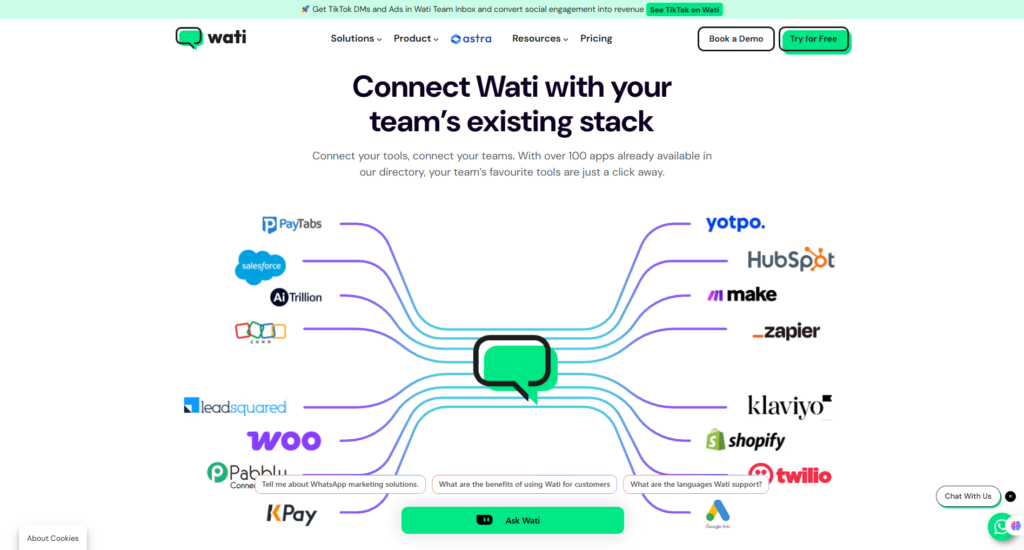
6. Integrations and Ecommerce
Wati’s value increases significantly when customer conversations are connected to business data.
The platform supports integrations with commerce, CRM, productivity, and automation tools.
Depending on plan availability, these may include systems such as:
- Shopify
- HubSpot
- Salesforce
- Zapier
- Google Sheets
- CRM platforms
- Ecommerce tools
- APIs and webhooks
Shopify is particularly relevant.
Wati’s Shopify integration can help businesses:
- Add WhatsApp chat to a store
- Send automated customer messages
- Display product catalogs
- Send order-related communication
- Track messaging activity
- Run ecommerce campaigns
On Growth, Wati currently includes two selected commerce/CRM integrations.
Pro expands this to five integrations, including HubSpot, while Business provides unlimited integrations and broader API/webhook capacity.
For ecommerce businesses, this connection between customer conversations and order data can be more valuable than the messaging functionality alone.
Wati Pros and Cons
Pros
Wati has several clear strengths for businesses that use WhatsApp as a serious customer channel.
- Strong WhatsApp specialization: Wati remains particularly well suited to WhatsApp-driven business workflows.
- Shared Team Inbox: Multiple sales and support agents can manage conversations centrally.
- No-code automation: Businesses can automate common customer journeys without building custom software.
- Campaign functionality: Useful for promotions, retargeting, lead nurturing, and customer engagement.
- AI capabilities: CoPilot and Astra expand Wati beyond traditional chatbot automation.
- Strong ecommerce fit: Shopify and commerce workflows make Wati useful for online stores.
- Sales-oriented workflows: Lead qualification, routing, and follow-up can support revenue teams.
- Increasing omnichannel capabilities: Wati now supports channels beyond WhatsApp.
- Scalable integrations and APIs: Higher-tier plans offer stronger CRM and developer capabilities.
Cons
Wati is powerful, but there are several limitations buyers should understand.
- Pricing is more complex than a flat SaaS fee.
- WhatsApp messaging charges apply separately from the subscription.
- Astra AI Agents are priced separately.
- Advanced features may require Pro or Business.
- Meta and WhatsApp messaging policies still apply.
- Growth does not support additional users beyond its included user count.
- Businesses with low message volume may not need Wati.
- Advanced workflows require some learning and setup.
- Companies needing a traditional enterprise contact center may still require another platform.
The biggest issue is cost predictability.
A company should never evaluate Wati only by looking at the headline subscription price.
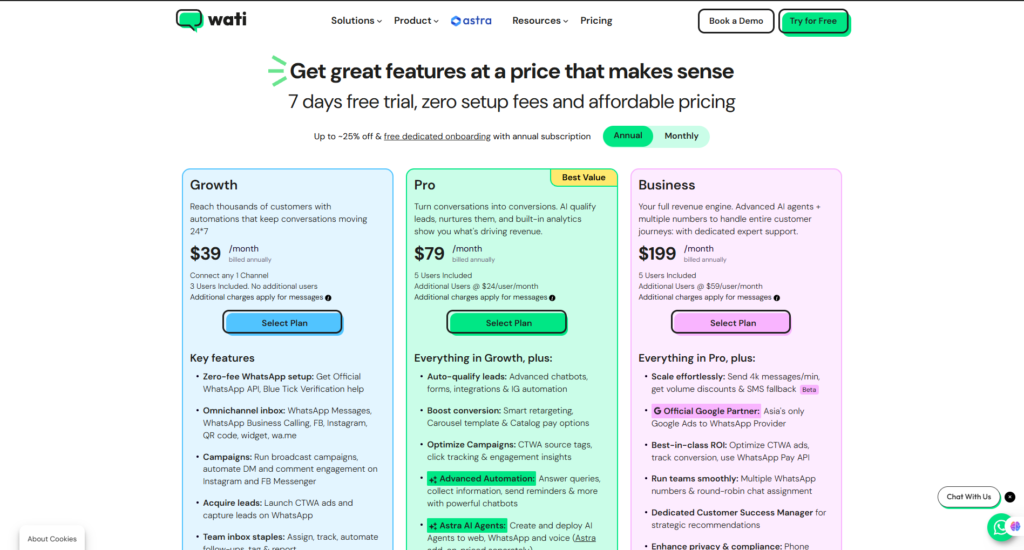
Wati Pricing 2026
Wati currently offers three main platform plans:
- Growth
- Pro
- Business
Exact displayed subscription prices can vary by country, billing cycle, currency, and promotion, so Flowcrai should recheck the official pricing page immediately before publication.
More importantly, Wati itself explains that total pricing consists of three separate components:
Subscription Fee + Messaging Charges + Optional Add-ons
This is the correct way to evaluate the real cost of Wati.
Wati Pricing Comparison
| Plan | Included Users | Broadcasts | Automation Triggers | Integrations | Best For |
| Growth | 3 | 15,000/month | 1,000/month | 2 selected integrations | Small growing teams |
| Pro | 5 | Unlimited | 2,000/month | 5 integrations | Growing sales & ecommerce teams |
| Business | 5 | Unlimited | 5,000/month | Unlimited integrations | High-volume businesses |
Additional messaging charges apply. Optional add-ons and AI services may also increase total cost.
Growth Plan
Growth is designed for businesses beginning to scale customer conversations.
It currently includes:
- 1 connected channel
- 3 users
- Shared Team Inbox
- WhatsApp Business Calling
- Instagram and Facebook engagement
- Campaign functionality
- Click-to-WhatsApp lead capture
- Basic ecommerce tools
- 15,000 broadcasts per month
- 1,000 automation triggers
- 2 selected commerce/CRM integrations
- 10,000 API calls per month
- 250 AI CoPilot credits
- Email support
Growth can work well for smaller businesses that are beginning to formalize WhatsApp sales and customer support.
However, it has one important limitation:
Additional users are not available on this plan.
If the team expands, upgrading may become necessary.
Pro Plan
Pro is likely to be the strongest value tier for many serious Wati users.
It currently includes five users, with extra users available for an additional fee.
Pro expands Wati with:
- Advanced chatbots
- Lead qualification
- Forms
- Instagram automation
- Smart retargeting
- Carousel campaigns
- Catalog payment options
- Campaign analytics
- CTWA source tracking
- Advanced Team Inbox
- Automatic routing
- Operator reports
- Shopify sales workflows
- Unlimited broadcasts
- 2,000 automation triggers
- Five integrations
- HubSpot integration
- 200,000 API calls per month
- Limited webhooks
- 500 AI CoPilot credits
- 24/7 email and chat support
For businesses using Wati across marketing, sales, and support rather than for simple WhatsApp messaging, Pro is likely to make the most sense.
Business Plan
Business is designed for larger organizations with higher messaging and automation requirements.
It currently includes capabilities such as:
- Multiple WhatsApp numbers
- Higher messaging throughput
- Volume discounts
- SMS fallback
- Advanced CTWA optimization
- WhatsApp Pay API
- Round-robin assignment
- Dedicated Customer Success Manager
- Roles and permissions
- IP whitelisting
- Phone-number masking
- Unlimited integrations
- 20 million API calls per month
- Extensive webhooks
- 1,500 AI CoPilot credits
- 5,000 automation triggers
- Priority support
Business is clearly aimed at organizations where customer messaging has become an operationally important revenue channel.
Does Wati Have a Free Plan?
For the main Wati platform, buyers should not assume there is a permanent full-featured free plan.
Wati promotes plan selection and demos depending on product and region.
Astra, however, currently has a separate Free AI Agent plan.
That Astra Free plan includes:
- 1 AI agent
- 1 team member
- 100 monthly credits
- 1 MB of training data
- Website widget access
- Basic analytics
The important distinction is:
Astra Free is not the same thing as a free Wati WhatsApp Business platform subscription.
This distinction should be made clear in any pricing comparison.
Understanding Wati’s Real Cost
This is one of the most important sections of this Wati review.
The subscription price is only the first layer.
A more accurate formula is:
Total Wati Cost = Subscription + Messaging Fees + Add-ons
1. Subscription Fee
This covers access to Growth, Pro, or Business.
2. Messaging Fees
WhatsApp messages can incur additional charges.
Wati states that per-message pricing varies based on message type, including categories such as:
- Marketing
- Utility
- Authentication
Businesses should therefore estimate expected messaging volume before choosing a plan.
3. Optional Add-ons
Additional costs may come from features such as:
- Extra automation triggers
- Additional AI CoPilot credits
- Shopify integration
- Additional WhatsApp numbers
- Astra AI Agents
- Dedicated onboarding
- Other advanced services
This means two businesses using the same Wati subscription plan could have very different monthly bills.
For a buyer, evaluating anticipated message volume and add-on requirements is more important than simply comparing headline subscription prices.
Is Wati Worth the Price?
For the right business, Wati can provide strong value.
The key question is whether WhatsApp already contributes meaningfully to customer acquisition, sales, or support.
Strong Value
Wati is easiest to justify for businesses where:
- WhatsApp generates leads
- Customers regularly ask product questions
- Multiple employees handle conversations
- Customer support volume is high
- Marketing campaigns generate measurable revenue
- Automation can reduce repetitive work
For these organizations, Wati is not just another software expense.
It becomes part of the revenue and service infrastructure.
Potentially Good Value
Growing ecommerce businesses and service companies can also benefit, especially when they are transitioning from manual WhatsApp processes to a team-based system.
In this situation, Growth can provide an entry point while Pro offers more room for automation and conversion optimization.
Weak Value
Wati is harder to justify for a company receiving only a few WhatsApp messages each week.
If one person can comfortably manage all conversations in the regular WhatsApp Business app, the additional subscription, messaging, and add-on costs may not provide enough return.
Wati Performance Evaluation
Score Table
| Category | Score |
| Ease of Use | 4.5/5 |
| WhatsApp Features | 4.9/5 |
| Automation | 4.7/5 |
| AI Capability | 4.6/5 |
| Team Collaboration | 4.7/5 |
| Marketing Features | 4.7/5 |
| Integrations | 4.6/5 |
| Ecommerce Features | 4.7/5 |
| Scalability | 4.6/5 |
| Pricing & Value | 4.2/5 |
| Overall Rating | 4.6/5 |
Evaluation Methodology
Our Wati rating is based on the platform’s documented capabilities rather than unsupported claims of hands-on testing.
We considered:
WhatsApp functionality:
How well Wati supports WhatsApp-based customer communication, campaigns, and business workflows.
Automation:
The depth of chatbot, routing, campaign, and customer-journey automation.
AI capability:
Wati CoPilot and Astra AI Agent functionality.
Team collaboration:
Shared inbox, routing, agent management, and reporting capabilities.
Integrations:
Connections with ecommerce, CRM, API, and business systems.
Pricing:
Not only the subscription fee, but also messaging charges and optional add-ons.
Scalability:
How effectively the product can move from a small team to a larger messaging operation.
Based on these criteria, Wati earns an overall 4.6/5.
Wati’s strongest argument is not simply that it helps companies send WhatsApp messages.
The platform’s real value comes from turning customer messaging into a structured business workflow.
A company can potentially move from:
Ad → WhatsApp Lead → AI Qualification → Sales Agent → Conversion → Support → Retargeting
without managing every stage manually.
The Shared Team Inbox provides the operational foundation, while automation and campaigns help teams scale engagement. Ecommerce integrations connect conversations with purchase behavior, and Wati’s expanding AI capabilities create additional opportunities for automating lead qualification and customer service.
The main weakness is pricing complexity.
Businesses need to evaluate not just the Growth, Pro, or Business subscription, but also message volume, AI usage, additional users, automation triggers, integrations, and optional add-ons.
For businesses where WhatsApp already contributes meaningful revenue or support volume, these costs may be justified.
For very small companies with limited WhatsApp activity, Wati may be more infrastructure than they need.
Wati vs Competitors
Wati operates in a competitive market where several platforms help businesses manage messaging, automation, lead generation, and customer support.
The most relevant Wati alternatives include Respond.io, SleekFlow, Interakt, and Manychat.
Each platform overlaps with Wati in some areas, but their positioning is different.
Wati is strongest when WhatsApp is a central business channel.
Respond.io leans more heavily toward omnichannel messaging.
SleekFlow focuses strongly on conversational commerce.
Interakt is often positioned toward smaller ecommerce and WhatsApp-first businesses.
Manychat is especially popular for social media automation across channels such as Instagram and Messenger.
The best platform therefore depends less on which one has the longest feature list and more on how your customers actually communicate with your business.
Wati Competitor Comparison
| Platform | Best For | Main Strength | Main Consideration |
| Wati | WhatsApp-first sales, support & ecommerce | WhatsApp automation + team inbox + AI | Pricing can include multiple cost layers |
| Respond.io | Omnichannel communication teams | Advanced multi-channel workflows | Can require more setup |
| SleekFlow | Conversational commerce | Messaging + ecommerce workflows | Compare plan limits carefully |
| Interakt | SMEs and online stores | Accessible WhatsApp commerce tools | May offer less depth for complex teams |
| Manychat | Social media marketers & creators | Instagram/Messenger automation | Different core focus from Wati |
Competitor plans, limits, and features change frequently. Always verify the latest information on each provider’s official website before choosing a platform.
Wati vs Respond.io
Wati vs Respond.io is one of the most important comparisons for businesses evaluating WhatsApp automation software.
Both platforms help businesses manage customer conversations, automate workflows, and coordinate multiple agents.
The difference is largely one of focus.
Wati remains particularly strong around WhatsApp-centric customer journeys.
That makes it attractive to ecommerce stores, sales teams, and support departments where WhatsApp is already one of the primary customer channels.
Respond.io generally takes a broader omnichannel approach.
A business may want to manage conversations across:
- Messenger
- Telegram
- Web chat
- Other messaging channels
inside a more unified workflow environment.
Choose Wati If:
- WhatsApp is your primary customer channel
- You run Click-to-WhatsApp Ads
- Ecommerce is an important use case
- You need WhatsApp campaigns
- You want a shared inbox for WhatsApp-heavy teams
- You want Wati’s AI and automation ecosystem
Choose Respond.io If:
- You need deeper omnichannel communication
- Customers regularly contact you through several messaging apps
- Cross-channel workflows are a priority
- Your sales and support process is not centered primarily on WhatsApp
For a company where 70–80% of customer conversations happen through WhatsApp, Wati may feel more focused.
For a company managing a much broader messaging ecosystem, Respond.io may deserve stronger consideration.
Wati vs SleekFlow
SleekFlow is another close competitor because it also focuses heavily on conversational commerce.
Both products are designed to help businesses convert messaging conversations into measurable commercial outcomes.
The key question is whether you primarily want a WhatsApp-centric operating system or a broader conversational-commerce environment.
Wati Strengths
Wati may be attractive for businesses that prioritize:
- WhatsApp automation
- WhatsApp Business workflows
- Team inbox management
- Campaigns
- Click-to-WhatsApp lead generation
- Ecommerce messaging
- AI-assisted sales and support
SleekFlow Strengths
SleekFlow may deserve consideration for businesses that want:
- Multiple messaging channels
- Conversational commerce
- Product and payment journeys
- Broader customer engagement across social platforms
- Unified messaging operations
For ecommerce businesses, both platforms may be viable.
The better choice depends on integrations, channel mix, automation requirements, and total cost at your expected message volume.
Wati vs Interakt
Interakt competes with Wati particularly in the WhatsApp commerce and small-business market.
For smaller online sellers, Interakt can be appealing because its positioning is relatively straightforward.
Typical use cases include:
- WhatsApp marketing
- Ecommerce notifications
- Customer support
- Product catalogs
- Order updates
- Promotional campaigns
Wati tends to become more attractive when businesses need a more sophisticated team structure and deeper automation.
Choose Wati If:
- Several employees handle conversations
- Advanced automation matters
- You need AI capabilities
- Lead qualification is important
- You need stronger integrations
- Your customer operation is scaling
Choose Interakt If:
- You operate a smaller ecommerce business
- Your WhatsApp requirements are relatively straightforward
- Simplicity and affordability are higher priorities
- You do not need a complex customer-engagement stack
The important point is that more features do not automatically make Wati the better choice.
A small store should not pay for enterprise-style capabilities it does not need.
Wati vs Manychat
Wati and Manychat overlap in automation, but they are designed around somewhat different customer journeys.
Manychat is particularly well known among creators, marketers, and small businesses using social media to generate leads.
Its strongest use cases often involve:
- Instagram automation
- Facebook Messenger
- Comment-to-DM campaigns
- Lead capture
- Social media funnels
- Creator marketing
Wati is more naturally positioned around business messaging, especially WhatsApp.
Choose Wati If:
Your core funnel looks like:
Ad → WhatsApp → Sales Conversation → Purchase → Support
Choose Manychat If:
Your core funnel looks more like:
Instagram Content → Comment/DM → Automated Conversation → Lead → Offer
Many businesses could theoretically use both.
For example, Manychat could generate social leads while Wati handles deeper WhatsApp sales and support conversations.
The two products therefore should not always be viewed as direct substitutes.
Which Wati Alternative Should You Choose?
The simplest way to decide is to start with your dominant communication channel.
Choose Wati
Best for businesses that rely heavily on WhatsApp for:
- Sales
- Customer service
- Ecommerce
- Lead qualification
- Marketing campaigns
- Customer retention
Choose Respond.io
Best for companies where omnichannel messaging is a core requirement.
Choose SleekFlow
Best for businesses focused on conversational commerce across several messaging channels.
Choose Interakt
Best for smaller ecommerce businesses wanting relatively straightforward WhatsApp commerce functionality.
Choose Manychat
Best for creators and marketers whose customer acquisition starts primarily on Instagram, Messenger, and social media.
For WhatsApp-first businesses, Wati remains one of the strongest platforms to shortlist.
Frequently Asked Questions About Wati
What Is Wati Used For?
Wati is used to manage customer communication, sales, marketing, and support through WhatsApp and other supported channels.
Businesses can use the platform for:
- Shared team messaging
- Lead management
- Customer support
- WhatsApp campaigns
- Automated workflows
- Chatbots
- AI-powered conversations
- Ecommerce messaging
- Customer follow-up
Its main value is helping businesses move from manual messaging to a structured customer-engagement system.
Is Wati an Official WhatsApp Business Solution?
Wati is built around the official WhatsApp Business ecosystem and provides businesses with tools for using WhatsApp Business messaging at scale.
However, businesses still need to comply with Meta and WhatsApp rules.
That includes requirements related to:
- Business verification
- Message templates
- Customer consent
- Marketing communications
- Messaging categories
Using Wati does not remove those compliance obligations.
Is Wati Free?
Wati should not be viewed as a permanently free WhatsApp business platform.
Its main customer-engagement product is built around paid plans.
Wati may offer trials, demos, or promotional access depending on product and region.
Separately, Astra AI Agents currently includes a limited free tier.
That free Astra plan should not be confused with a full free Wati subscription.
How Much Does Wati Cost?
The real cost of Wati depends on several factors.
The most useful formula is:
Wati Subscription + WhatsApp Messaging Fees + Optional Add-ons
Potential additional costs can include:
- Message charges
- Extra users
- Additional automation usage
- AI credits
- Astra AI Agents
- Additional numbers
- Premium integrations
- Advanced support or onboarding
This is why businesses should estimate their expected monthly message volume before choosing a Wati plan.
Does Wati Support WhatsApp Automation?
Yes.
Automation is one of Wati’s main strengths.
Businesses can build workflows for use cases such as:
- Lead qualification
- FAQ responses
- Customer onboarding
- Appointment booking
- Order inquiries
- Support routing
- Follow-up sequences
- Customer re-engagement
More advanced automation capabilities may depend on the selected Wati plan.
Can Wati Send WhatsApp Broadcast Messages?
Yes.
Wati supports WhatsApp campaigns and broadcast-style customer communication.
Businesses can use this functionality for:
- Promotions
- Product launches
- Customer updates
- Retargeting
- Events
- Re-engagement
However, WhatsApp is not an unrestricted bulk-email substitute.
Businesses must follow Meta rules regarding customer opt-in, approved templates, and marketing communications.
This is especially important for companies considering Wati primarily as a promotional messaging tool.
Is Wati Good for Ecommerce?
Yes, ecommerce is one of Wati’s stronger use cases.
An online store can potentially use Wati for:
- Product inquiries
- Order notifications
- Cart recovery
- Customer support
- Promotions
- Product recommendations
- Repeat-purchase campaigns
- Shopify-related workflows
The strongest value appears when WhatsApp is already part of the store’s customer journey.
If customers rarely use WhatsApp, a dedicated ecommerce email or customer-support platform may provide better value.
What Are the Best Wati Alternatives?
The main alternatives worth considering include:
- Respond.io
- SleekFlow
- Interakt
- Manychat
Respond.io is attractive for broader omnichannel communication.
SleekFlow focuses strongly on conversational commerce.
Interakt may work well for smaller WhatsApp-focused ecommerce businesses.
Manychat is particularly strong for social media automation and creator-led marketing.
Final Verdict: Is Wati Worth It in 2026?
After evaluating its WhatsApp functionality, Shared Team Inbox, campaign tools, automation, AI capabilities, integrations, pricing structure, and competitive positioning, Wati earns an overall Flowcrai rating of:
4.6/5
Wati is particularly compelling for businesses where WhatsApp is already tied to revenue.
That distinction matters.
A company receiving five customer messages per week has a very different need from an ecommerce store receiving hundreds of WhatsApp conversations every day.
For the second business, manual messaging quickly becomes inefficient.
Sales leads need routing.
Customer questions need prioritization.
Support requests need ownership.
Campaigns require segmentation.
Managers need analytics.
Wati provides infrastructure for handling these requirements at scale.
Wati Is Best For
- Ecommerce businesses
- WhatsApp-heavy sales teams
- Customer-support departments
- Marketing teams
- Growing SMEs
- Agencies
- International businesses
- Companies running Click-to-WhatsApp Ads
- Businesses generating leads through WhatsApp
- Organizations needing multiple agents on customer conversations
Wati Is Not Recommended For
Wati may not make sense for:
- Casual WhatsApp users
- Freelancers receiving very few inquiries
- Businesses that rarely communicate through WhatsApp
- Companies needing only email marketing
- Extremely budget-sensitive startups
- Small businesses that can comfortably operate through the WhatsApp Business app
- Organizations requiring a specialized enterprise contact-center platform
- Businesses unwilling to manage Meta messaging policies and related costs
Final Recommendation
Wati’s biggest strength is the way it turns WhatsApp from a simple communication tool into a more structured business channel.
Instead of treating every conversation as an isolated chat, businesses can create a connected workflow:
Customer Acquisition → Conversation → Qualification → Human Agent → Conversion → Support → Retargeting
That is the real reason to consider Wati.
The Shared Team Inbox helps teams coordinate conversations.
Automation reduces repetitive work.
Campaign tools support customer engagement.
Ecommerce integrations connect messaging with purchases.
And Wati’s growing AI capabilities introduce another layer of automation for sales and customer service.
Its biggest weakness is cost transparency.
The subscription price alone does not necessarily represent the final monthly expense.
Messaging fees, AI usage, extra users, automation capacity, integrations, and optional add-ons can all influence total cost.
Businesses should therefore calculate expected usage before subscribing.
For a small company receiving only occasional WhatsApp inquiries, Wati may be unnecessary.
But for an ecommerce store, sales team, agency, or customer-support organization already handling significant WhatsApp traffic, the platform can solve a very real operational problem.
Overall Flowcrai Rating: 4.6/5
If WhatsApp is already an important source of leads, sales, or customer-support conversations, Wati deserves a place on your shortlist.
Explore Wati’s current plans, automation capabilities, integrations, and WhatsApp Business features to determine whether the platform fits your customer-engagement strategy.