

GTHost Review 2026: Pricing, Performance, Pros & Cons
Meta Description:
GTHost review 2026 covering dedicated servers, VPS, pricing, locations, performance, pros and cons to help you decide if GTHost is worth it.
Overall Rating: 4.6/5
Best For: Developers, agencies, SaaS businesses, high-traffic websites, and users who need dedicated server infrastructure
Last Updated: August 2026
Reviewed by: Team Flowcrai
Affiliate Disclosure: This article may contain affiliate links. If you purchase through one of these links, Flowcrai may earn a commission at no additional cost to you.
GTHost is a hosting infrastructure provider focused heavily on instant dedicated servers, bare-metal infrastructure, VPS hosting, and storage solutions.
Instead of competing primarily with beginner-focused shared hosting companies, GTHost targets users who need more control over hardware, server location, computing resources, and deployment flexibility.
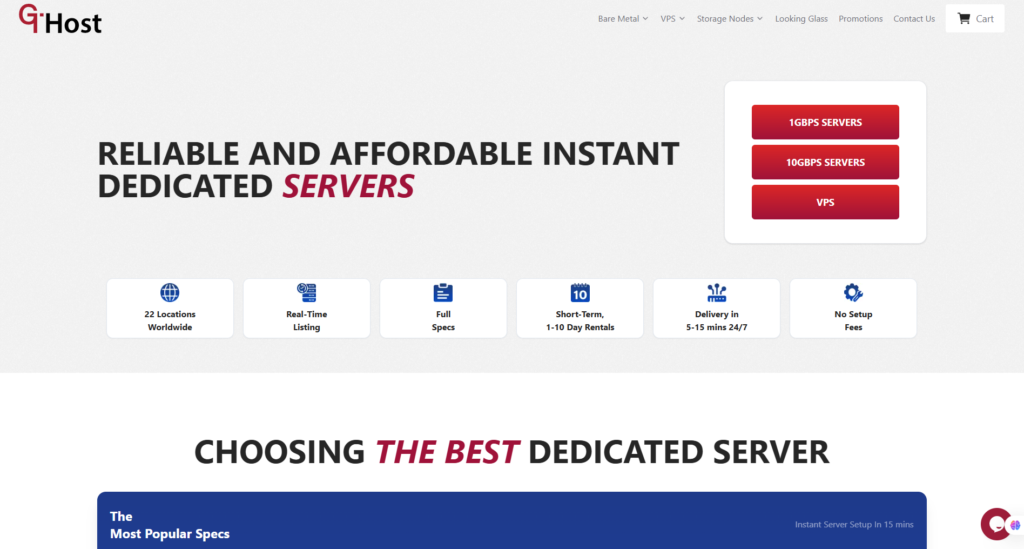
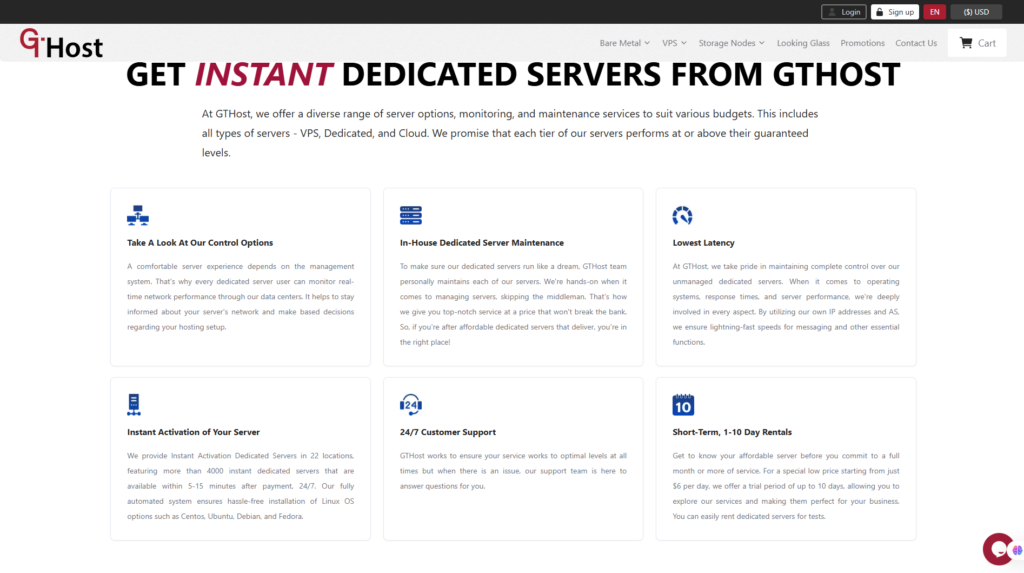
One of its biggest selling points is speed of provisioning. GTHost currently advertises dedicated-server delivery in approximately 5–15 minutes, along with short-term rentals that allow customers to use selected servers for 1–10 days before committing to a longer billing period.
But does that make GTHost a good hosting provider in 2026?
In this GTHost review, we look at its core services, target users, pricing approach, server deployment model, key advantages, limitations, and how it compares with other infrastructure providers.
GTHost Review: Key Takeaways
- GTHost is primarily designed for users who need VPS, dedicated, bare-metal, or storage infrastructure rather than basic shared hosting.
- One of its biggest differentiators is fast dedicated-server provisioning, with GTHost advertising approximately 5–15 minute delivery on instant configurations.
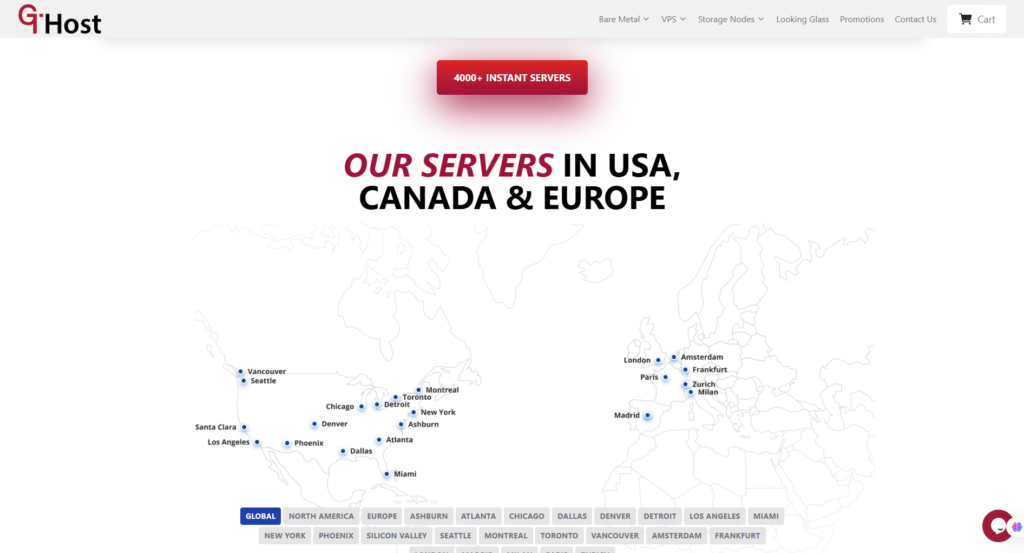
- GTHost offers infrastructure across multiple locations in the US, Canada, and Europe, making geographic server placement an important part of its value proposition.
- VPS plans currently start from $4 per month, while dedicated-server pricing varies substantially depending on CPU, RAM, storage, bandwidth, and location.
- GTHost is most attractive to developers, agencies, infrastructure teams, and businesses that are comfortable managing servers; complete beginners may find managed hosting easier.
GTHost Review: Quick Verdict
GTHost at a Glance
| Category | GTHost |
| Overall Rating | 4.6/5 |
| Best For | Developers, businesses, agencies, SaaS and dedicated workloads |
| Main Services | Dedicated Servers, Bare Metal, VPS, Storage |
| VPS Starting Price | From $4/month* |
| Dedicated Server Pricing | Varies by inventory and configuration |
| Server Deployment | Around 5–15 minutes on advertised instant servers* |
| Short-Term Rental | 1–10 days on eligible servers |
| Setup Fee | No setup fee advertised on instant dedicated servers |
| Server Regions | USA, Canada and Europe |
| Support | 24/7 support advertised |
| Official Website | GTHost.com |
Pricing, server inventory, and availability can change. Always check GTHost’s current listing before ordering.
GTHost’s VPS page currently lists plans starting from $4 per month, while its dedicated-server pages emphasize real-time inventory, no setup fees and approximately 5–15 minute provisioning.
Our Verdict
GTHost is worth considering if you need dedicated computing resources, flexible server locations, rapid provisioning, or short-term bare-metal capacity.
Its strongest proposition is not simply low-cost hosting. The more interesting combination is instant server inventory, configurable hardware, geographically distributed locations, and the ability to rent selected servers for short periods before committing to a full month.
That flexibility can be particularly useful for developers, agencies, infrastructure-heavy websites, SaaS companies, test environments, or temporary workloads.
However, GTHost is not necessarily the easiest option for a beginner who only wants to launch a small WordPress website. Users who prefer a fully managed environment with simplified dashboards, automatic maintenance, and hands-off server administration may be better served by a managed hosting provider.
Overall Flowcrai Rating: 4.6/5
Check GTHost Server Availability
What Is GTHost?
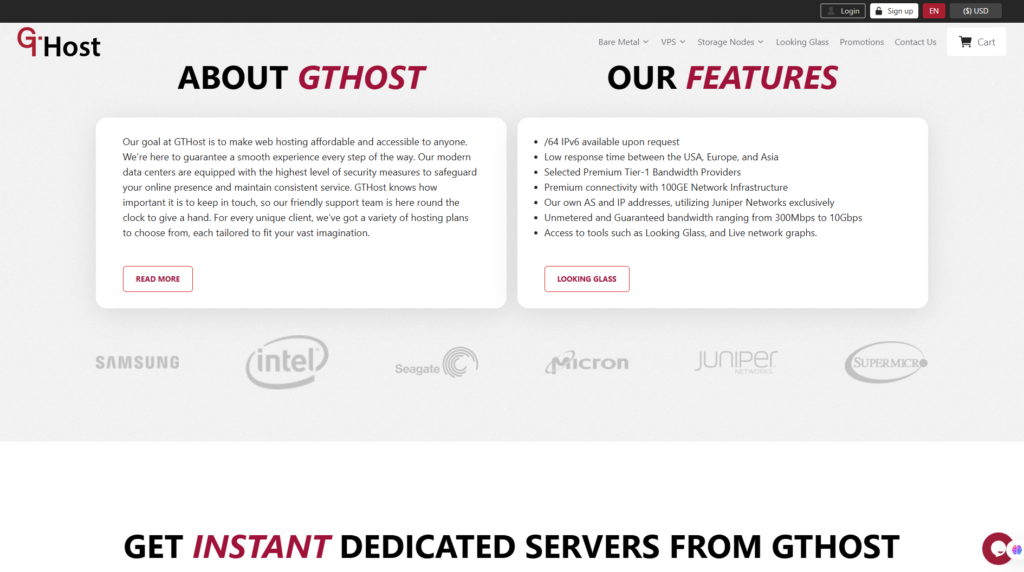
GTHost is a hosting infrastructure provider operated under GlobalTeleHost Corp., offering services centered around dedicated servers, virtual private servers, storage infrastructure, and related bare-metal hosting products. Its official pages identify GlobalTeleHost Corp. and show the company operating its hosting services across North American and European locations.
Unlike traditional shared-hosting providers that divide one server among many customers, GTHost places more emphasis on giving customers access to dedicated or isolated computing resources.
Its main product categories include:
- Instant dedicated servers
- Bare-metal servers
- VPS hosting
- Storage dedicated servers
- Storage nodes
- AMD-powered dedicated servers
- High-bandwidth configurations
- Location-specific server infrastructure
For buyers evaluating GTHost, this distinction matters.
A basic personal blog might only require inexpensive shared hosting. A SaaS application, data-heavy website, game server, development environment, API infrastructure, or high-traffic ecommerce operation may benefit more from the greater control and predictable resource allocation available through VPS or dedicated infrastructure.
GTHost also operates Storage Nodes as a separate storage layer. Its current Storage Node pricing starts at $10/month for 1 TB, with larger 3 TB, 5 TB, and 10 TB options available. Internal traffic between compatible GTHost servers and Storage Nodes in the same data center is advertised as free.
That makes the platform broader than a simple “rent a server” service.
What Problem Does GTHost Solve?
The core problem GTHost addresses is the need for fast access to dedicated or isolated server resources without waiting days for manual hardware provisioning.
Traditional bare-metal hosting can involve several friction points:
- Waiting for hardware deployment
- Paying setup fees
- Limited geographic locations
- Fixed long-term contracts
- Difficulty testing hardware before committing
- Limited flexibility when workloads change
GTHost attempts to reduce some of that friction with what it calls real-time server listings and instant deployment.
For eligible dedicated servers, the company advertises provisioning in approximately 5–15 minutes, no setup fee, and month-to-month options.
GTHost also offers short-term server rentals. Its current homepage states that selected dedicated servers can be rented for 1–10 days, with short-term pricing starting from approximately $6 per day on some configurations.
This can be useful for users who need infrastructure for:
- Application testing
- Migration testing
- Temporary workloads
- Software development
- Proof-of-concept deployments
- Short campaigns or projects
- Server benchmarking
- Backup infrastructure
Instead of paying for an entire month before deciding whether a configuration suits the workload, a user may be able to test eligible hardware for a shorter period.
How Does GTHost Work?
The purchasing process is conceptually straightforward.
A customer first selects the type of infrastructure they need, such as a VPS or dedicated server.
For dedicated servers, the buyer can then evaluate available inventory based on factors such as:
CPU → RAM → Storage → Bandwidth → Location → Price
Once a suitable configuration is selected and payment is completed, the system provisions the server and the user can begin configuring the operating system and workload.
GTHost’s location-specific dedicated-server pages advertise Linux auto-deployment alongside fast provisioning, while its VPS offering emphasizes NVMe storage and worldwide server-location options.
This model differs from fully managed web hosting.
With managed hosting, much of the operating-system maintenance, security configuration, updates, backups, and server administration may be handled by the provider.
With VPS and dedicated infrastructure, the customer generally needs a higher level of technical understanding or someone capable of managing the server environment.
That extra responsibility is the trade-off for increased control.
What Makes GTHost Different?
Several aspects help GTHost stand out from conventional hosting providers.
Fast Dedicated Server Provisioning
The most notable feature is the advertised 5–15 minute deployment time for instant dedicated servers.
Many bare-metal products historically required manual provisioning. GTHost’s real-time inventory model is designed to make dedicated infrastructure available more like an on-demand service.
Short-Term Dedicated Server Rentals
Another unusual feature is the ability to rent eligible servers for just 1–10 days.
This is potentially valuable for developers or businesses that do not need permanent infrastructure and want to validate a configuration before purchasing longer-term service.
Multiple Infrastructure Types
GTHost is not restricted to one server category.
Customers can choose among VPS, dedicated, storage-oriented, AMD-based, and other infrastructure configurations depending on the workload.
Geographic Flexibility
GTHost maintains hosting infrastructure across multiple locations in the United States, Canada, and Europe.
Choosing a server closer to end users can reduce network latency and may improve application responsiveness, which is particularly relevant for real-time applications, ecommerce systems, media delivery, and customer-facing SaaS platforms.
Infrastructure-Focused Positioning
Perhaps most importantly, GTHost is aimed more at users who care about hardware resources and infrastructure control than users looking for a simple website builder or one-click shared-hosting experience.
That distinction defines who is most likely to benefit from the service.
Who Should Use GTHost?
GTHost is not a universal hosting solution. Its value depends heavily on your workload and technical requirements.
GTHost Is Best For
Developers
Developers who need dedicated environments for applications, APIs, databases, staging systems, automation platforms, or testing infrastructure may find GTHost attractive.
The combination of VPS options, bare-metal resources, and short-term rentals gives developers several ways to match infrastructure to project requirements.
SaaS and Application Businesses
A growing SaaS business may eventually need more predictable CPU, RAM, storage, bandwidth, or geographic placement than basic shared hosting provides.
Dedicated resources can make infrastructure capacity easier to plan as applications grow.
Agencies
Agencies managing multiple websites or applications may benefit from controlling their own server environments rather than purchasing separate shared-hosting plans for every project.
High-Traffic Websites
Websites processing significant traffic, databases, downloads, media, or ecommerce activity may eventually require more computing resources than entry-level shared hosting can provide.
Data and Storage Workloads
GTHost’s Storage Nodes and storage-oriented dedicated servers make the platform potentially relevant for backups, archives, project files, media libraries, and other storage-heavy workloads.
The Storage Node service currently supports FTP, SFTP, and Samba access and advertises free internal traffic when paired appropriately with GTHost infrastructure in the same data center.
Temporary Infrastructure Requirements
The short-term rental model is particularly interesting for businesses that only need dedicated hardware for a limited period.
For example:
Test → validate → migrate → scale
rather than immediately committing to long-term infrastructure.
Who Should Skip GTHost?
GTHost may be less suitable for several types of users.
Complete Beginners
If you have never managed a VPS or dedicated server, the technical requirements can be significantly higher than using beginner-focused managed hosting.
Small Personal Blogs
A new blog with minimal traffic generally does not need dedicated hardware.
Paying for dedicated infrastructure in that situation could create unnecessary cost and technical complexity.
Users Who Want Fully Managed WordPress Hosting
If your priority is:
- Automatic WordPress setup
- Automatic updates
- Managed security
- Managed backups
- Staging tools
- Simplified control panels
- Minimal server administration
a specialized managed WordPress provider may be a better fit.
Users Who Do Not Want Server Administration
Dedicated infrastructure provides greater control, but control also means responsibility.
Users who do not want to manage operating systems, security, software stacks, databases, monitoring, or server configuration should carefully determine which management services are included before purchasing.
GTHost’s value proposition becomes much clearer when it is evaluated as an infrastructure provider rather than a conventional shared web host.
Its most compelling features are the combination of instant dedicated-server inventory, fast provisioning, flexible VPS options, short-term rentals, storage services, and geographically distributed server locations.
For developers and businesses that understand server infrastructure, those characteristics can make GTHost an interesting alternative to larger cloud and dedicated-hosting providers.
For beginners, however, the additional control may also introduce additional complexity.
That makes the next question especially important: what exactly do you get for your money?
GTHost Setup and User Experience
GTHost is more technical than a traditional shared-hosting provider, but its purchasing model is relatively straightforward for users who already understand basic server infrastructure.
Instead of choosing from simplified plans such as “Starter,” “Business,” or “Premium,” customers typically select infrastructure according to CPU, RAM, storage, bandwidth, server location, and price.
That makes GTHost more suitable for buyers who know what resources their workload needs.
Choosing a Server
For dedicated servers, the first step is to browse the available real-time inventory and identify a configuration that matches your project.
The most important specifications to consider include:
- CPU model and core count
- RAM capacity
- SSD or NVMe storage
- Network speed
- Bandwidth allocation
- Server location
- Monthly or short-term rental cost
This approach provides more flexibility than standardized hosting packages, but it also requires more technical knowledge.
A developer deploying an API or SaaS backend, for example, may prioritize CPU and RAM. A backup workload may care more about storage capacity, while a customer-facing application may place greater emphasis on server location and latency.
GTHost’s dedicated server inventory currently spans multiple locations across the United States, Canada, and Europe, although the company’s own pages show slightly different location counts depending on the product page. The full inventory page currently states 21 locations, while other GTHost materials advertise broader coverage.
For buyers, the practical lesson is simple: check the current location and server inventory before ordering rather than relying on a fixed number quoted in an older review.
Server Deployment
One of GTHost’s strongest selling points is provisioning speed.
The company advertises approximately 5–15 minute deployment for eligible instant dedicated servers, together with real-time listings and no setup fee. Its Los Angeles dedicated server page, for example, promotes 5–15 minute delivery, while the company’s instant-server offering makes the same deployment claim.
That is particularly useful for users who need infrastructure quickly.
Potential use cases include:
- Replacing a failed server
- Launching a staging environment
- Testing a new application
- Migrating workloads
- Expanding capacity during a temporary traffic increase
- Setting up an additional geographic location
Traditional bare-metal deployment can sometimes be slower than virtual cloud infrastructure because physical hardware needs to be allocated and provisioned. GTHost attempts to reduce that gap by maintaining preconfigured inventory.
However, the advertised 5–15 minute timeframe should be understood as a provider claim for eligible instant servers, not an independent performance measurement by Flowcrai.
Server Management and Learning Curve
GTHost should not be confused with beginner-focused managed hosting.
With a typical managed WordPress plan, the provider may handle much of the infrastructure layer for you, including software updates, server security, optimization, backups, and maintenance.
A dedicated server or VPS provides much more control, but that control also creates additional responsibility.
Depending on the specific service and configuration, users may need to manage:
- Operating system configuration
- Web server software
- Firewalls
- Security patches
- Databases
- SSL configuration
- Monitoring
- Backups
- Application deployment
GTHost does advertise Linux auto-deployment and 24/7 support on its dedicated-server pages, but buyers should still confirm exactly what management services are included with the configuration they select.
For experienced developers, this level of control can be an advantage.
For someone launching their first WordPress website, it can be unnecessary complexity.
Our Analysis
From a usability perspective, GTHost appears optimized around infrastructure flexibility rather than maximum simplicity.
The ordering process gives technical users considerable control over server resources and location, while real-time inventory reduces some of the friction traditionally associated with dedicated hardware.
The trade-off is a steeper learning curve than managed hosting.
We therefore rate GTHost more highly for developers, agencies, SaaS operators, and technically capable businesses than for absolute beginners.
Key Features of GTHost
1. Instant Dedicated Servers
Dedicated servers are the core of GTHost’s positioning.
Unlike a VPS, where multiple virtual machines share the same physical host, a dedicated server gives the customer access to the underlying physical server resources.
This can provide advantages for workloads requiring:
- Predictable CPU resources
- Large memory allocations
- Heavy databases
- High traffic
- Custom server configurations
- Resource-intensive applications
- Greater infrastructure isolation
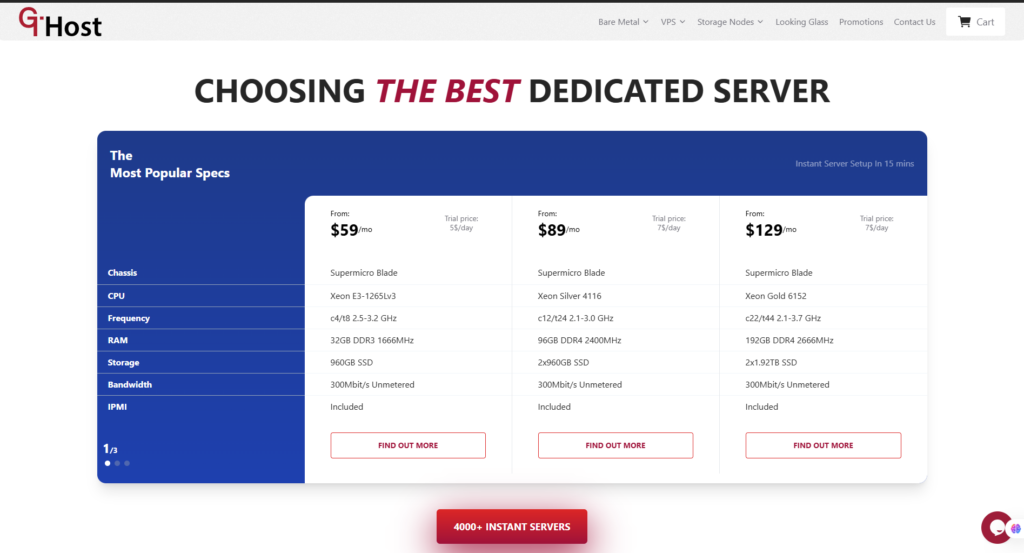
GTHost’s instant dedicated-server inventory currently advertises configurations starting from around $59 per month on selected locations and hardware. Its 1 Gbps instant-server page also promotes prices from $59, 5–15 minute deployment, short-term trials, and 24/7 support.
The main advantage here is not simply dedicated hardware.
It is the combination of:
Dedicated resources + real-time inventory + fast provisioning + short billing options
That combination makes GTHost potentially attractive to businesses that want bare-metal control without waiting for a conventional manual deployment process.
2. Global Server Locations
Server location matters because physical distance can influence network latency.
For a US-based audience, choosing a North American server may provide better response times than hosting the same workload several thousand miles away. Likewise, a European company serving mostly European customers may prefer infrastructure located in Europe.
GTHost’s current full dedicated-server inventory states that servers are available across 21 locations in the USA, Canada, and Europe. Its VPS offering also advertises availability across 21 locations worldwide.
The exact inventory varies, so users should evaluate availability at the time of purchase.
Geographic flexibility can be useful for:
- SaaS applications
- Ecommerce websites
- Game servers
- Regional APIs
- Customer portals
- Databases
- Backup infrastructure
- Multi-region architectures
It is important not to oversimplify this benefit.
Placing a server near customers can reduce network distance, but actual application performance also depends on software architecture, routing, caching, database design, CDN usage, and other factors.
3. VPS Hosting
Not every project needs an entire physical server.
For smaller applications, development environments, websites, testing, or early-stage projects, a VPS can provide a more affordable entry point.
GTHost currently advertises VPS plans starting at $4 per month, using NVMe storage and offering availability across multiple locations.
The main difference is resource architecture.
A VPS gives customers an isolated virtual environment while still sharing the underlying physical server with other VPS instances.
That generally makes VPS hosting:
Cheaper → easier to scale gradually → suitable for smaller workloads
while dedicated hardware is better suited to workloads that need:
More raw resources → physical isolation → predictable hardware access
GTHost’s USA VPS page currently advertises 15 US locations, plans from $4, and no setup fees.
For a startup or developer, beginning with a VPS and moving to dedicated infrastructure later may be more economical than over-provisioning from day one.
4. Flexible Server Configurations
One benefit of infrastructure-focused hosting is the ability to choose resources that more closely match the workload.
Rather than paying for a generic hosting package, buyers can evaluate combinations of:
- Processor generation
- Core count
- RAM
- SSD/NVMe capacity
- Storage configuration
- Network port speed
- Location
- Monthly price
GTHost’s dedicated server inventory varies according to available physical hardware, which means configurations and pricing are not permanently fixed.
This can be both an advantage and a limitation.
The advantage is that users may find competitively priced hardware that matches their requirements.
The downside is that a particular configuration available today may not necessarily be available when another customer checks later.
For that reason, we recommend treating GTHost’s server catalog more like live infrastructure inventory than a conventional fixed SaaS pricing table.
5. Short-Term Dedicated Server Rentals
Short-term rentals are one of GTHost’s most distinctive features.
The current GTHost homepage advertises server rentals for 1–10 days, with short-term pricing starting at approximately $6 per day. Several location-specific pages advertise similar trials from around $5 per day, which demonstrates that the exact offer can vary by server or location.
This type of pricing can be useful when a full month of dedicated hardware is unnecessary.
Examples include:
Server Testing
A company considering a migration can evaluate whether a specific hardware configuration is appropriate before making a longer commitment.
Development Projects
Developers may need bare-metal infrastructure temporarily for compilation, database migration, load testing, or application deployment.
Temporary Capacity
A business may require additional compute resources for a short project or traffic spike.
Proof-of-Concept Work
Teams can test whether a dedicated infrastructure model solves a performance issue before committing to ongoing costs.
This flexibility is a meaningful differentiator because many hosting providers structure dedicated-server billing primarily around monthly or longer commitments.
6. Storage Nodes and Storage Servers
GTHost also offers storage-oriented infrastructure.
Its Storage Node service currently starts at $10 per month and is designed primarily for backup storage and server migration. The service advertises simple file-access protocols and free internal traffic between compatible GTHost servers and Storage Nodes, while external traffic can be purchased separately.
Current external traffic options include tiers such as 10 TB, 20 TB, and larger allocations, each priced separately.
Potential use cases include:
- Server backups
- Website backups
- Migration files
- Archives
- Development datasets
- Media storage
- Disaster recovery copies
However, users should read the usage policies carefully.
GTHost’s current Terms of Service states that Storage Nodes are intended primarily for backup storage and server migration. Heavy public-download, streaming, or certain high-I/O usage may be restricted or require separate arrangements.
That limitation should be considered before treating Storage Nodes as a replacement for a high-volume CDN or public media-delivery platform.
GTHost Pros and Cons
GTHost Pros
Fast Dedicated Server Provisioning
The advertised 5–15 minute deployment is one of the platform’s clearest differentiators.
Broad Geographic Selection
GTHost offers infrastructure across numerous North American and European locations, giving customers flexibility when choosing where workloads are hosted.
Dedicated Hardware Options
Businesses can obtain physical server resources instead of relying exclusively on shared or virtualized hosting environments.
Affordable VPS Entry Point
VPS plans currently start at $4 per month, which creates a relatively low-cost path into the GTHost ecosystem.
Short-Term Rentals
The ability to rent selected dedicated servers for 1–10 days is valuable for testing and temporary workloads.
No Setup Fee on Advertised Instant Servers
GTHost promotes free setup on its instant dedicated-server offerings.
Multiple Infrastructure Types
Customers can choose among VPS, dedicated servers, high-bandwidth infrastructure, and storage products.
24/7 Support
GTHost advertises round-the-clock support across several of its hosting products.
GTHost Cons
Less Beginner-Friendly Than Managed Hosting
Managing VPS or dedicated infrastructure requires more technical knowledge than purchasing standard shared hosting.
Pricing Is Inventory-Dependent
Dedicated-server configurations change based on available hardware, so there is no single permanent pricing structure.
Server Availability Can Vary by Location
A specific CPU, RAM configuration, or price may be available in one city but unavailable elsewhere.
Not Designed Primarily for One-Click WordPress Hosting
Users seeking an all-in-one WordPress dashboard, site builder, email marketing, automatic optimization, and simplified management may find Hostinger or another managed provider easier.
Storage Nodes Have Usage Restrictions
The Storage Node service is primarily positioned for backups and migration rather than unrestricted public-content distribution.
Independent Performance Data Is Still Important
GTHost makes several performance and reliability claims on its own pages, but we would prefer independent benchmark data before making strong conclusions about uptime, latency, disk performance, or CPU performance.
That is why this review does not claim that Flowcrai personally benchmarked the infrastructure.
GTHost Pricing: How Much Does It Cost?
GTHost pricing differs substantially depending on the type of infrastructure you purchase.
Unlike a SaaS platform with three fixed subscription plans, server pricing depends on hardware and location.
GTHost Pricing Overview
| Service | Current Starting/Example Price | Best For |
| VPS Hosting | From $4/month | Smaller apps, websites, development |
| Dedicated Servers | From around $59/month on selected inventory | Production workloads, high traffic |
| Short-Term Dedicated Rental | From around $5–$6/day on eligible servers | Testing and temporary workloads |
| Storage Nodes | From $10/month | Backup and migration storage |
| Dedicated Storage Servers | Varies by configuration | Larger storage workloads |
Current VPS pricing starts at $4/month, while GTHost’s instant dedicated-server pages advertise selected servers from around $59/month. Short-term rental pricing varies by location and configuration, with current pages showing approximately $5–$6 per day.
Because inventory changes, buyers should treat these as starting or example prices, not guaranteed fixed rates.
What Affects GTHost Pricing?
Several variables determine the final cost.
CPU
Newer or higher-performance processors generally cost more.
RAM
Memory-heavy workloads such as databases, virtualization, or analytics may require larger RAM configurations.
Storage
NVMe and large-capacity storage configurations can increase pricing.
Network Speed
Servers with higher network capacity, such as 10 Gbps offerings, may carry different pricing.
Location
Hardware availability and data-center costs vary by city and region.
Rental Period
A one-day test, monthly rental, and longer-term commitment may have different effective costs.
Is GTHost Good Value for Money?
For the right customer, GTHost appears competitive primarily because it combines relatively accessible pricing with infrastructure flexibility.
A $4 VPS can be attractive for small workloads, while dedicated inventory around the $59 entry point provides a relatively low-cost path into bare-metal hosting compared with some enterprise-focused providers.
However, the cheapest server is not automatically the best value.
Buyers should compare:
CPU performance + RAM + storage + bandwidth + location + management requirements + support + upgrade flexibility
For example, a technically inexperienced user could save money on the monthly server fee but spend significantly more time managing the infrastructure.
For an experienced developer or infrastructure team, however, that same control may be exactly what makes GTHost attractive.
GTHost Performance Evaluation
Because Flowcrai has not independently benchmarked GTHost hardware for this review, our scores are based on published specifications, product structure, provisioning options, infrastructure flexibility, pricing, and market positioning, rather than claimed hands-on tests.
GTHost Scorecard
| Category | Score |
| Server Selection | 4.7/5 |
| Location Flexibility | 4.7/5 |
| Deployment Flexibility | 4.8/5 |
| Hardware Options | 4.6/5 |
| Ease of Use | 4.2/5 |
| Support Offering | 4.4/5 |
| Pricing & Value | 4.5/5 |
| Overall Rating | 4.6/5 |
Server Selection — 4.7/5
The combination of VPS, dedicated, storage, and high-bandwidth configurations gives GTHost a strong infrastructure catalog.
Location Flexibility — 4.7/5
Availability across numerous cities in the US, Canada, and Europe provides useful geographic choice, although inventory varies.
Deployment Flexibility — 4.8/5
Fast provisioning and 1–10 day rentals are among the strongest parts of the offering.
Hardware Options — 4.6/5
Real-time dedicated inventory gives buyers multiple CPU, memory, storage, and network combinations.
Ease of Use — 4.2/5
The purchasing process is reasonably clear for technical users, but VPS and dedicated-server administration is inherently more complex than managed hosting.
Support — 4.4/5
GTHost advertises 24/7 support, but support quality is difficult to assess conclusively without long-term direct interaction.
Pricing & Value — 4.5/5
Low-cost VPS plans, entry-level dedicated inventory, free setup, and short-term rentals create a competitive value proposition for users who can manage their own infrastructure.
Evaluation Methodology
Our GTHost rating is an editorial assessment, not a laboratory benchmark.
The score is based on:
- Current official server specifications
- Current pricing and inventory
- Infrastructure options
- Geographic availability
- Provisioning flexibility
- Storage offerings
- Publicly stated support features
- Technical complexity
- Market positioning relative to competing hosting providers
We deliberately do not assign measured scores for latency, CPU benchmark performance, disk I/O, uptime, or packet loss because those metrics would require controlled server testing.
This distinction matters for EEAT.
A hosting review should clearly separate verified product information, provider claims, and independent hands-on measurements rather than presenting all three as the same type of evidence.
GTHost’s strongest advantage is its combination of dedicated hardware, rapid provisioning, location flexibility, affordable VPS access, and short-term server rentals.
The platform is particularly compelling for technically capable users who want more infrastructure control without immediately entering the complexity or pricing structure of a hyperscale cloud platform.
Its limitations are equally clear.
GTHost is not primarily built for users who want a completely managed, beginner-friendly hosting experience. Dedicated inventory changes over time, pricing depends on available configurations, and buyers need to understand what level of server management they are taking on.
For developers, agencies, SaaS operators, and infrastructure-focused businesses, however, the value proposition is strong enough to warrant serious consideration.
GTHost vs Competitors
GTHost competes in a crowded infrastructure market that includes large cloud platforms, budget-focused dedicated-server providers, and developer-oriented VPS companies.
The right choice depends less on which provider is “best” overall and more on what kind of infrastructure you need.
GTHost is particularly strong when the priority is fast dedicated-server deployment, flexible server locations, live inventory, and short-term bare-metal rentals. Competitors such as Hetzner, Vultr, DigitalOcean, and OVHcloud may be stronger in other areas, including broader cloud ecosystems, simplified developer tools, or larger-scale infrastructure portfolios.
GTHost Comparison Table
| Provider | Main Strength | Best For | Potential Limitation |
| GTHost | Fast dedicated-server deployment and flexible inventory | Developers, agencies, dedicated workloads | More technical than managed hosting |
| Hetzner | Strong price-to-performance ratio | Cost-conscious technical users | Location availability may not fit every market |
| Vultr | Global cloud compute platform | Developers and distributed applications | Cloud pricing can become more complex at scale |
| DigitalOcean | Simple developer experience | Startups, developers, SaaS projects | Dedicated bare-metal flexibility is not its main focus |
| OVHcloud | Broad infrastructure portfolio | Businesses and larger infrastructure deployments | Platform complexity can be higher |
Pricing and product availability vary frequently across infrastructure providers, so users should compare current configurations rather than relying on a single headline price.
GTHost vs Hetzner
Hetzner is one of the most commonly considered alternatives for users searching for affordable VPS, cloud, and dedicated infrastructure.
Its biggest advantage is usually price-to-performance. Hetzner has built a strong reputation among developers and technically experienced users looking for relatively powerful infrastructure at competitive prices.
GTHost takes a somewhat different approach.
Its main advantages include:
- Rapid dedicated-server provisioning
- Live server inventory
- Short-term server rentals
- Multiple North American locations
- Flexible dedicated hardware selection
GTHost may therefore be more attractive if you need a server in a specific US or Canadian location or want to deploy dedicated hardware quickly.
Hetzner may be more attractive when maximizing compute value per dollar is the primary goal and its available regions fit your audience.
Which Should You Choose?
Choose GTHost if you prioritize:
- Fast dedicated-server availability
- Short-term server rental
- North American location flexibility
- Live bare-metal inventory
Choose Hetzner if you prioritize:
- Aggressive price-to-performance
- Developer-friendly infrastructure
- Cost efficiency for long-term workloads
For many technical buyers, this comparison should come down to location, workload, and total resource cost, not brand recognition alone.
GTHost vs Vultr
Vultr is more strongly positioned as a global cloud infrastructure platform.
Its ecosystem includes cloud compute, bare metal, GPU infrastructure, managed databases, Kubernetes-related products, and other developer-oriented services.
GTHost is narrower in comparison, but that can also make its value proposition easier to understand.
GTHost focuses heavily on:
Dedicated servers + VPS + storage + rapid provisioning
Vultr focuses more broadly on:
Cloud infrastructure + distributed compute + developer services
A startup building an application that needs easily deployable cloud instances across many regions may find Vultr more convenient.
A business that specifically wants access to physical dedicated servers with short deployment times may find GTHost more compelling.
GTHost vs Vultr: Best Use Cases
GTHost may be better for:
- Dedicated infrastructure
- Bare-metal workloads
- Temporary dedicated servers
- Agencies needing physical server resources
- Users wanting predictable dedicated hardware
Vultr may be better for:
- Cloud-native applications
- Rapidly scalable virtual machines
- Multi-region application deployment
- Kubernetes and developer infrastructure
- Users wanting a broader cloud ecosystem
Neither platform is automatically better. The decision depends on whether your workload is primarily bare-metal infrastructure or cloud compute.
GTHost vs DigitalOcean
DigitalOcean is one of the best-known cloud providers among developers, startups, and smaller SaaS companies.
Its core strength is simplicity.
DigitalOcean has historically focused on making cloud infrastructure easier for developers to understand and deploy. Its product ecosystem includes Droplets, managed databases, Kubernetes, object storage, app deployment tools, and other developer services.
GTHost is more infrastructure-focused.
Instead of emphasizing a broad developer platform, it gives greater prominence to dedicated servers, live hardware inventory, VPS hosting, and storage infrastructure.
That creates a clear distinction.
Choose GTHost If:
You want:
- Physical dedicated servers
- Short-term server rental
- A specific dedicated hardware configuration
- Greater hardware-level control
- Fast bare-metal provisioning
Choose DigitalOcean If:
You want:
- Developer-friendly cloud instances
- Managed databases
- Easier application deployment
- Cloud-native services
- An ecosystem suited to startups and software teams
DigitalOcean may therefore be easier for a developer launching a modern web application.
GTHost may be better for someone who already knows they need a dedicated or bare-metal environment.
GTHost vs OVHcloud
OVHcloud operates at a larger infrastructure scale and offers a broad range of products, including dedicated servers, public cloud infrastructure, VPS, storage, networking, and enterprise services.
Its scale can be an advantage for organizations with more complex infrastructure requirements.
GTHost, however, offers a simpler proposition for users primarily interested in dedicated-server inventory.
Its strengths include:
- Fast server provisioning
- Short-term rentals
- Straightforward live inventory
- Multiple server configurations
- North American and European locations
OVHcloud may be a better fit when an organization needs a broader ecosystem involving networking, private cloud, hybrid infrastructure, or large-scale enterprise requirements.
GTHost may be easier to evaluate when the requirement is simply:
“I need a dedicated server with these resources in this location as quickly as possible.”
That narrower focus can be valuable.
Which GTHost Alternative Should You Choose?
There is no single best provider for every workload.
A practical way to decide is to match the provider to your priorities.
Choose GTHost if your priorities are fast dedicated-server deployment, physical hardware, flexible location selection, and short-term server rentals.
Choose Hetzner if cost efficiency and price-to-performance matter most.
Choose Vultr if you need a broad global cloud compute platform.
Choose DigitalOcean if you value developer simplicity and managed cloud services.
Choose OVHcloud if you need a larger infrastructure ecosystem with a wide range of enterprise and cloud products.
For technically experienced users, it can also be worth comparing the exact CPU model, RAM, storage type, bandwidth allocation, and data-center location before making a decision.
A lower monthly price does not always represent better value if the hardware, network allowance, or geographic location is less suitable for your workload.
Frequently Asked Questions About GTHost
Is GTHost Legit?
Yes. GTHost operates as a hosting and infrastructure provider under GlobalTeleHost Corp. and offers dedicated servers, VPS hosting, storage services, and related infrastructure products through its official website.
However, as with any hosting provider, buyers should review the current terms of service, acceptable-use policy, billing conditions, refund rules, and exact server specifications before purchasing.
For higher-value workloads, it is also sensible to begin with a smaller configuration or short-term rental before migrating critical infrastructure.
Is GTHost Good for VPS Hosting?
GTHost can be a good option for users who want relatively affordable VPS hosting combined with multiple server locations.
Its VPS plans currently start at a low entry price, making the service accessible for development environments, smaller websites, APIs, automation tools, testing environments, and lightweight applications.
The main question is whether you are comfortable managing the VPS yourself.
Users who want a fully managed experience may prefer a managed hosting provider instead.
How Much Does GTHost Cost?
GTHost pricing varies according to the service and hardware configuration.
Current pricing can include:
- VPS plans starting from around a few dollars per month
- Dedicated servers starting from approximately the lower tens of dollars per month on selected inventory
- Short-term server rental priced per day
- Storage Nodes starting from relatively low monthly pricing
Dedicated-server prices vary based on CPU, RAM, storage, bandwidth, and location.
Because server inventory changes frequently, always check the current GTHost pricing page before purchasing.
How Fast Does GTHost Deploy a Server?
GTHost advertises approximately 5–15 minute deployment for eligible instant dedicated servers.
This is one of the platform’s main selling points.
However, actual provisioning can depend on server availability, configuration, payment processing, operating-system deployment, and other operational factors.
The 5–15 minute figure should therefore be treated as GTHost’s advertised provisioning target rather than a guaranteed independent benchmark.
Does GTHost Offer Dedicated Servers?
Yes.
Dedicated servers are one of GTHost’s core products.
Customers can choose from live hardware inventory with different combinations of:
- CPU
- RAM
- SSD or NVMe storage
- Bandwidth
- Network capacity
- Data-center location
The company also offers short-term rental on selected servers, which makes it possible to evaluate certain configurations without immediately committing to a full month.
Is GTHost Good for Beginners?
It depends on what the beginner wants to accomplish.
A beginner who already understands Linux, networking, SSH, firewalls, databases, and server administration may be able to use GTHost without difficulty.
A beginner who simply wants to launch a WordPress blog may find it unnecessarily technical.
For that audience, managed hosting with automatic updates, backups, security, and a simplified control panel is usually easier.
GTHost is better suited to users who want infrastructure control, not users who want infrastructure hidden from them.
Does GTHost Offer Short-Term Server Rentals?
Yes.
One of the more distinctive GTHost features is the ability to rent selected dedicated servers for short periods, including 1–10 day options on eligible configurations.
This can be useful for:
- Performance testing
- Migration projects
- Development
- Temporary workloads
- Proof-of-concept deployments
- Emergency infrastructure
Users should verify the current short-term pricing and eligible server inventory before ordering.
What Are the Best GTHost Alternatives?
The best alternatives depend on your requirements.
Some of the most relevant competitors include:
Hetzner — strong price-to-performance.
Vultr — strong global cloud compute offering.
DigitalOcean — strong developer experience and cloud ecosystem.
OVHcloud — broad dedicated and cloud infrastructure portfolio.
Other alternatives may also be appropriate depending on location, bandwidth, required CPU architecture, and whether managed hosting is needed.
Final Verdict: Is GTHost Worth It in 2026?
GTHost is worth considering if your hosting requirements go beyond basic shared hosting and you want more direct control over infrastructure.
Its strongest advantage is not any single server specification.
Instead, the value comes from the combination of:
fast provisioning + dedicated hardware + flexible inventory + multiple locations + VPS options + short-term rentals
That combination makes GTHost particularly attractive to developers, agencies, infrastructure teams, SaaS operators, and businesses that know what server resources they need.
GTHost Is Best For
GTHost is particularly well suited to:
- Developers
- SaaS businesses
- Agencies
- High-traffic websites
- Application hosting
- Dedicated-server workloads
- Infrastructure testing
- Temporary server projects
- Businesses needing specific geographic server locations
- Users comfortable managing their own infrastructure
GTHost May Not Be Best For
GTHost is less suitable for:
- Complete hosting beginners
- Small personal blogs
- Users who only need inexpensive shared hosting
- People who want fully managed WordPress hosting
- Users who do not want to manage servers
- Businesses that require a broader managed-cloud ecosystem
Final Recommendation
The biggest strength of GTHost is its infrastructure flexibility.
Users can move from relatively affordable VPS hosting to more powerful dedicated hardware, choose among multiple geographic locations, evaluate live server configurations, and even rent selected dedicated servers for short periods.
That flexibility is particularly valuable for technical buyers who do not want to wait days for bare-metal provisioning or commit immediately to long-term infrastructure.
The main limitation is that greater control comes with greater responsibility.
GTHost does not eliminate the technical work involved in managing a VPS or dedicated server. Beginners who simply want to publish a website may achieve better results with a managed hosting provider.
For developers, agencies, SaaS operators, and technically experienced businesses, however, GTHost offers a compelling balance of server choice, deployment speed, pricing flexibility, and infrastructure control.
Flowcrai Rating: 4.6/5
Best For: Developers, agencies, dedicated-server users, SaaS applications, and infrastructure-heavy workloads.
Main Strength: Fast and flexible dedicated-server deployment.
Main Weakness: Less beginner-friendly than managed hosting.
Final Verdict: Recommended for technically capable users who need VPS or dedicated infrastructure and value rapid provisioning and flexible server configurations.